Tian Ming, Yuan Yun-Chuan, Li Jia-Yi, Gionfriddo Michael R, Huang Rong-Chong
Department of Cardiology, The First Affiliated Hospital of Dalian Medical University, Dalian, Liaoning 116011, China.
Department of Endocrinology, The Third Gorges Centre Hospital of Chongqing, Chongqing 404100, China.
Chronic Dis Transl Med. 2015 Mar 22;1(1):18-26. doi: 10.1016/j.cdtm.2015.02.002. eCollection 2015 Mar.
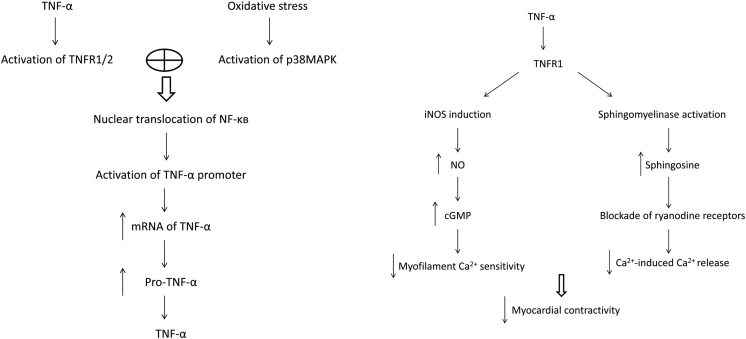
Tumor necrosis factor-α (TNF-α) contributes to myocardial infarction (MI) injury. Polymorphism of TNF-α gene promoter region and secretion and release of TNF-α and its transformation by a series of signaling pathways are all changed at different points of pathophysiological process in MI. Researches also investigated TNF-α antagonists and their potential therapeutic role in the setting of MI and heart failure at both molecular and clinical level. This article briefly reviews TNF-α and its mechanism as a mediator in MI.
肿瘤坏死因子-α(TNF-α)会导致心肌梗死(MI)损伤。TNF-α基因启动子区域的多态性、TNF-α的分泌与释放及其通过一系列信号通路的转化在MI病理生理过程的不同阶段均发生改变。研究还在分子和临床层面探究了TNF-α拮抗剂及其在MI和心力衰竭中的潜在治疗作用。本文简要综述了TNF-α及其作为MI介质的机制。