Xu Yi-Li, Xu Kuan-Feng, Bai Jian-Ling, Liu Yun, Yu Rong-Bin, Liu Chun-Lan, Shen Chong, Wu Xiao-Hong
Department of Nephrology, The First Affiliated Hospital with Nanjing Medical University, Nanjing, Jiangsu 210029, China.
Department of Endocrinology, The First Affiliated Hospital with Nanjing Medical University, Nanjing, Jiangsu 210029, China.
Chronic Dis Transl Med. 2016 Nov 2;2(2):81-91. doi: 10.1016/j.cdtm.2016.09.003. eCollection 2016 Jun.
Recently, several cohort studies suggested a positive relationship between serum uric acid (SUA) and type 2 diabetes mellitus (T2DM), which is inconsistent with the results of functional research. Our aim was to further evaluate this correlation by conducting a systematic review.
Computerized literature searches of the Medline database, EMBASE database, and PubMed were used to evaluate the relationship between SUA and T2DM in cohort studies. Cochran's and statistics were used to evaluate heterogeneity among studies, and pooled relative risk () and odds ratio () with 95% confidence intervals () were calculated using random-effects and fixed-effects models. The summary and of per 1 mg/ml-SUA increase were calculated separately because of their different epidemiological implications and calculation methods. Additionally, sensitivity analysis, stratified analysis, meta-regression, and multiple meta-regression were applied to investigate the heterogeneity among studies.
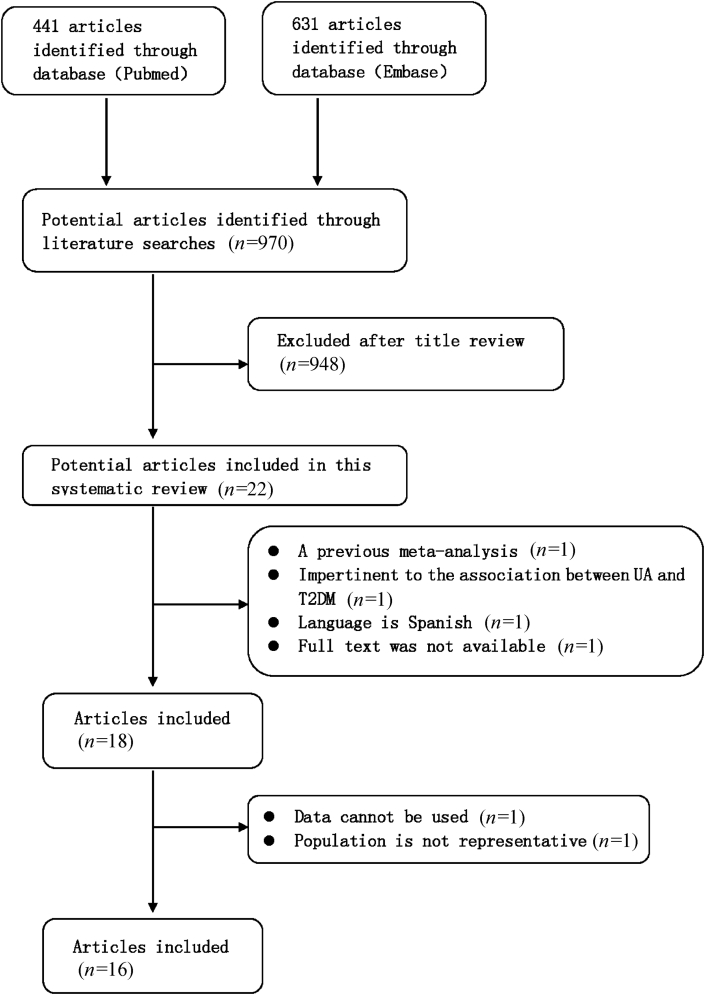
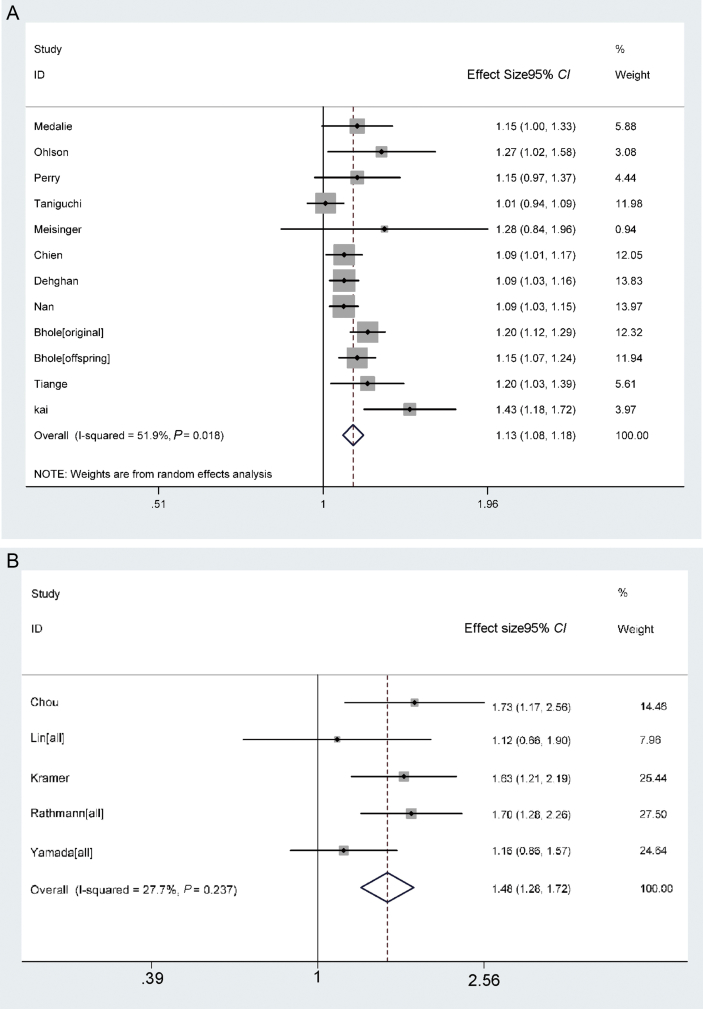
A total of 970 articles were retrieved from the searches. Sixteen publications of cohort studies containing 61,714 participants were included. The pooled was 1.131 (95% : 1.084-1.179) with significant heterogeneity among studies ( = 51.9%, = 0.018). Adjusted to evaluate the stability of the relationship between SUA and T2DM in the sensitivity analysis was similar ( = 1.140, 95% : 1.087-1.197), with statistically significant heterogeneity ( = 54.5%, = 0.015). Stratified analysis and meta-regression showed that the positive relationship remained irrespective of age, sex, region, and adjustment for confounding factors including body mass index, fasting blood glucose, systolic blood pressure, diastolic blood pressure, alcohol consumption, smoking, blood cholesterol, waist circumference, fatty liver, and drugs affecting SUA.
Although SUA is independently associated with development of T2DM, insulin resistance increased as the baseline SUA concentration increased; thus, the correlation between SUA and T2DM requires further evaluation and the baseline insulin resistance status should also be considered.
近期,多项队列研究提示血清尿酸(SUA)与2型糖尿病(T2DM)之间存在正相关关系,这与功能研究结果不一致。我们的目的是通过进行系统评价来进一步评估这种相关性。
利用计算机检索Medline数据库、EMBASE数据库和PubMed,以评估队列研究中SUA与T2DM之间的关系。采用Cochran's Q检验和I²统计量评估研究间的异质性,并使用随机效应模型和固定效应模型计算合并相对危险度(RR)和比值比(OR)及其95%置信区间(CI)。由于每1mg/ml-SUA升高的汇总RR和OR具有不同的流行病学意义和计算方法,因此分别进行计算。此外,应用敏感性分析、分层分析、meta回归和多重meta回归来研究研究间的异质性。
检索共获得970篇文章。纳入16篇队列研究文献,共61714名参与者。合并RR为1.131(95%CI:1.084-1.179),研究间存在显著异质性(I² = 51.9%,P = 0.018)。敏感性分析中用于评估SUA与T2DM之间关系稳定性的校正RR相似(RR = 1.140,95%CI:1.087-1.197),具有统计学意义的异质性(I² = 54.5%,P = 0.015)。分层分析和meta回归显示,无论年龄、性别、地区以及对包括体重指数、空腹血糖、收缩压、舒张压、饮酒、吸烟、血胆固醇、腰围、脂肪肝和影响SUA的药物等混杂因素进行校正,这种正相关关系均存在。
虽然SUA与T2DM的发生独立相关,但随着基线SUA浓度升高,胰岛素抵抗增加;因此,SUA与T2DM之间的相关性需要进一步评估,同时也应考虑基线胰岛素抵抗状态。