Department of Medical Microbiology, University of Groningen, University Medical Center Groningen, Groningen, The Netherlands.
Department of Medical Microbiology, Certe, Groningen, The Netherlands.
Eur J Clin Microbiol Infect Dis. 2018 Jan;37(1):175-183. doi: 10.1007/s10096-017-3118-1. Epub 2017 Oct 23.
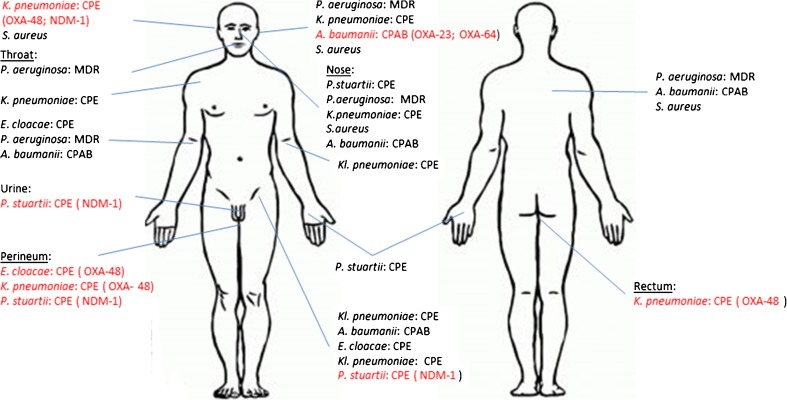
Health care of severe burn patients is highly specialized and may require international patient transfer. Burn patients have an increased risk of developing infections. Patients that have been hospitalized in countries where carbapenemase-producing microorganisms (CPMO) are endemic may develop infections that are difficult to treat. In addition, there is a risk on outbreaks with CPMOs in burn centers. This study underlines that burn patients may extensively be colonized with CPMOs, and it provides best practice recommendations regarding clinical microbiology and infection control. We evaluated CPMO-carriage and wound colonization in a burn patient initially treated in Romania, and transported to the Netherlands. The sequence types and acquired beta-lactamase genes of highly-resistant microorganisms were derived from next generation sequencing data. Next, we searched literature for reports on CPMOs in burn patients. Five different carbapenemase-producing isolates were cultured: two unrelated OXA-48-producing Klebsiella pneumoniae isolates, OXA-23-producing Acinetobacter baumanii, OXA-48-producing Enterobacter cloacae, and NDM-1-producing Providencia stuartii. Also, multi-drug resistant Pseudomonas aeruginosa isolates were detected. Among the sampling sites, there was high variety in CPMOs. We found 46 reports on CPMOs in burn patients. We listed the epidemiology of CPMOs by country of initial treatment, and summarized recommendations for care of these patients based on these reports and our study.
严重烧伤患者的医疗护理专业性很强,可能需要国际患者转移。烧伤患者感染的风险增加。在产碳青霉烯酶微生物(CPMO)流行的国家住院的患者可能会感染难以治疗的感染。此外,烧伤中心也存在 CPMO 爆发的风险。本研究强调烧伤患者可能广泛定植 CPMO,并就临床微生物学和感染控制提供最佳实践建议。我们评估了最初在罗马尼亚治疗并转运至荷兰的烧伤患者的 CPMO 携带情况和伤口定植情况。从下一代测序数据中得出高度耐药微生物的序列类型和获得的β-内酰胺酶基因。然后,我们在文献中搜索关于烧伤患者 CPMO 的报告。培养了五种不同的产碳青霉烯酶的分离株:两种不相关的产 OXA-48 的肺炎克雷伯菌分离株、产 OXA-23 的鲍曼不动杆菌、产 OXA-48 的阴沟肠杆菌和产 NDM-1 的斯氏普罗维登斯菌。此外,还检测到多药耐药铜绿假单胞菌分离株。在采样部位,CPMO 的种类繁多。我们发现了 46 篇关于烧伤患者 CPMO 的报告。我们按初始治疗国家列出了 CPMO 的流行病学,并根据这些报告和我们的研究总结了对这些患者的护理建议。