Szabó Sándor, Feier Bogdan, Capatina Denisa, Tertis Mihaela, Cristea Cecilia, Popa Adina
Department of Analytical Chemistry, Faculty of Pharmacy, "Iuliu Hațieganu" University of Medicine and Pharmacy Cluj-Napoca, 400349 Cluj-Napoca, Romania.
Department of Clinical Pharmacy, Faculty of Pharmacy, "Iuliu Hațieganu" University of Medicine and Pharmacy Cluj-Napoca, 400349 Cluj-Napoca, Romania.
J Clin Med. 2022 Jun 4;11(11):3204. doi: 10.3390/jcm11113204.
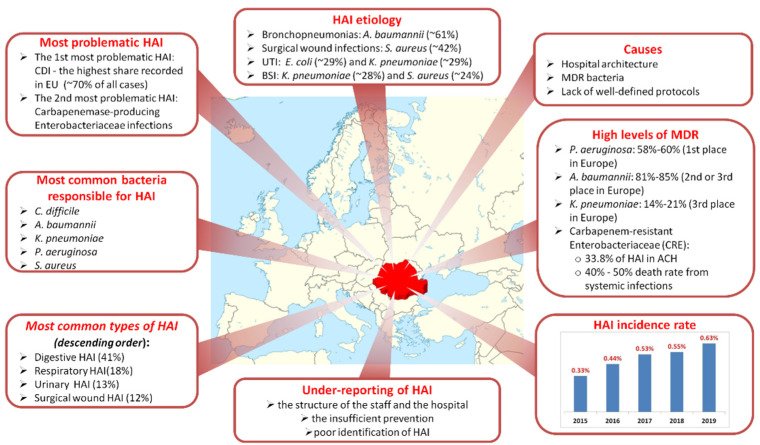
Healthcare-associated infections can occur in different care units and can affect both patients and healthcare professionals. Bacteria represent the most common cause of nosocomial infections and, due to the excessive and irrational use of antibiotics, resistant organisms have appeared. The most important healthcare-associated infections are central line-associated bloodstream infections, catheter-associated urinary tract infections, surgical site, soft tissue infections, ventilator-associated pneumonia, hospital acquired pneumonia, and colitis. In Europe, some hospitalized patients develop nosocomial infections that lead to increased costs and prolonged hospitalizations. Healthcare-associated infection prevalence in developed countries is lower than in low-income and middle-income countries such as Romania, an Eastern European country, where several factors contribute to the occurrence of many nosocomial infections, but official data show a low reporting rate. For the rapid identification of bacteria that can cause these infections, fast, sensitive, and specific methods are needed, and they should be cost-effective. Therefore, this review focuses on the current situation regarding healthcare-associated infections in Europe and Romania, with discussions regarding the causes and possible solutions. As a possible weapon in the fight against the healthcare-associated infections, the diagnosis methods and tests used to determine the bacteria involved in healthcare-associated infections are evaluated.
医疗保健相关感染可发生在不同的护理单元,且会影响患者和医护人员。细菌是医院感染最常见的病因,由于抗生素的过度和不合理使用,耐药菌已经出现。最重要的医疗保健相关感染包括中心静脉导管相关血流感染、导尿管相关尿路感染、手术部位感染、软组织感染、呼吸机相关性肺炎、医院获得性肺炎和结肠炎。在欧洲,一些住院患者会发生医院感染,这导致成本增加和住院时间延长。发达国家医疗保健相关感染的患病率低于罗马尼亚等低收入和中等收入国家,罗马尼亚是一个东欧国家,有几个因素导致许多医院感染的发生,但官方数据显示报告率较低。为了快速识别可能导致这些感染的细菌,需要快速、灵敏且特异的方法,并且这些方法应该具有成本效益。因此,本综述重点关注欧洲和罗马尼亚医疗保健相关感染的现状,并讨论其病因及可能的解决办法。作为对抗医疗保健相关感染的一种可能武器,对用于确定医疗保健相关感染中涉及的细菌的诊断方法和检测进行了评估。