Graduate Institute of Clinical Medical Sciences, College of Medicine, Chang Gung University, Kaohsiung 81362, Taiwan.
Department of Otorhinolaryngology-Head & Neck Surgery, Kaohsiung Veterans General Hospital, Kaohsiung 81362, Taiwan.
Int J Mol Sci. 2017 Oct 23;18(10):2219. doi: 10.3390/ijms18102219.
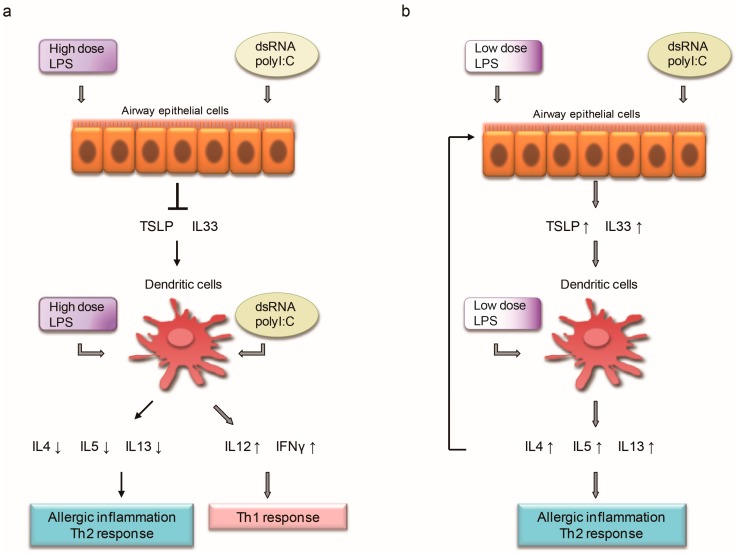
The original hygiene hypothesis declares "more infections in early childhood protect against later atopy". According to the hygiene hypothesis, the increased incidence of allergic disorders in developed countries is explained by the decrease of infections. Epithelial cells and dendritic cells play key roles in bridging the innate and adaptive immune systems. Among the various pattern-recognition receptor systems of epithelial cells and dendritic cells, including toll-like receptors (TLRs), nucleotide-binding oligomerization domain (NOD)-like receptors (NLRs) and others, TLRs are the key systems of immune response regulation. In humans, TLRs consist of TLR1 to TLR10. They regulate cellular responses through engagement with TLR ligands, e.g., lipopolysaccharides (LPS) acts through TLR4 and dsRNA acts through TLR3, but there are certain common components between these two TLR pathways. dsRNA activates epithelial cells and dendritic cells in different directions, resulting in allergy-related Th2-skewing tendency in epithelial cells, and Th1-skewing tendency in dendritic cells. The Th2-skewing effect by stimulation of dsRNA on epithelial cells could be suppressed by the presence of LPS above some threshold. When LPS level decreases, the Th2-skewing effect increases. It may be via these interrelated networks and related factors that LPS modifies the allergic responses and provides a plausible mechanism of the hygiene hypothesis. Several hygiene hypothesis-related phenomena, seemingly conflicting, are also discussed in this review, along with their proposed mechanisms.
原始卫生假说宣称“幼儿时期更多的感染可以预防后期的过敏症”。根据卫生假说,发达国家过敏疾病发病率的增加是由于感染的减少引起的。上皮细胞和树突状细胞在连接先天免疫和适应性免疫系统方面发挥着关键作用。在包括 Toll 样受体 (TLRs)、核苷酸结合寡聚化结构域 (NOD)-样受体 (NLRs) 等在内的各种模式识别受体系统中,TLRs 是免疫反应调节的关键系统。在人类中,TLRs 由 TLR1 到 TLR10 组成。它们通过与 TLR 配体的结合来调节细胞反应,例如,脂多糖 (LPS) 通过 TLR4 起作用,双链 RNA 通过 TLR3 起作用,但这两种 TLR 途径之间存在某些共同成分。双链 RNA 以不同的方向激活上皮细胞和树突状细胞,导致上皮细胞中与过敏相关的 Th2 偏斜倾向,以及树突状细胞中的 Th1 偏斜倾向。dsRNA 在上皮细胞中刺激产生的 Th2 偏斜效应可以被高于某个阈值的 LPS 所抑制。当 LPS 水平下降时,Th2 偏斜效应增加。可能正是通过这些相互关联的网络和相关因素,LPS 改变了过敏反应,并提供了卫生假说的一个合理机制。本综述还讨论了几个看似相互矛盾的与卫生假说相关的现象及其提出的机制。