Lin Xinliu, Ren Xia, Xiao Xiaojun, Yang Zhaowei, Yao Siyang, Wong Gary Wk, Liu Zhigang, Wang Charles, Su Zhong, Li Jing
Department of Allergy and Clinical Immunology, Guangzhou Institute of Respiratory Health, State Key Laboratory of Respiratory Disease, The First Affiliated Hospital of Guangzhou Medical University, Guangzhou, China.
Institute of Allergy and Immunology, School of Medicine, Shenzhen University, Shenzhen, China.
Allergy Asthma Immunol Res. 2020 Nov;12(6):934-948. doi: 10.4168/aair.2020.12.6.934.
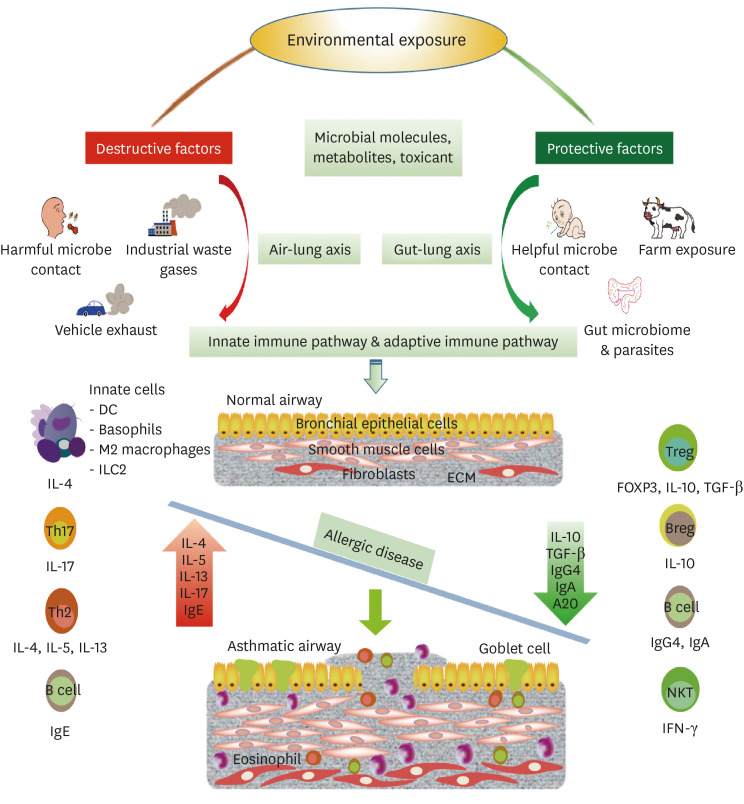
Allergic asthma is a public health problem that affects human health and socioeconomic development. Studies have found that the prevalence of asthma has significantly increased in recent years, which has become particularly pronounced in developed countries. With rapid urbanization in China in the last 3 decades, the prevalence of asthma has increased significantly in urban areas. As changes in genetic backgrounds of human populations are limited, environmental exposure may be a major factor that is responsible for the increased prevalence of asthma. This review focuses on environmental components of farms and rural areas that may have protective effects in reducing the development of asthma. Farm and rural related microorganism- and pathogen-associated molecular patterns are considered to be important environmental factors that modulate host's innate and adaptive immune system to induce protection effects later in life. Environmental microbial-related immunotherapy will also be discussed as the future research direction for the prevention of allergic asthma.
过敏性哮喘是一个影响人类健康和社会经济发展的公共卫生问题。研究发现,近年来哮喘的患病率显著上升,在发达国家尤为明显。在过去三十年中,随着中国快速城市化,城市地区哮喘的患病率显著增加。由于人类种群遗传背景的变化有限,环境暴露可能是导致哮喘患病率上升的主要因素。本综述聚焦于农场和农村地区的环境因素,这些因素可能对降低哮喘的发生具有保护作用。与农场和农村相关的微生物及病原体相关分子模式被认为是重要的环境因素,它们可调节宿主的固有免疫和适应性免疫系统,从而在生命后期产生保护作用。环境微生物相关免疫疗法也将作为预防过敏性哮喘的未来研究方向进行讨论。