Department of General Surgery, Drum Tower Hospital, Medical School of Nanjing University, Nanjing, Jiangsu, 210008, China.
Department of General Surgery, Sir Run Run Shaw Hospital, School of Medicine, Zhejiang University, Hangzhou, Zhejiang, 310016, China.
World J Surg Oncol. 2017 Oct 24;15(1):191. doi: 10.1186/s12957-017-1258-5.
Postoperative complications following gastric cancer resection remain a clinical problem. Early detection of postoperative complications is needed before critical illness develops. The purpose of this study was to evaluate the prognostic value of C-reactive protein/albumin ratio in patients with gastric cancer.
A total of 322 patients undergoing curative (R0) gastrectomy between 2015 and 2017 were retrospectively analyzed. Univariate and multivariate analyses were performed to identify clinical factors predicting postoperative complications. The cutoff values and diagnostic accuracy of C-reactive protein/albumin ratio and C-reactive protein were determined by receiver-operating characteristic curves.
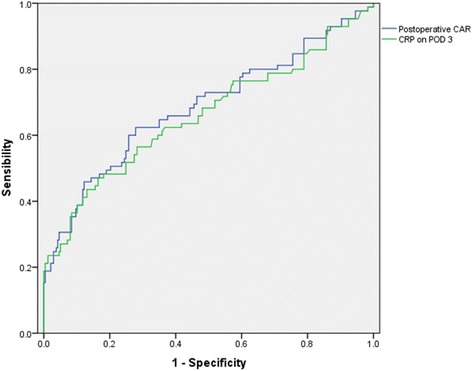
Among all of the patients, 85 (26.4%) developed postoperative complications. The optimal cutoff of C-reactive protein/albumin ratio was set at 3.04 based on the ROC analysis. Multivariate analysis identified C-reactive protein/albumin ratio was an independent risk factors for complications after gastrectomy (OR 3.037; 95% CI 1.248-7.392; P = 0.014). Additionally, C-reactive protein/albumin ratio showed a higher diagnostic accuracy than C-reactive protein on postoperative day 3 (AUC: 0.685 vs 0.660; sensitivity: 0.624 vs 0.471; specificity: 0.722 vs 0.835).
Elevated C-reactive protein/albumin ratio was an independent predictor for postoperative complications following gastrectomy of gastric cancer, and the diagnostic accuracy was higher than C-reactive protein alone. Overall, postoperative C-reactive protein/albumin ratio may help to identify patients with high probability of postoperative complications.
胃癌切除术后的并发症仍然是一个临床问题。在出现危急病症之前,需要早期发现术后并发症。本研究旨在评估 C 反应蛋白/白蛋白比值在胃癌患者中的预后价值。
回顾性分析了 2015 年至 2017 年间接受根治性(R0)胃切除术的 322 例患者。采用单因素和多因素分析来确定预测术后并发症的临床因素。通过受试者工作特征曲线确定 C 反应蛋白/白蛋白比值和 C 反应蛋白的临界值和诊断准确性。
所有患者中有 85 例(26.4%)发生术后并发症。基于 ROC 分析,C 反应蛋白/白蛋白比值的最佳临界值设定为 3.04。多因素分析确定 C 反应蛋白/白蛋白比值是胃癌手术后并发症的独立危险因素(OR 3.037;95%CI 1.248-7.392;P=0.014)。此外,与 C 反应蛋白相比,C 反应蛋白/白蛋白比值在术后第 3 天具有更高的诊断准确性(AUC:0.685 对 0.660;敏感性:0.624 对 0.471;特异性:0.722 对 0.835)。
C 反应蛋白/白蛋白比值升高是胃癌胃切除术后并发症的独立预测因子,诊断准确性高于单独 C 反应蛋白。总体而言,术后 C 反应蛋白/白蛋白比值可能有助于识别术后并发症发生概率较高的患者。