Wu Fengshou, Su Huifang, Wang Kai, Wong Wai-Kwok, Zhu Xunjin
Key Laboratory for Green Chemical Process of the Ministry of Education, School of Chemical Engineering and Pharmacy, Wuhan Institute of Technology, Wuhan.
Department of Chemistry and Institute of Advanced Materials, HKBU Institute of Research and Continuing Education (Shenzhen), Hong Kong Baptist University, Hong Kong.
Int J Nanomedicine. 2017 Oct 10;12:7375-7391. doi: 10.2147/IJN.S147165. eCollection 2017.
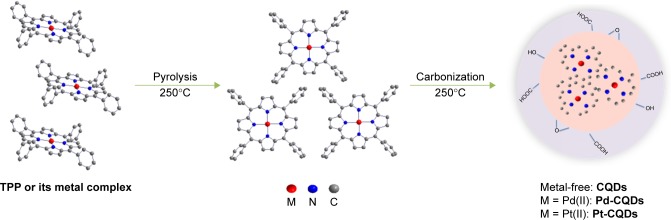
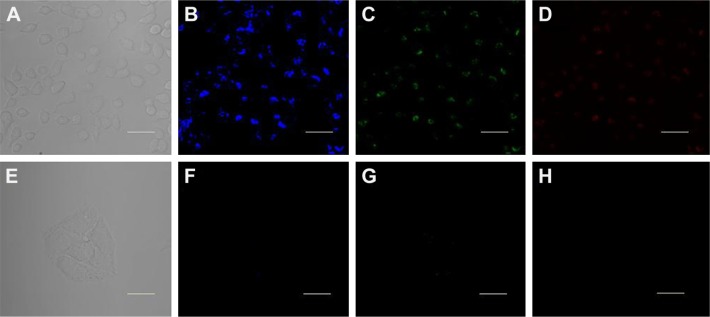
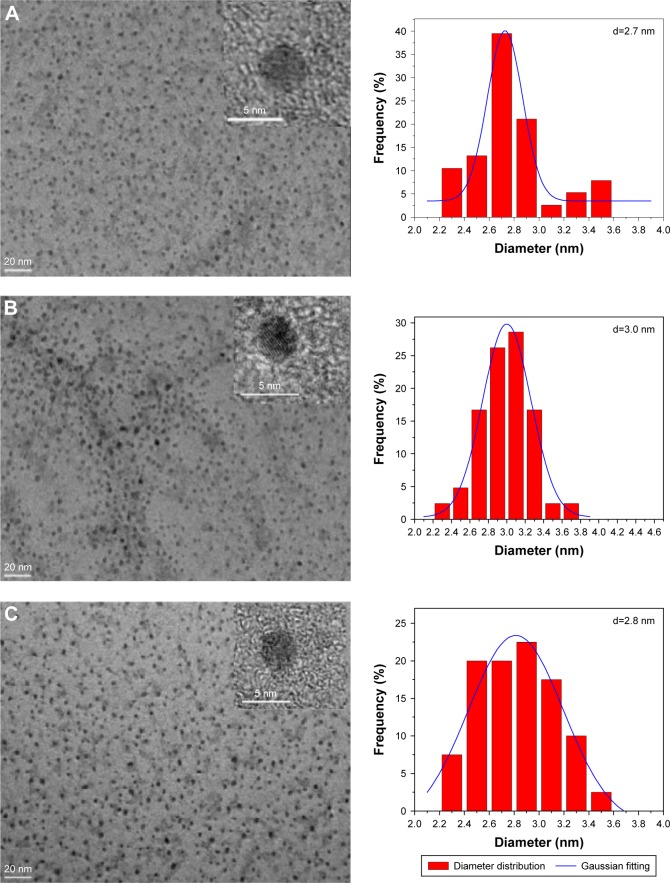
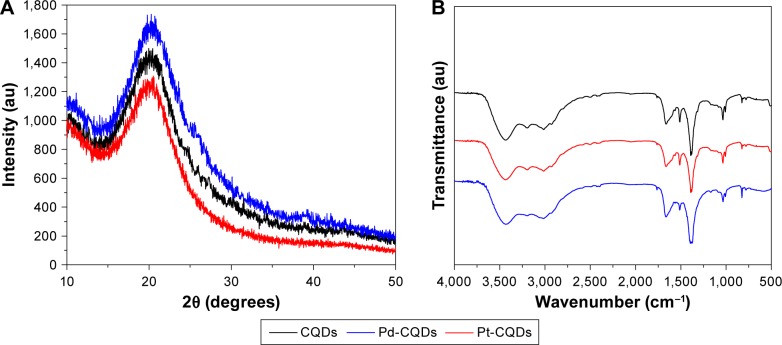
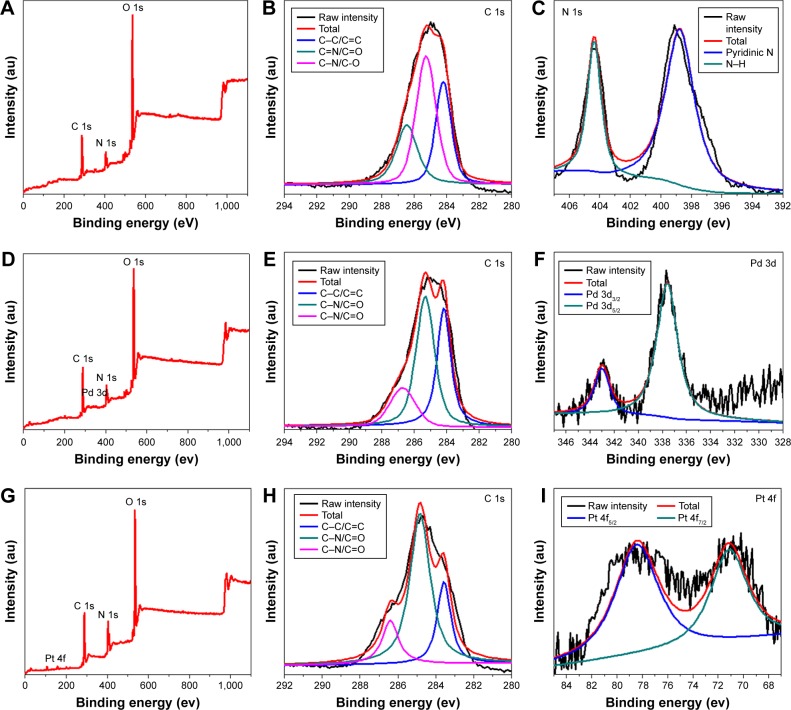
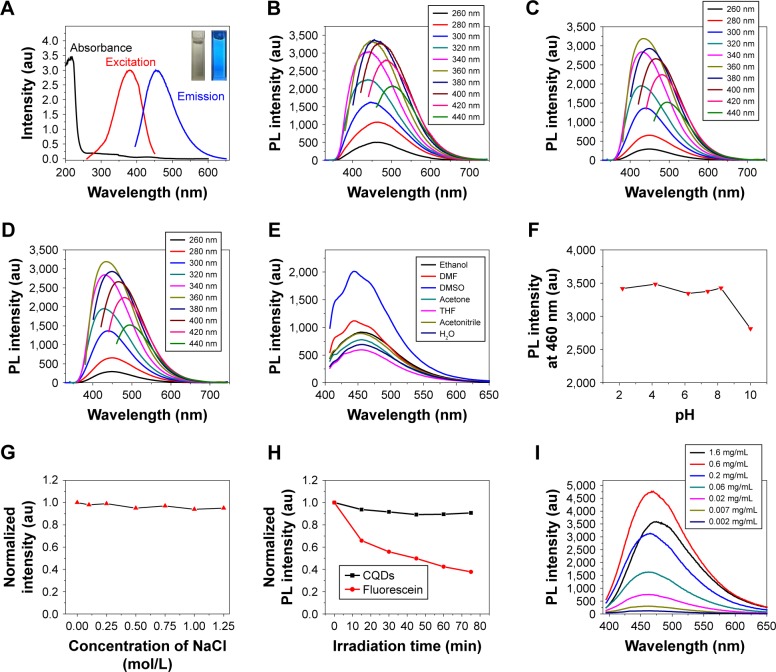
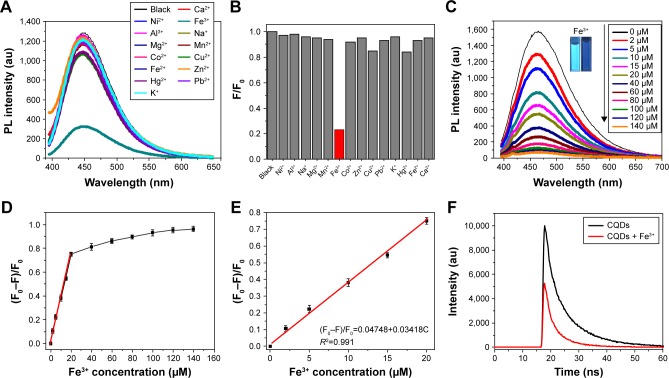
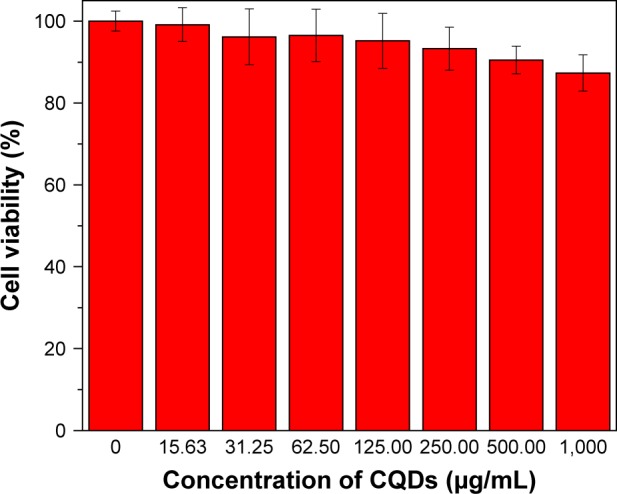
N-rich metal-free and metal-doped carbon quantum dots (CQDs) have been prepared through one-step hydrothermal method using tetraphenylporphyrin or its transition metal (Pd or Pt) complex as precursor. The structures and morphology of the as-prepared nanoparticles were analyzed by X-ray diffraction, high-resolution transmission electron microscopy, X-ray photoelectron spectroscopy, and Fourier transform infrared spectra. Three kinds of nanocomposites show similar structures except for the presence of metal ions in Pd-CQDs and Pt-CQDs indicated by X-ray photoelectron spectroscopy. All of them display bright blue emission upon exposure to ultraviolet irradiation. The CQDs exhibit typical excitation-dependent emission behavior, with the emission quantum yield of 10.1%, 17.8%, and 15.2% for CQDs, Pd-CQDs, and Pt-CQDs, respectively. Moreover, the CQDs, Pd-CQDs, and Pt-CQDs could serve as fluorescent probes for the specific and sensitive detection of Fe ions in aqueous solution. The low cytotoxicity of CQDs is demonstrated by MTT assay against HeLa cells. Therefore, the CQDs can be used as efficient probes for cellular multicolor imaging and fluorescence sensors for the detection of Fe ions due to their low toxicity, excellent biocompatibility, and low detection limits. This work provides a new route to synthesize highly luminescent N-rich metal-free or metal-doped CQDs for multifunctional applications.
以四苯基卟啉或其过渡金属(钯或铂)配合物为前驱体,通过一步水热法制备了富氮无金属和金属掺杂的碳量子点(CQDs)。采用X射线衍射、高分辨率透射电子显微镜、X射线光电子能谱和傅里叶变换红外光谱对所制备纳米颗粒的结构和形貌进行了分析。X射线光电子能谱表明,除了钯掺杂碳量子点(Pd-CQDs)和铂掺杂碳量子点(Pt-CQDs)中存在金属离子外,三种纳米复合材料显示出相似的结构。在紫外光照射下,它们均发出明亮的蓝色荧光。碳量子点表现出典型的激发依赖发射行为,碳量子点、Pd-CQDs和Pt-CQDs的发射量子产率分别为10.1%、17.8%和15.2%。此外,碳量子点、Pd-CQDs和Pt-CQDs可作为荧光探针用于水溶液中Fe离子的特异性和灵敏检测。通过MTT法检测碳量子点对HeLa细胞的毒性较低。因此,由于其低毒性、优异的生物相容性和低检测限,碳量子点可作为细胞多色成像的有效探针和检测Fe离子的荧光传感器。这项工作为合成用于多功能应用的高发光富氮无金属或金属掺杂碳量子点提供了一条新途径。