Department of Sport, Exercise and Health, University of Basel, Birsstrasse 320B, 4052, Basel, Switzerland.
Institute of Exercise Training and Computer Science in Sport, German Sport University Cologne, Köln, Germany.
BMC Geriatr. 2017 Oct 25;17(1):247. doi: 10.1186/s12877-017-0634-x.
Aging is accompanied by a decline of executive function. Aerobic exercise training induces moderate improvements of cognitive domains (i.e., attention, processing, executive function, memory) in seniors. Most conclusive data are obtained from studies with dementia or cognitive impairment. Confident detection of exercise training effects requires adequate between-day reliability and low day-to-day variability obtained from acute studies, respectively. These absolute and relative reliability measures have not yet been examined for a single aerobic training session in seniors.
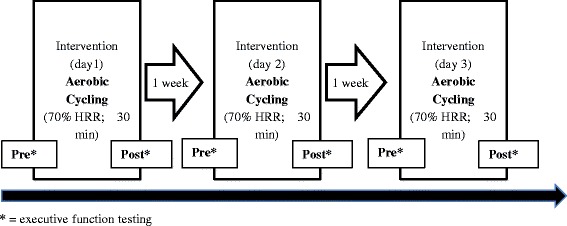
Twenty-two healthy and physically active seniors (age: 69 ± 3 y, BMI: 24.8 ± 2.2, VO: 32 ± 6 mL/kg/bodyweight) were enrolled in this randomized controlled cross-over study. A repeated between-day comparison [i.e., day 1 (habituation) vs. day 2 & day 2 vs. day 3] of executive function testing (Eriksen-Flanker-Test, Stroop-Color-Test, Digit-Span, Five-Point-Test) before and after aerobic cycling exercise at 70% of the heart rate reserve [0.7 × (HR - HR)] was conducted. Reliability measures were calculated for pre, post and change scores.
Large between-day differences between day 1 and 2 were found for reaction times (Flanker- and Stroop Color testing) and completed figures (Five-Point test) at pre and post testing (0.002 < p < 0.05, 0.16 < ɳ < 0.38). These differences notably declined when comparing day 2 and 3. Absolute between days variability (CoV) dropped from 10 to 5% when comparing day 2 vs. day 3 instead of day 1 vs. day 2. Also ICC ranges increased from day 1 vs. day 2 (0.65 < ICC < 0.87) to day 2 vs. day 3 (0.40 < ICC < 0.93). Interestingly, reliability measures for pre-post change scores were low (0.02 < ICC < 0.71). These data did not improve when comparing day 2 with day 3. During inhibition tests, reaction times showed excellent reliability values compared to the poor to fair reliability of accuracy.
Notable habituation to the whole testing procedure should be considered as it increased the reliability of different executive function tests. Change scores of executive function after acute aerobic exercise cannot be detected reliably. Large intra- and inter-individual of responses to acute aerobic exercise in seniors can be presumed.
衰老伴随着执行功能的下降。有氧运动训练可适度改善老年人的认知领域(即注意力、加工、执行功能、记忆)。最有说服力的数据来自于痴呆或认知障碍的研究。在急性研究中,分别需要足够的日内可靠性和低的日间变异性来确定运动训练效果的检测。这些绝对和相对可靠性指标尚未在老年人的单次有氧运动训练中进行检查。
22 名健康和活跃的老年人(年龄:69 ± 3 岁,BMI:24.8 ± 2.2,VO:32 ± 6 mL/kg/体重)参加了这项随机对照交叉研究。在有氧运动(心率储备的 70%[0.7×(HR-HR)])前后,对执行功能测试(Eriksen-Flanker-Test、Stroop-Color-Test、Digit-Span、Five-Point-Test)进行了重复的日内比较[即第 1 天(适应)与第 2 天和第 3 天,第 2 天与第 3 天]。计算了预、后和变化分数的可靠性指标。
在预测试和后测试中,第 1 天和第 2 天之间的反应时间(Flanker 和 Stroop Color 测试)和完成的数字(五点测试)存在较大的日内差异(0.002 < p < 0.05,0.16 < n < 0.38)。当比较第 2 天和第 3 天时,这些差异明显下降。当比较第 2 天与第 3 天而不是第 1 天与第 2 天时,绝对日内变异性(CoV)从 10%降至 5%。同时 ICC 范围从第 1 天与第 2 天(0.65 < ICC < 0.87)增加到第 2 天与第 3 天(0.40 < ICC < 0.93)。有趣的是,预-后变化分数的可靠性指标较低(0.02 < ICC < 0.71)。当比较第 2 天与第 3 天时,这些数据并没有改善。在抑制测试中,与准确性的较差至一般可靠性相比,反应时间显示出极好的可靠性值。
应该考虑到对整个测试过程的明显适应,因为它提高了不同执行功能测试的可靠性。急性有氧运动后执行功能的变化分数不能可靠地检测到。可以假定老年人对急性有氧运动的反应存在较大的个体内和个体间差异。