Chin Kok-Yong, Low Nie Yen, Kamaruddin Alia Annessa Ain, Dewiputri Wan Ilma, Soelaiman Ima-Nirwana
Department of Pharmacology, Universiti Kebangsaan Malaysia Medical Centre, Cheras, Malaysia.
ASASIpintar Foundation Program, PERMATApintar National Gifted Centre, Universiti Kebangsaan Malaysia, Bangi, Malaysia.
Ther Clin Risk Manag. 2017 Oct 6;13:1333-1341. doi: 10.2147/TCRM.S145519. eCollection 2017.
Calcaneal quantitative ultrasound (QUS) is a useful tool in osteoporosis screening. However, QUS device may not be available at all primary health care settings. Osteoporosis self-assessment tool for Asians (OSTA) is a simple algorithm for osteoporosis screening that does not require any sophisticated instruments. This study explored the possibility of replacing QUS with OSTA by determining their agreement in identifying individuals at risk of osteoporosis.
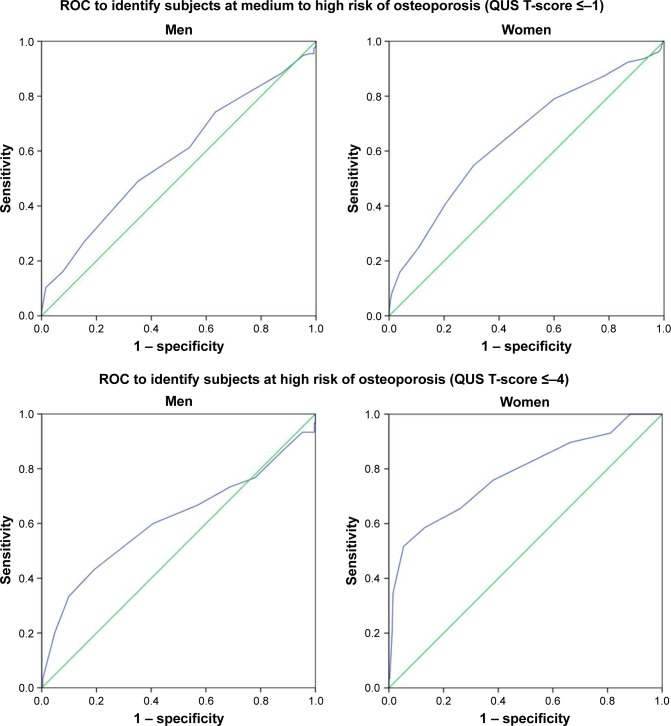
A cross-sectional study was conducted to recruit Malaysian men and women aged ≥50 years. Their bone health status was measured using a calcaneal QUS device and OSTA. The association between OSTA and QUS was determined using Spearman's correlation and their agreement was assessed using Cohen Kappa and receiver-operating curve.
All QUS indices correlated significantly with OSTA (<0.05). The agreement between QUS and OSTA was minimal but statistically significant (<0.05). The performance of OSTA in identifying subjects at risk of osteoporosis according to QUS was poor-to-fair in women (<0.05), but not statistically significant for men (>0.05). Changing the cut-off values improved the performance of OSTA in women but not in men.
The agreement between QUS and OSTA is minimal in categorizing individuals at risk of osteoporosis. Therefore, they cannot be used interchangeably in osteoporosis screening.
跟骨定量超声(QUS)是骨质疏松症筛查的一种有用工具。然而,并非所有基层医疗保健机构都配备QUS设备。亚洲人骨质疏松自我评估工具(OSTA)是一种无需任何复杂仪器的骨质疏松症筛查简单算法。本研究通过确定QUS与OSTA在识别骨质疏松症高危个体方面的一致性,探讨了用OSTA替代QUS的可能性。
开展一项横断面研究,招募年龄≥50岁的马来西亚男性和女性。使用跟骨QUS设备和OSTA测量他们的骨骼健康状况。采用Spearman相关性分析确定OSTA与QUS之间的关联,并使用Cohen Kappa系数和受试者工作特征曲线评估它们的一致性。
所有QUS指标均与OSTA显著相关(<0.05)。QUS与OSTA之间的一致性极小,但具有统计学意义(<0.05)。根据QUS,OSTA在识别骨质疏松症高危女性受试者方面的表现为差到中等(<0.05),但在男性中无统计学意义(>0.05)。改变临界值可提高OSTA在女性中的表现,但对男性无效。
在对骨质疏松症高危个体进行分类时,QUS与OSTA之间的一致性极小。因此,它们不能在骨质疏松症筛查中互换使用。