Hall Kevin D, Sanghvi Arjun, Göbel Britta
National Institute of Diabetes and Digestive and Kidney Diseases, Bethesda, Maryland, USA.
Sanofi-Aventis Deutschland GmbH, Frankfurt am Main, Germany.
Obesity (Silver Spring). 2017 Dec;25(12):2088-2091. doi: 10.1002/oby.21978. Epub 2017 Oct 25.
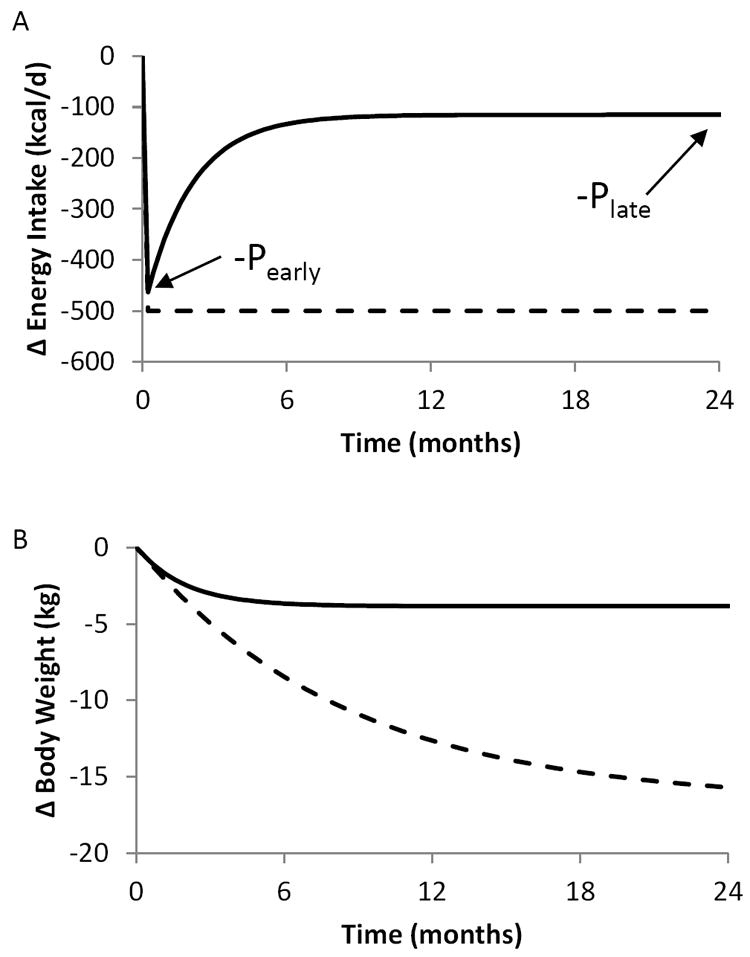
Obesity pharmacotherapies result in an exponential time course for energy intake whereby large early decreases dissipate over time. This pattern of declining drug efficacy to decrease energy intake results in a weight loss plateau within approximately 1 year. This study aimed to elucidate the physiology underlying the exponential decay of drug effects on energy intake.
Placebo-subtracted energy intake time courses were examined during long-term obesity pharmacotherapy trials for 14 different drugs or drug combinations within the theoretical framework of a proportional feedback control system regulating human body weight.
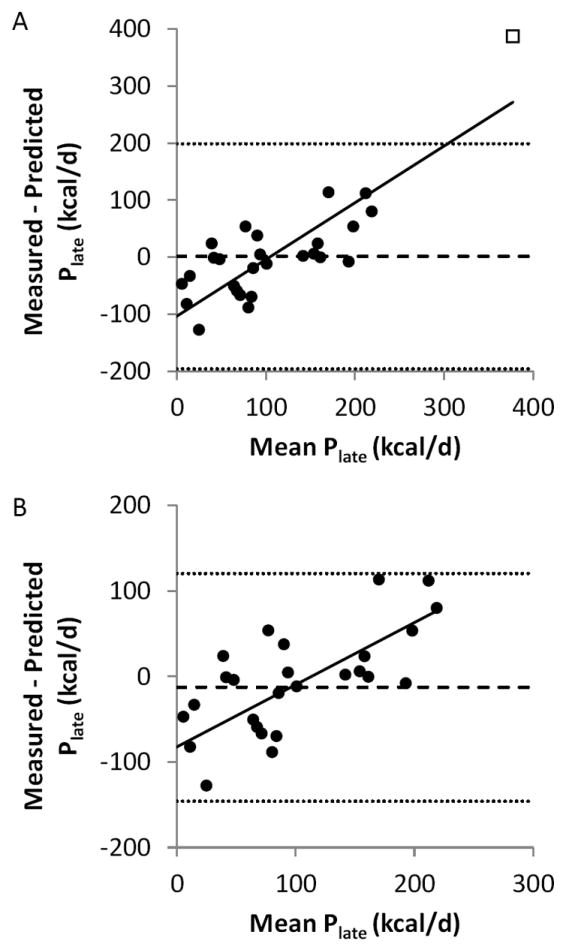
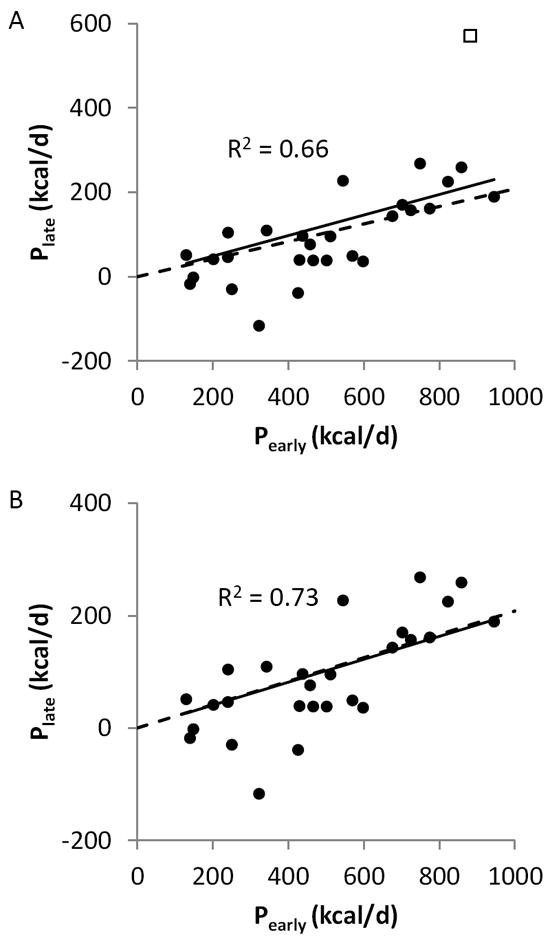
Assuming each obesity drug had a relatively constant effect on average energy intake and did not affect other model parameters, our model correctly predicted that long-term placebo-subtracted energy intake was linearly related to early reductions in energy intake according to a prespecified equation with no free parameters. The simple model explained about 70% of the variance between drug studies with respect to the long-term effects on energy intake, although a significant proportional bias was evident.
The exponential decay over time of obesity pharmacotherapies to suppress energy intake can be interpreted as a relatively constant effect of each drug superimposed on a physiological feedback control system regulating body weight.
肥胖症药物疗法导致能量摄入呈指数时间进程,即早期大幅下降会随时间消散。这种药物降低能量摄入的疗效下降模式会在大约1年内导致体重减轻达到平台期。本研究旨在阐明药物对能量摄入产生指数衰减作用的生理机制。
在长期肥胖症药物治疗试验中,针对14种不同药物或药物组合,在调节人体体重的比例反馈控制系统的理论框架内,研究减去安慰剂后的能量摄入时间进程。
假设每种肥胖症药物对平均能量摄入有相对恒定的作用,且不影响其他模型参数,我们的模型正确预测,根据一个没有自由参数的预先设定方程,长期减去安慰剂后的能量摄入与能量摄入的早期减少呈线性相关。尽管存在明显的显著比例偏差,但该简单模型解释了药物研究之间在能量摄入长期影响方面约70%的方差。
肥胖症药物疗法抑制能量摄入随时间的指数衰减可解释为每种药物叠加在调节体重的生理反馈控制系统上的相对恒定作用。