Tuleta Izabela, Skowasch Dirk, Aurich Florian, Eckstein Nicolas, Schueler Robert, Pizarro Carmen, Schahab Nadjib, Nickenig Georg, Schaefer Christian, Pingel Simon
Department of Internal Medicine II-Cardiology, Pulmonology and Angiology, University of Bonn, Bonn, Germany.
PLoS One. 2017 Oct 26;12(10):e0186820. doi: 10.1371/journal.pone.0186820. eCollection 2017.
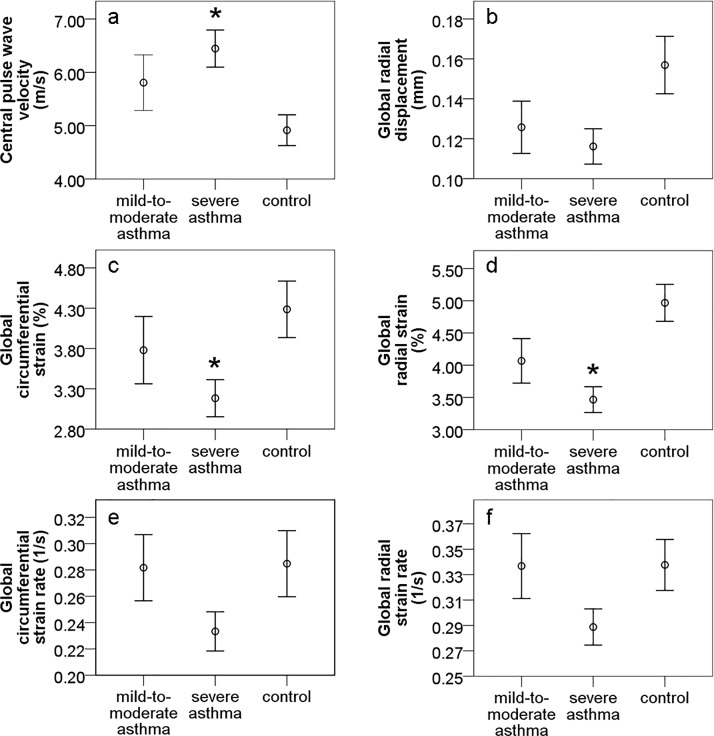
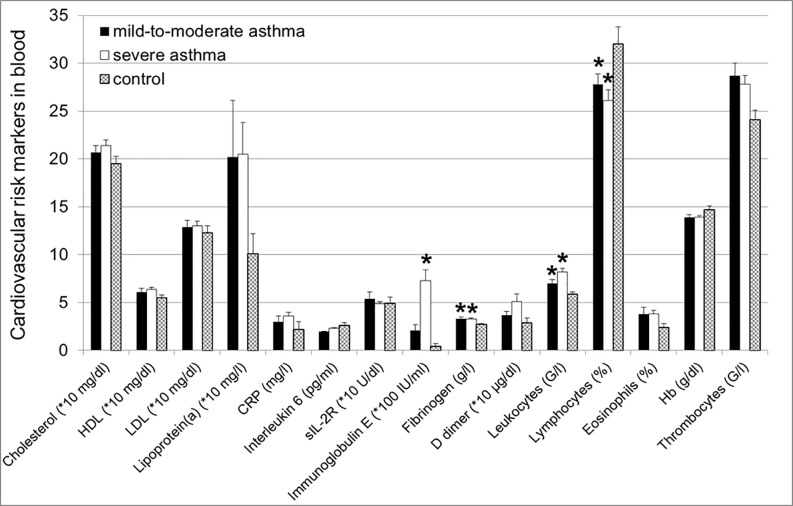
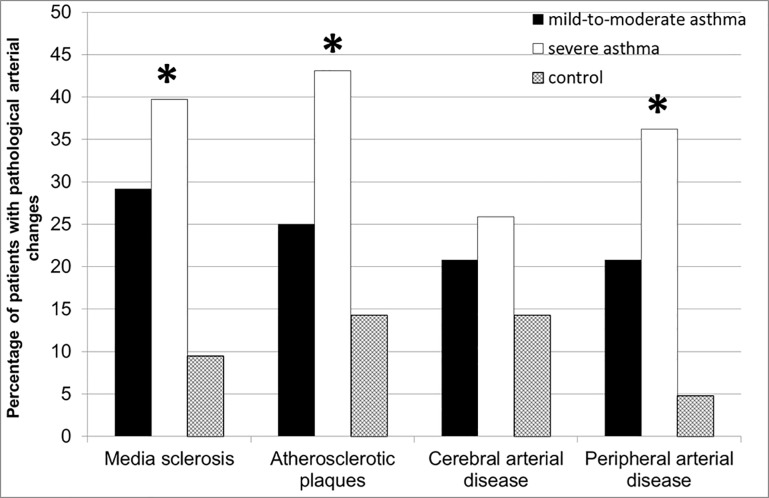
Asthma is a chronic airway inflammation with a potential systemic impact. Atherosclerosis is a chronic inflammatory artery disease. The aim of our study was to prove if there is a correlation between the occurrence of asthma and increased atherosclerotic vessel disorders. Vessel status was compared between mild-to-moderate, severe allergic asthma and matched controls. Measurements of artery stiffness were calculated by central pulse wave velocity, ultrasonographic strain imaging and ankle-brachial index. Atherosclerotic plaque burden was assessed by colour-coded duplex sonography. Additionally, analysis of cardiovascular and asthma blood markers was conducted. Arterial stiffness expressed as an increased central pulse wave velocity and decreased circumferential and radial strains as well as the prevalence of media sclerosis were significantly higher among asthma patients compared to controls. Atherosclerotic plaque burden was relevantly increased in asthma groups vs. controls (severe asthma: 43.1%, mild-to-moderate asthma: 25.0%, control: 14.3% of study participants). Except for the elevated IgE and fibrinogen concentrations as well as leukocyte number there were no relevant differences in the blood parameters between the groups. Allergic asthma is associated with distinct atherosclerotic artery changes compared to the respectively matched control collective. The severity of asthma correlates with more pronounced pathological vessel alternations.
哮喘是一种具有潜在全身影响的慢性气道炎症。动脉粥样硬化是一种慢性炎症性动脉疾病。我们研究的目的是证明哮喘的发生与动脉粥样硬化血管疾病增加之间是否存在关联。比较了轻度至中度、重度过敏性哮喘患者与匹配对照组的血管状况。通过中心脉搏波速度、超声应变成像和踝臂指数计算动脉僵硬度。通过彩色编码双功超声评估动脉粥样硬化斑块负荷。此外,还对心血管和哮喘血液标志物进行了分析。与对照组相比,哮喘患者中以中心脉搏波速度增加、圆周和径向应变降低以及中层硬化患病率表示的动脉僵硬度明显更高。与对照组相比,哮喘组的动脉粥样硬化斑块负荷显著增加(重度哮喘:43.1%,轻度至中度哮喘:25.0%,对照组:14.3%的研究参与者)。除了IgE、纤维蛋白原浓度和白细胞数量升高外,各组之间的血液参数没有显著差异。与相应匹配的对照组相比,过敏性哮喘与明显的动脉粥样硬化动脉变化相关。哮喘的严重程度与更明显的病理性血管改变相关。