Paech Gemma M, Crowley Stephanie J, Eastman Charmane I
Biological Rhythms Research Laboratory, Department of Behavioral Sciences, Rush University Medical Center, Chicago, Illinois, United States of America.
PLoS One. 2017 Oct 26;12(10):e0186843. doi: 10.1371/journal.pone.0186843. eCollection 2017.
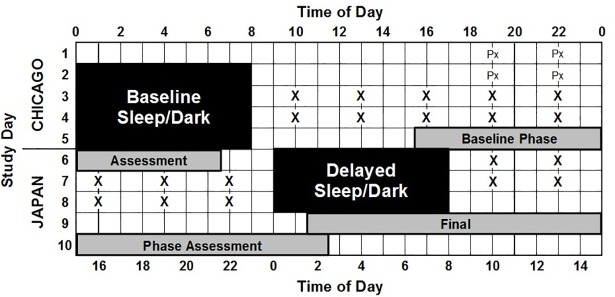
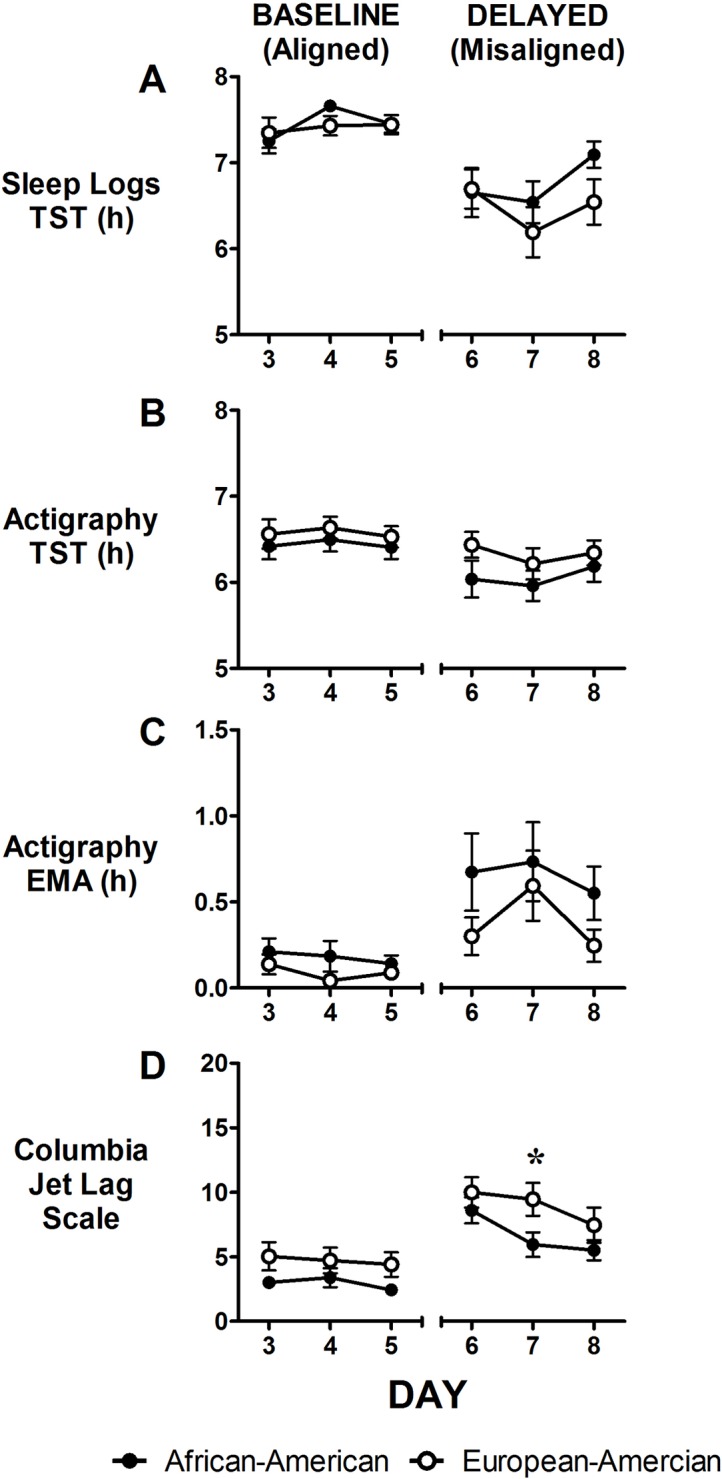
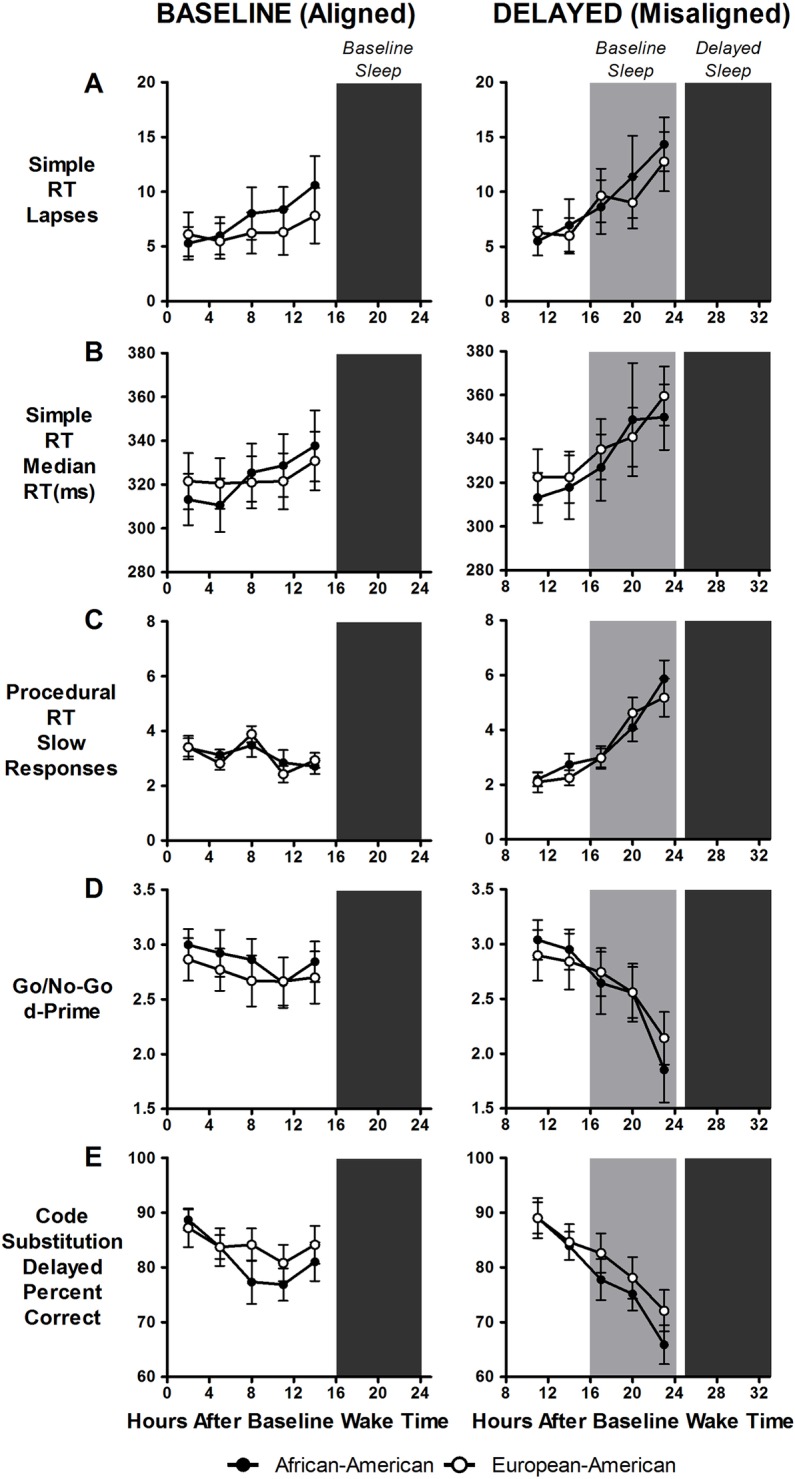
We conducted two studies of circadian misalignment in non-Hispanic African and European-Americans. In the first, the sleep/wake (light/dark) schedule was advanced 9 h, similar to flying east, and in the second these schedules were delayed 9 h, similar to flying west or sleeping during the day after night work. We confirmed that the free-running circadian period is shorter in African-Americans compared to European-Americans, and found differences in the magnitude and direction of circadian rhythm phase shifts which were related to the circadian period. The sleep and cognitive performance data from the first study (published in this journal) documented the impairment in both ancestry groups due to this extreme circadian misalignment. African-Americans slept less and performed slightly worse during advanced/misaligned days than European-Americans. The current analysis is of sleep and cognitive performance from the second study. Participants were 23 African-Americans and 22 European-Americans (aged 18-44 years). Following four baseline days (8 h time in bed, based on habitual sleep), the sleep/wake schedule was delayed by 9 h for three days. Sleep was monitored using actigraphy. During the last two baseline/aligned days and the first two delayed/misaligned days, beginning 2 h after waking, cognitive performance was assessed every 3 h using the Automated Neuropsychological Assessment Metrics (ANAM) battery. Mixed model ANOVAs assessed the effects of ancestry (African-American or European-American) and condition (baseline/aligned or delayed/misaligned) on sleep and performance. There was decreased sleep and impaired cognitive performance in both ancestry groups during the two delayed/misaligned days relative to baseline/aligned days. Sleep and cognitive performance did not differ between African-Americans and European-Americans during either baseline/aligned or delayed/misaligned days. While our previous work showed that an advance in the sleep/wake schedule impaired the sleep of African-Americans more than European-Americans, delaying the sleep/wake schedule impaired the sleep and cognitive performance of African-Americans and European-Americans equally.
我们对非西班牙裔非洲裔美国人和欧裔美国人的昼夜节律失调进行了两项研究。在第一项研究中,睡眠/清醒(光照/黑暗)时间表提前了9小时,类似于向东飞行;在第二项研究中,这些时间表推迟了9小时,类似于向西飞行或在夜间工作后白天睡觉。我们证实,与欧裔美国人相比,非裔美国人的自由运行昼夜节律周期更短,并且发现昼夜节律相移的幅度和方向存在差异,这些差异与昼夜节律周期有关。第一项研究(发表在本期刊上)的睡眠和认知表现数据记录了由于这种极端的昼夜节律失调,两个祖先群体都出现了损伤。在时间表提前/失调的日子里,非裔美国人的睡眠时间比欧裔美国人少,表现也略差。当前的分析来自第二项研究的睡眠和认知表现。参与者为23名非裔美国人和22名欧裔美国人(年龄在18至44岁之间)。在四个基线日(根据习惯睡眠时间,卧床8小时)之后,睡眠/清醒时间表推迟9小时,持续三天。使用活动记录仪监测睡眠。在最后两个基线/对齐日和前两个推迟/失调日,从醒来后2小时开始,每3小时使用自动神经心理评估指标(ANAM)电池评估一次认知表现。混合模型方差分析评估了祖先(非裔美国人或欧裔美国人)和条件(基线/对齐或推迟/失调)对睡眠和表现的影响。与基线/对齐日相比,在两个推迟/失调日期间,两个祖先群体的睡眠都减少了,认知表现也受损。在基线/对齐日或推迟/失调日期间,非裔美国人和欧裔美国人的睡眠和认知表现没有差异。虽然我们之前的研究表明,睡眠/清醒时间表提前对非裔美国人睡眠的损害比对欧裔美国人更大,但推迟睡眠/清醒时间表对非裔美国人和欧裔美国人的睡眠和认知表现的损害是相同的。