Shan Xia, Sawangjit Anuck, Born Jan, Inostroza Marion
Institute of Medical Psychology and Behavioral Neurobiology, University of Tübingen, Tübingen, Germany.
German Center for Mental Health (DZPG), Site Tübingen, Tübingen, Germany.
Eur J Neurosci. 2025 Jun;61(12):e70162. doi: 10.1111/ejn.70162.
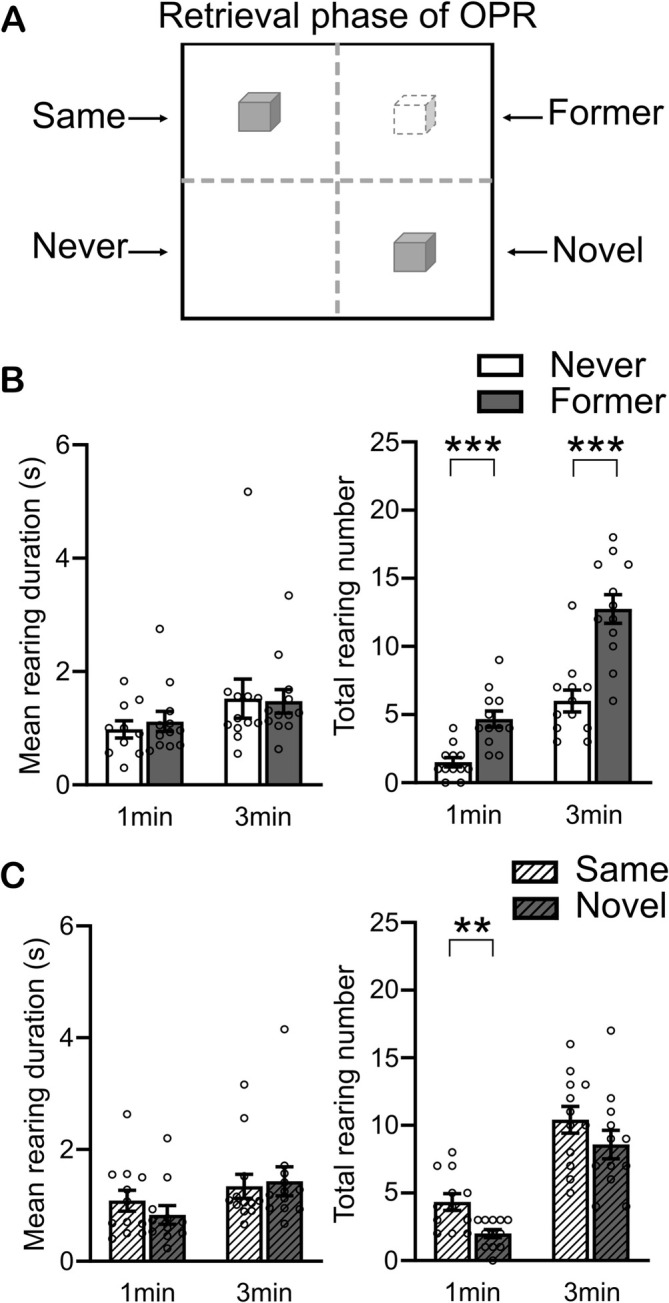
Among the various forms of exploration, rearing-where rodents stand on their hind legs-reflects the animal's processing of spatial information and response to environmental novelty. Here, we investigated the developmental trajectory of rearing in response to spatial novelty in a standard object-place recognition (OPR) task, with the OPR retrieval phase allowing for a direct comparison of measures of rearing, object exploration, and locomotion as indicators of spatial novelty and memory. Groups of male rats were tested on postnatal day (PD) 25, PD31, PD38, PD48, and at adulthood (PD84). The OPR task comprised a 5-min encoding phase with the rat exposed to an arena with two identical objects and, 3 h later, a 5-min retrieval phase in the same arena with one object being displaced to another arena zone. Rearing increased in response to spatial novelty (i.e., the displaced object) at retrieval relative to encoding, with this increase occurring first on PD31, and thus later than preferential object exploration-based responses emerging already on PD25. Importantly, zone-specific analyses during retrieval revealed an increase in rearing events in the (now empty) zone where the displaced object is used to be at encoding. This increase was only observed in adult rats (PD84) and likely indicates the presence of specific object-place associations in memory. These findings evidence rearing as behavior covering aspects of spatial novelty complementary to those of object exploration, thereby enabling a more comprehensive characterization of the emergence of spatial episodic memory during early life.
在各种探索形式中,直立(即啮齿动物用后腿站立)反映了动物对空间信息的处理以及对环境新奇性的反应。在此,我们在标准物体-位置识别(OPR)任务中研究了直立行为对空间新奇性反应的发育轨迹,OPR检索阶段允许直接比较直立、物体探索和运动的测量值,以此作为空间新奇性和记忆的指标。对雄性大鼠分组在出生后第25天(PD25)、第31天(PD31)、第38天(PD38)、第48天(PD48)以及成年期(PD84)进行测试。OPR任务包括一个5分钟的编码阶段,在此期间大鼠被置于一个有两个相同物体的场地中,3小时后,在同一个场地进行一个5分钟的检索阶段,其中一个物体被移到场地的另一个区域。相对于编码阶段,在检索阶段,直立行为会因空间新奇性(即被移动的物体)而增加,这种增加首先出现在PD31,因此比在PD25时就已出现的基于优先物体探索的反应要晚。重要的是,检索阶段的区域特异性分析显示,在(现在为空的)编码时被移动物体所在的区域,直立事件有所增加。这种增加仅在成年大鼠(PD84)中观察到,可能表明记忆中存在特定的物体-位置关联。这些发现证明,直立行为作为一种行为,涵盖了与物体探索互补的空间新奇性方面,从而能够更全面地描述生命早期空间情景记忆的出现。