Department of Materials Science and Engineering, University of Illinois at Urbana-Champaign, Urbana, IL 61801, USA.
Department of Bioengineering, University of Illinois at Urbana-Champaign, Urbana, IL 61801, USA.
Sci Adv. 2017 Oct 25;3(10):e1701350. doi: 10.1126/sciadv.1701350. eCollection 2017 Oct.
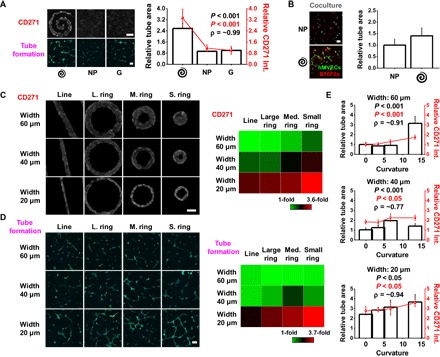
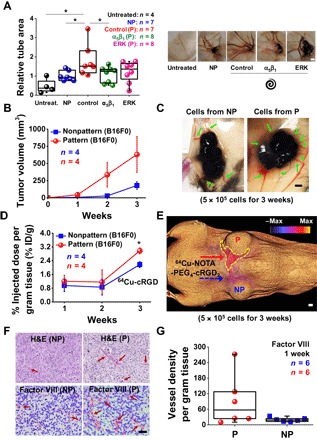
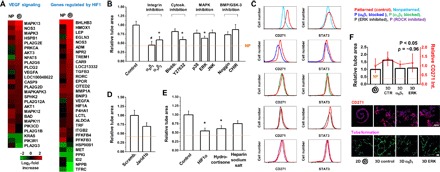
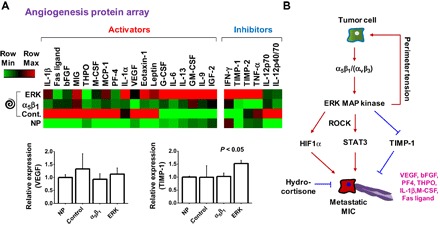
Tumor angiogenesis provides critical nutrients for cancer progression and may also facilitate pathways for dissemination during the process of metastasis. It is well established that cells that metastasize display characteristics of stem cells; however, the prevailing paradigm points to these stem-like cells residing in the hypoxic niche within the tumor interior. Controlling the geometry at the interface of a population of melanoma cells reveals a role for perimeter topology in promoting a stem-like state with enhanced tumorigenicity. We show that this putative melanoma-initiating cell (MIC) demonstrates significant enhancement in the secretion of proangiogenic molecules. This finding suggests the possibility of an "invasive niche" at the perimeter of a growing tumor that promotes a MIC state with angiogenic activity. Using several in vitro and in vivo models of tumor angiogenesis, we see concurrent stem-like characteristics with initiation of neovascularization. In the absence of hypoxia, precise topological cues induce signaling through integrin αβ and downstream extracellular signal-regulated kinase (ERK) signaling to regulate the MIC secretome through the signal transducer and activator of transcription (STAT) and hypoxia-inducible factor 1α (HIF1α) pathways. Inhibiting integrin αβ and ERK signaling attenuates both the MIC phenotype and proangiogenic signaling. These results suggest that topological cues in the periphery of malignant melanoma promote the MIC state-using mechanotransduction in lieu of low oxygen-to facilitate the formation of new vasculature for progression and invasion.
肿瘤血管生成为癌症的发展提供了关键的营养物质,也可能在转移过程中为传播途径提供便利。已经证实,转移的细胞具有干细胞的特征;然而,目前的主流观点认为这些类干细胞存在于肿瘤内部的缺氧龛中。控制一群黑色素瘤细胞界面的几何形状揭示了周长拓扑在促进具有增强致瘤性的类干细胞状态中的作用。我们表明,这种假定的黑色素瘤起始细胞 (MIC) 在促血管生成分子的分泌中表现出显著增强。这一发现表明,在生长肿瘤的周边可能存在一个“侵袭性龛”,促进具有血管生成活性的 MIC 状态。使用几种肿瘤血管生成的体外和体内模型,我们看到了与新血管生成起始同时存在的类干细胞特征。在没有缺氧的情况下,精确的拓扑线索通过整合素 αβ 和下游细胞外信号调节激酶 (ERK) 信号传导来诱导信号转导,通过信号转导子和转录激活子 (STAT) 和缺氧诱导因子 1α (HIF1α) 途径调节 MIC 分泌组。抑制整合素 αβ 和 ERK 信号传导会减弱 MIC 表型和促血管生成信号传导。这些结果表明,恶性黑色素瘤周边的拓扑线索促进了 MIC 状态——利用机械转导代替低氧——促进新血管形成以促进进展和侵袭。