Institut für Theoretische Physik, Universität Bremen, P.O. Box 330 440, 28334, Bremen, Germany.
Bremen Center for Computational Materials Science, Universität Bremen, TAB-Gebäude, Am Fallturm 1, 28359, Bremen, Germany.
Nat Commun. 2017 Oct 27;8(1):1166. doi: 10.1038/s41467-017-01298-6.
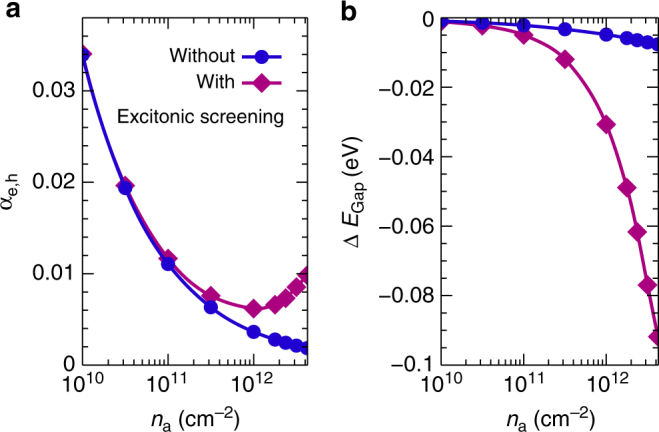
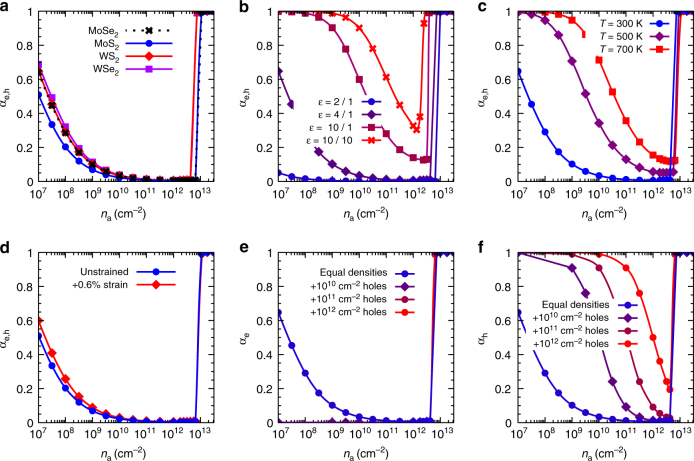
When electron-hole pairs are excited in a semiconductor, it is a priori not clear if they form a plasma of unbound fermionic particles or a gas of composite bosons called excitons. Usually, the exciton phase is associated with low temperatures. In atomically thin transition metal dichalcogenide semiconductors, excitons are particularly important even at room temperature due to strong Coulomb interaction and a large exciton density of states. Using state-of-the-art many-body theory, we show that the thermodynamic fission-fusion balance of excitons and electron-hole plasma can be efficiently tuned via the dielectric environment as well as charge carrier doping. We propose the observation of these effects by studying exciton satellites in photoemission and tunneling spectroscopy, which present direct solid-state counterparts of high-energy collider experiments on the induced fission of composite particles.
当半导体中的电子-空穴对被激发时,它们是形成未束缚费米子等离子体还是称为激子的复合玻色子气体,这在最初是不清楚的。通常,激子相与低温有关。在原子薄的过渡金属二卤代物半导体中,由于强库仑相互作用和大激子态密度,即使在室温下,激子也特别重要。利用最先进的多体理论,我们表明通过介电环境以及载流子掺杂,可以有效地调节激子和电子-空穴等离子体的热力学裂变-融合平衡。我们通过研究光电子和隧道光谱中的激子卫星来提出观察这些效应的建议,这些卫星呈现了高能对撞机实验中关于复合粒子诱导裂变的直接固态对应物。