Instituto de Recursos Naturales y Agrobiología de Sevilla, CSIC, Reina Mercedes 10, 41012, Seville, Spain.
JenaBios GmbH, Löbstedter Str. 80, 07749, Jena, Germany.
Chemistry. 2017 Dec 1;23(67):16985-16989. doi: 10.1002/chem.201704773. Epub 2017 Nov 20.
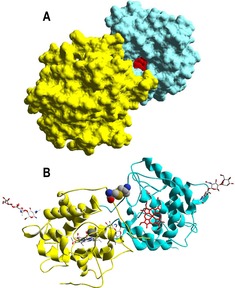
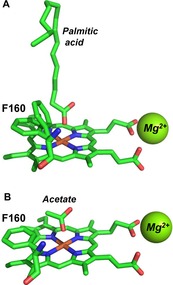
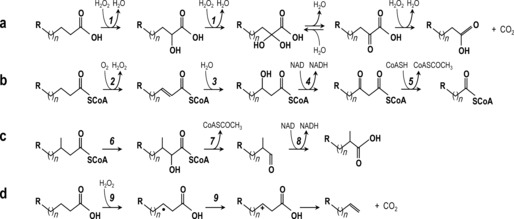
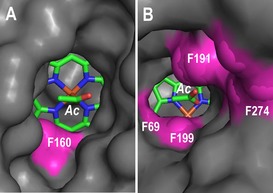
A recently discovered peroxygenase from the fungus Marasmius rotula (MroUPO) is able to catalyze the progressive one-carbon shortening of medium and long-chain mono- and dicarboxylic acids by itself alone, in the presence of H O . The mechanism, analyzed using H O , starts with an α-oxidation catalyzed by MroUPO generating an α-hydroxy acid, which is further oxidized by the enzyme to a reactive α-keto intermediate whose decarboxylation yields the one-carbon shorter fatty acid. Compared with the previously characterized peroxygenase of Agrocybe aegerita, a wider heme access channel, enabling fatty acid positioning with the carboxylic end near the heme cofactor (as seen in one of the crystal structures available) could be at the origin of the unique ability of MroUPO shortening carboxylic acid chains.
最近从真菌 Marasmius rotula 中发现的过氧化物酶(MroUPO)能够在 H O 的存在下,自行催化中链和长链单羧酸和二羧酸的逐个碳原子缩短。该机制通过 H O 进行分析,首先由 MroUPO 催化的 α-氧化生成 α-羟基酸,然后该酶进一步将其氧化为反应性的 α-酮中间产物,其脱羧产生一个碳原子较短的脂肪酸。与先前表征的 Agrocybe aegerita 过氧化物酶相比,更宽的血红素进入通道,使得脂肪酸能够以羧酸末端靠近血红素辅因子的方式定位(如可用的一个晶体结构中所示),可能是 MroUPO 缩短羧酸链的独特能力的起源。