Ramnefjell Maria, Aamelfot Christina, Aziz Sura, Helgeland Lars, Akslen Lars A
Centre for Cancer Biomarkers CCBIO, Department of Clinical Medicine, Section for PathologyUniversity of BergenBergenNorway.
Department of Thoracic MedicineHaukeland University HospitalBergenNorway.
J Pathol Clin Res. 2017 Sep 12;3(4):249-257. doi: 10.1002/cjp2.78. eCollection 2017 Oct.
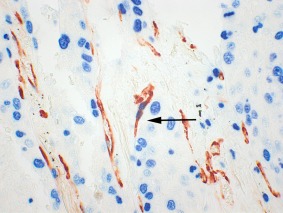
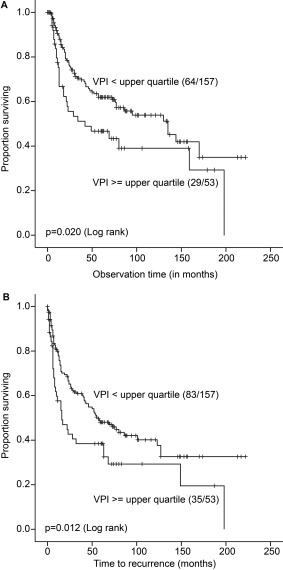
Despite new treatment options in lung cancer, there is still a need for better biomarkers to assist in therapy decisions. Angiogenesis has been associated with tumour growth and dissemination, and the vascular proliferation index (VPI) is a valuable prognostic marker in other tumours. Nestin, a marker of immature endothelium, was previously applied in combination with Ki67 for proliferating endothelium as a novel marker (Nestin-Ki67) of ongoing angiogenesis. Here, the prevalence and prognostic impact of vascular proliferation on lung cancer-specific survival (LCSS) in lung adenocarcinomas was studied. Selected tumour slides from a cohort of 210 patients treated surgically for adenocarcinoma at Haukeland University Hospital (Norway) from 1993 to 2010 were stained for Nestin-Ki67. VPI, the ratio between the density of proliferating vessels and the overall microvessel density were used, and the cut-off value was set at 4.4% (upper quartile). High VPI was associated with the presence of blood vessel invasion ( = 0.007) and tumour necrosis ( = 0.007). Further, high VPI was significantly associated with reduced LCSS ( = 0.020). By multivariate analysis, VPI remained an independent prognostic factor for reduced LCSS (HR 1.7; 95% CI 1.04-2.68; = 0.033) when adjusted for other prognostic clinico-pathological features. In conclusion, microvessel proliferation assessed using the VPI was associated with aggressive tumour features such as blood vessel invasion and tumour necrosis and, independently, decreased LCSS. This marker should be further explored in separate cohorts, and in trials of anti-angiogenesis therapy.
尽管肺癌有了新的治疗选择,但仍需要更好的生物标志物来辅助治疗决策。血管生成与肿瘤生长和扩散相关,血管增殖指数(VPI)在其他肿瘤中是一种有价值的预后标志物。巢蛋白是未成熟内皮细胞的标志物,以前曾与Ki67联合用于增殖内皮细胞,作为正在进行的血管生成的一种新型标志物(巢蛋白-Ki67)。在此,研究了血管增殖在肺腺癌患者肺癌特异性生存(LCSS)中的发生率和预后影响。选取了1993年至2010年在挪威豪克兰大学医院接受手术治疗的210例腺癌患者队列中的肿瘤切片,进行巢蛋白-Ki67染色。使用增殖血管密度与总微血管密度之比计算VPI,临界值设定为4.4%(上四分位数)。高VPI与血管侵犯(P = 0.007)和肿瘤坏死(P = 0.007)相关。此外,高VPI与LCSS降低显著相关(P = 0.020)。多因素分析显示,在调整其他预后临床病理特征后,VPI仍然是LCSS降低的独立预后因素(风险比1.7;95%置信区间1.04-2.68;P = 0.033)。总之,使用VPI评估的微血管增殖与血管侵犯和肿瘤坏死等侵袭性肿瘤特征相关,并且独立地与LCSS降低相关。该标志物应在单独的队列以及抗血管生成治疗试验中进一步探索。