Beavers Kristen M, Ambrosius Walter T, Rejeski W Jack, Burdette Jonathan H, Walkup Michael P, Sheedy Jessica L, Nesbit Beverly A, Gaukstern Jill E, Nicklas Barbara J, Marsh Anthony P
Department of Health and Exercise Science, Wake Forest University, Winston-Salem, North Carolina, USA.
Department of Biostatistical Sciences, Wake Forest School of Medicine, Winston-Salem, North Carolina, USA.
Obesity (Silver Spring). 2017 Nov;25(11):1823-1829. doi: 10.1002/oby.21977.
To examine the long-term effects of exercise modality during weight loss on body composition and associations between body composition and physical function changes.
Two hundred forty-nine older adults (66.9 ± 4.7 years, 71% women, 32% African American, BMI: 34.4 ± 3.7 kg/m ) were randomized to weight loss (WL; n = 82), WL plus aerobic training (WL + AT; n = 86), or WL plus resistance training (WL + RT; n = 81) for 18 months. Dual-energy x-ray absorptiometry-acquired body composition, 400-m walk time, and knee extensor strength were measured at baseline and at 6 and 18 months.
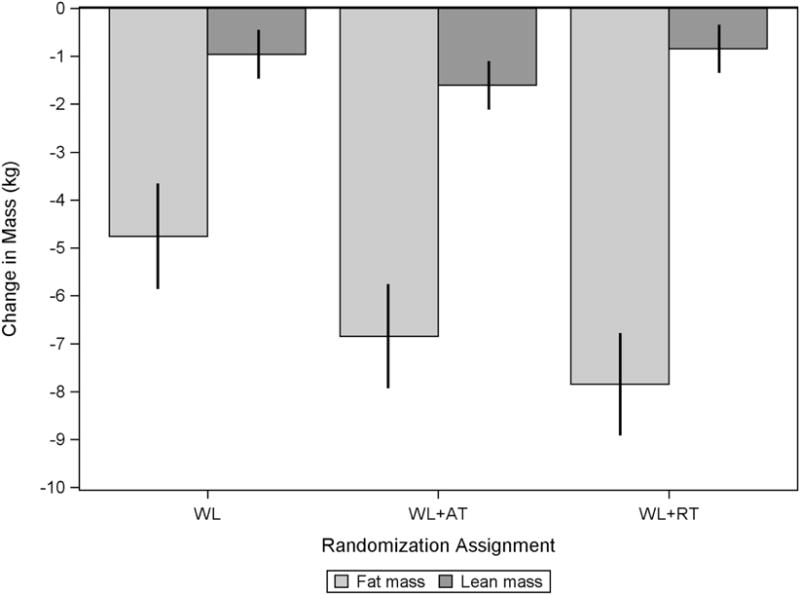
Total body mass loss was enhanced when WL was combined with exercise (WL: -5.7 ± 0.7 kg, WL + AT: -8.5 ± 0.7 kg, WL + RT: -8.7 ± 0.7 kg; P < 0.01). Total body fat mass loss was significantly greater in WL + AT (-6.8 ± 0.6 kg, -16.4%) and WL + RT (-7.8 ± 0.5 kg, -19.0%) than WL (-4.8 ± 0.6 kg, -10.9%); both P < 0.01. Lean mass loss was greatest in WL + AT (-1.6 ± 0.3 kg, -3.1%) compared with WL + RT (-0.8 ± 0.3 kg, -1.5%) or WL (-1.0 ± 0.3 kg; -2.0%); both P ≤ 0.02. Change in 400-m walk time was associated with change in fat mass (β/SD = +6.1 s; P < 0.01), while change in knee extensor strength was associated with change in lean mass (β/SD = +1.6 Nm; P < 0.01).
WL + RT results in less lean mass lost than WL + AT; WL plus exercise yields greater fat mass loss than WL alone.
研究减肥期间运动方式对身体成分的长期影响,以及身体成分与身体功能变化之间的关联。
249名老年人(66.9±4.7岁,71%为女性,32%为非裔美国人,体重指数:34.4±3.7kg/m²)被随机分为三组,分别进行18个月的减肥(WL组;n=82)、减肥加有氧训练(WL+AT组;n=86)或减肥加抗阻训练(WL+RT组;n=81)。在基线、6个月和18个月时,采用双能X线吸收法测量身体成分、400米步行时间和膝关节伸肌力量。
当减肥与运动相结合时,总体重减轻更为显著(WL组:-5.7±0.7kg,WL+AT组:-8.5±0.7kg,WL+RT组:-8.7±0.7kg;P<0.01)。WL+AT组(-6.8±0.6kg,-16.4%)和WL+RT组(-7.8±0.5kg,-19.0%)的总体脂肪量减少显著大于WL组(-4.8±0.6kg,-10.9%);两者P<0.01。与WL+RT组(-0.8±0.3kg,-1.5%)或WL组(-1.0±0.3kg;-2.0%)相比,WL+AT组(-1.6±0.3kg,-3.1%)的去脂体重减少最多;两者P≤0.02。400米步行时间的变化与脂肪量的变化相关(β/标准差=+6.1秒;P<0.01),而膝关节伸肌力量的变化与去脂体重的变化相关(β/标准差=+1.6牛米;P<0.01)。
与WL+AT组相比,WL+RT组的去脂体重损失更少;减肥加运动比单纯减肥能使脂肪量减少更多。