Noel Gaelle, Doucet Michele, Nataro James P, Kaper James B, Zachos Nicholas C, Pasetti Marcela F
a Center for Vaccine Development, Department of Microbiology and Immunology. University of Maryland School of Medicine , Baltimore , MD , USA.
b Department of Medicine, Division of Gastroenterology and Hepatology , Johns Hopkins University School of Medicine , Baltimore , MD , USA.
Gut Microbes. 2017 Oct 31;9(4):0. doi: 10.1080/19490976.2017.1398871.
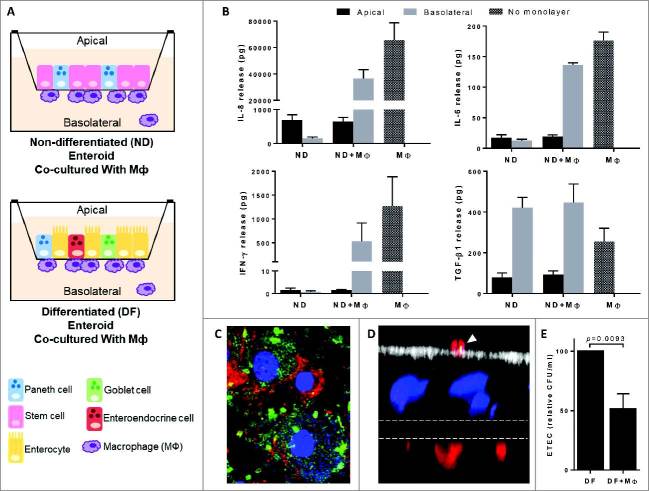
There is a paucity of information on diarrheagenic enterotoxigenic Escherichia coli (ETEC)'s interaction with innate immune cells, in part due to the lack of reliable models that recapitulate infection in human gut. In a recent publication, we described the development of an ex vivo enteroid-macrophage co-culture model using human primary cells. We reported that macrophages residing underneath the epithelial monolayer acquired "resident macrophage" phenotype characterized by lower production of inflammatory cytokines and strong phagocytic activity. These macrophages extended projections across the epithelium, which captured ETEC applied to the apical side of the epithelium and reduced luminal bacterial load. Additional evidence presented in this addendum confirms these findings and further demonstrates that macrophage adaptation occurs regardless of the stage of differentiation of epithelial cells, and that ETEC uptake arises rapidly after infection. The enteroid-macrophage co-culture represents a novel and relevant tool to study host-cell interactions and pathogenesis of enteric infections in humans.
关于致腹泻性产肠毒素大肠杆菌(ETEC)与天然免疫细胞相互作用的信息匮乏,部分原因是缺乏能够重现人类肠道感染情况的可靠模型。在最近发表的一篇文章中,我们描述了一种使用人原代细胞构建的体外肠上皮细胞 - 巨噬细胞共培养模型。我们报道称,位于上皮单层下方的巨噬细胞获得了“驻留巨噬细胞”表型,其特征为炎症细胞因子产生量较低且吞噬活性较强。这些巨噬细胞通过上皮层伸出突起,捕获施加在上皮层顶端的ETEC,并降低管腔内细菌载量。本附录中提供的其他证据证实了这些发现,并进一步表明,无论上皮细胞的分化阶段如何,巨噬细胞都会发生适应性变化,且感染后ETEC的摄取迅速发生。肠上皮细胞 - 巨噬细胞共培养代表了一种研究人类宿主细胞相互作用和肠道感染发病机制的新型且相关的工具。