McColl Karen, Wildey Gary, Sakre Nneha, Lipka Mary Beth, Behtaj Mohadese, Kresak Adam, Chen Yanwen, Yang Michael, Velcheti Vamsidhar, Fu Pingfu, Dowlati Afshin
Division of Hematology and Oncology, Case Western Reserve University, Cleveland, OH, USA.
Department of Pathology, University Hospitals Cleveland Medical Center, Cleveland, OH, USA.
Oncotarget. 2017 Aug 28;8(43):73745-73756. doi: 10.18632/oncotarget.20572. eCollection 2017 Sep 26.
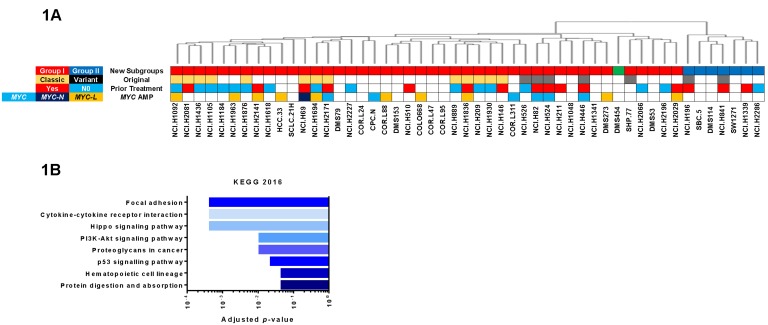
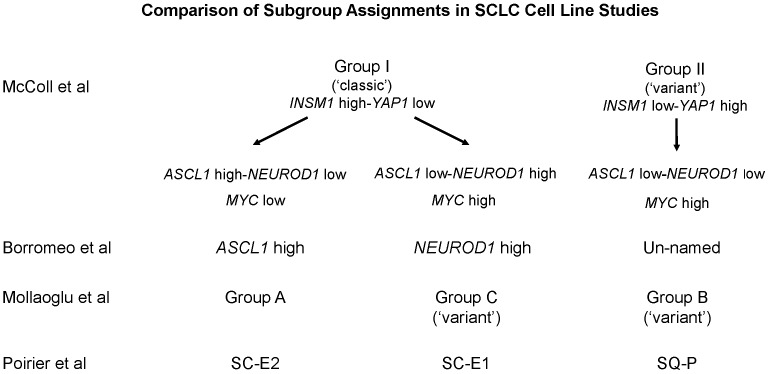
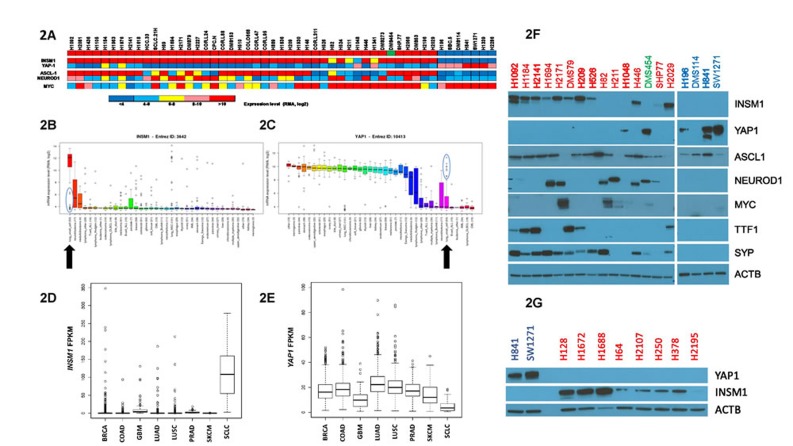
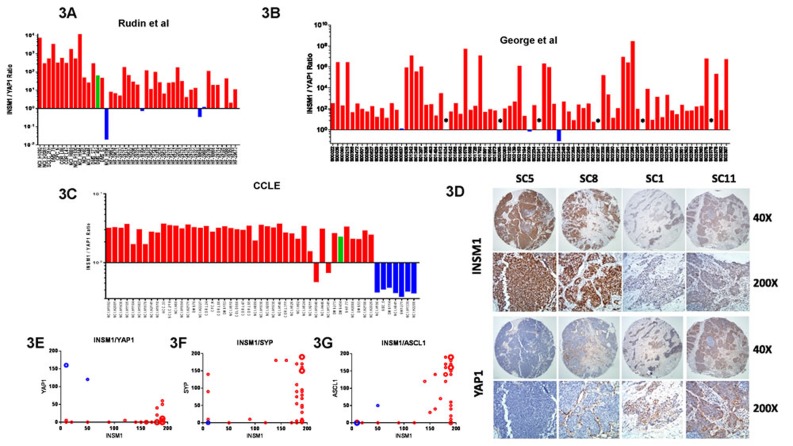
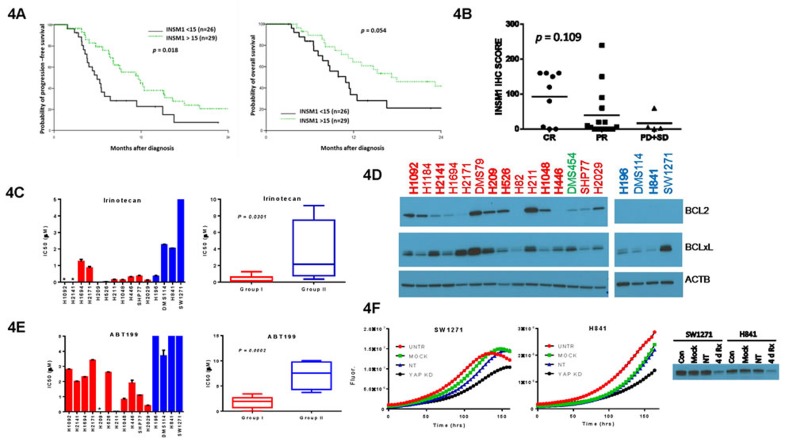
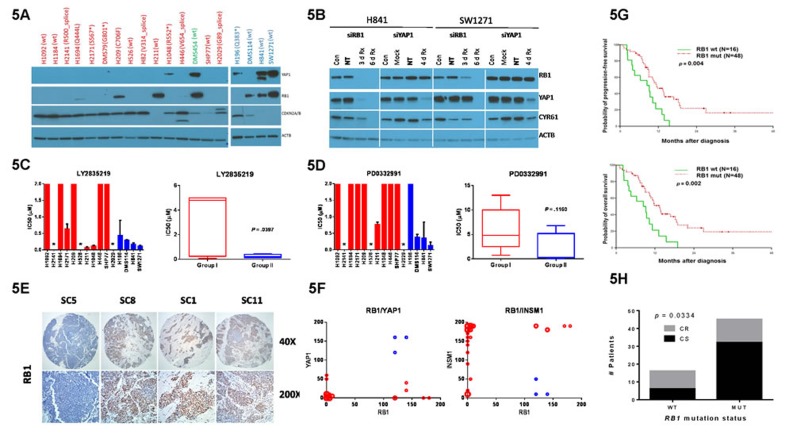
The majority of small cell lung cancer (SCLC) patients demonstrate initial chemo-sensitivity, whereas a distinct subgroup of SCLC patients, termed chemo-refractory, do not respond to treatment. There is little understanding of how to distinguish these patients prior to disease treatment. Here we used gene expression profiling to stratify SCLC into subgroups and characterized a molecular phenotype that may identify, in part, chemo-refractive SCLC patients. Two subgroups of SCLC were identified in both cell lines and tumors by the reciprocal expression of two genes; , a neuroendocrine transcription factor, and , a key mediator of the Hippo pathway. The great majority of tumors expressed INSM1, which was prognostic for increased progression-free survival and associated with chemo-sensitivity in cell lines. YAP1 is expressed in a minority of SCLC tumors and was shown in cell lines to be downstream of the retinoblastoma protein (RB1) and associated with decreased drug sensitivity. RB1 expression in SCLC cell lines sensitizes them to CDK4/6 inhibitors. Wild-type mutation status, used as a surrogate marker of YAP1 expression, was prognostic for decreased patient survival and increased chemo-refractory tumor response. Thus, the reciprocal expression of INSM1 and YAP1 appears to stratify SCLC into distinct subgroups and may be useful, along with mutation status, to identify chemo-refractory SCLC patients.
大多数小细胞肺癌(SCLC)患者表现出初始化疗敏感性,而一小部分被称为化疗难治性的SCLC患者对治疗无反应。在疾病治疗前如何区分这些患者,目前了解甚少。在此,我们利用基因表达谱将SCLC分层为不同亚组,并鉴定了一种分子表型,该表型可能部分地识别化疗难治性SCLC患者。通过两个基因的相互表达,在细胞系和肿瘤中均鉴定出SCLC的两个亚组;一个是神经内分泌转录因子,另一个是Hippo通路的关键介质。绝大多数肿瘤表达INSM1,其对无进展生存期的延长具有预后意义,并与细胞系中的化疗敏感性相关。YAP1在少数SCLC肿瘤中表达,在细胞系中显示其位于视网膜母细胞瘤蛋白(RB1)下游,并与药物敏感性降低相关。SCLC细胞系中的RB1表达使其对CDK4/6抑制剂敏感。野生型突变状态用作YAP1表达的替代标志物,对患者生存期缩短和化疗难治性肿瘤反应增加具有预后意义。因此,INSM1和YAP1的相互表达似乎将SCLC分层为不同亚组,并且与突变状态一起可能有助于识别化疗难治性SCLC患者。