Sanz-Hernández Dédalo, Fernández-Pacheco Amalio
Cavendish Laboratory, University of Cambridge, JJ Thomson Cambridge, CB3 0HE, United Kingdom.
Beilstein J Nanotechnol. 2017 Oct 13;8:2151-2161. doi: 10.3762/bjnano.8.214. eCollection 2017.
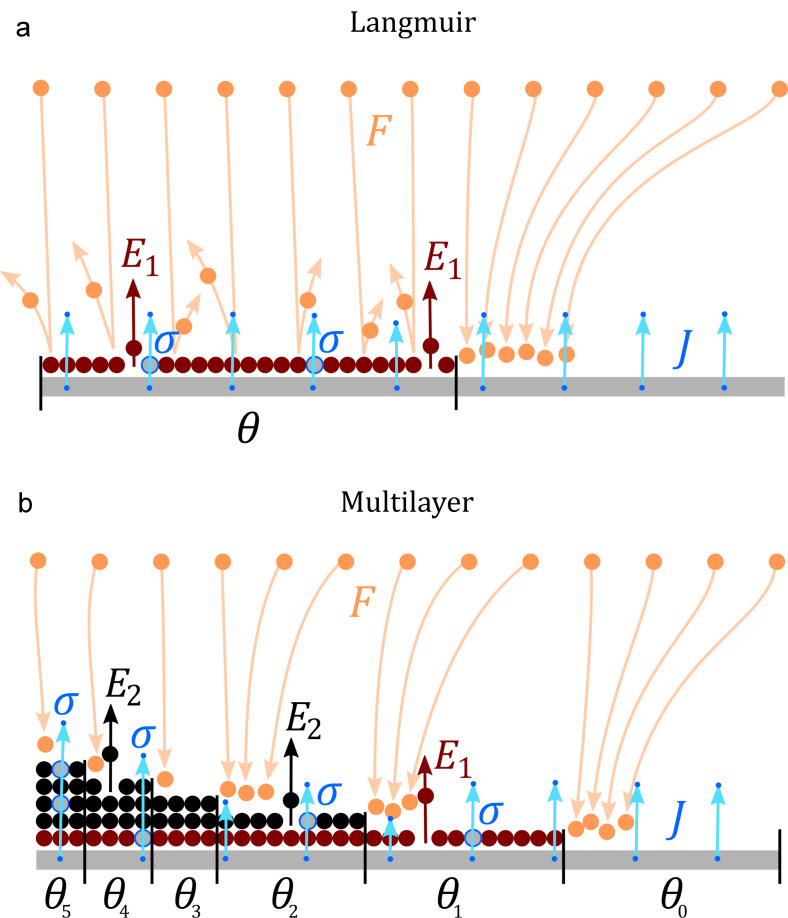
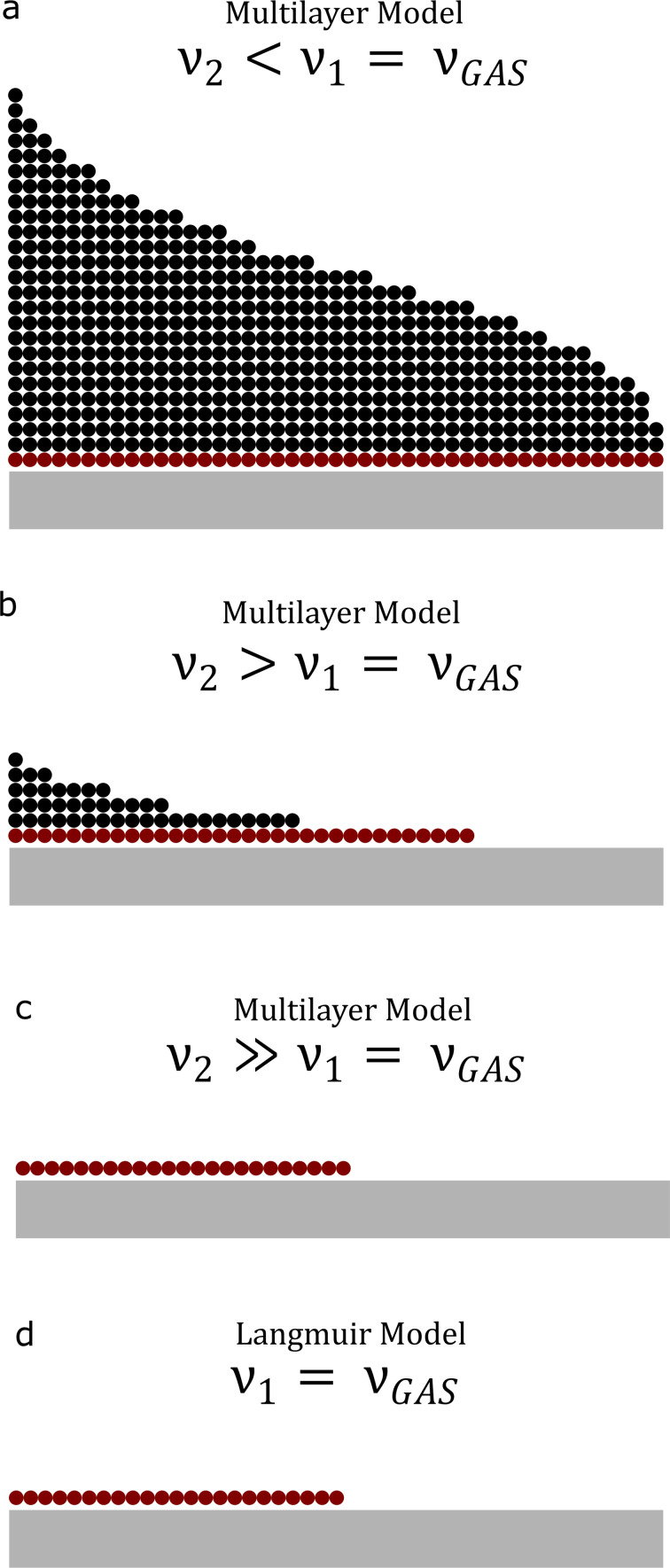
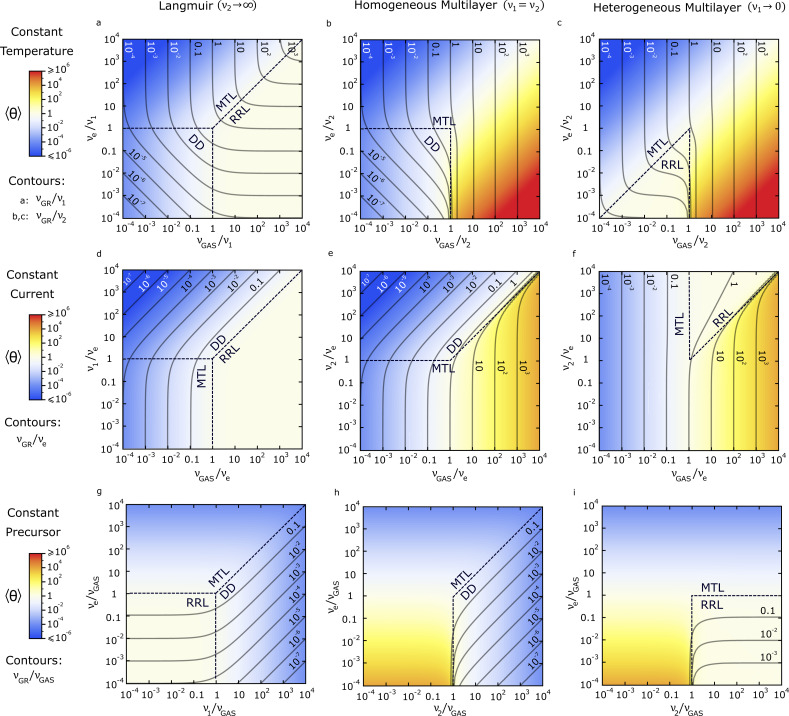
In this work, the continuum model for focused electron beam induced deposition (FEBID) is generalized to account for multilayer adsorption processes. Two types of adsorption energies, describing both physisorption and spontaneous chemisorption, are included. Steady state solutions under no diffusion are investigated and compared under a wide range of conditions. The different growth regimes observed are fully explained by relative changes in FEBID characteristic frequencies. Additionally, we present a set of FEBID frequency maps where growth rate and surface coverage are plotted as a function of characteristic timescales. From the analysis of Langmuir, as well as homogeneous and heterogeneous multilayer maps, we infer that three types of growth regimes are possible for FEBID under no diffusion, resulting into four types of adsorption isotherms. We propose the use of these maps as a powerful tool for the analysis of FEBID processes.
在这项工作中,聚焦电子束诱导沉积(FEBID)的连续介质模型被推广以考虑多层吸附过程。其中包括两种描述物理吸附和自发化学吸附的吸附能。研究了无扩散情况下的稳态解,并在广泛的条件下进行了比较。观察到的不同生长模式通过FEBID特征频率的相对变化得到了充分解释。此外,我们给出了一组FEBID频率图,其中生长速率和表面覆盖率作为特征时间尺度的函数绘制出来。通过对朗缪尔等温线以及均匀和非均匀多层图的分析,我们推断在无扩散情况下FEBID可能存在三种生长模式,从而产生四种吸附等温线类型。我们建议将这些图用作分析FEBID过程的有力工具。