• 文献检索
  • 文档翻译
  • 深度研究
  • 学术资讯
  • Suppr Zotero 插件Zotero 插件
  • 邀请有礼
  • 套餐&价格
  • 历史记录
应用&插件
Suppr Zotero 插件Zotero 插件浏览器插件Mac 客户端Windows 客户端微信小程序
定价
高级版会员购买积分包购买API积分包
服务
文献检索文档翻译深度研究API 文档MCP 服务
关于我们
关于 Suppr公司介绍联系我们用户协议隐私条款
关注我们

Suppr 超能文献

核心技术专利:CN118964589B侵权必究
粤ICP备2023148730 号-1Suppr @ 2026

文献检索

告别复杂PubMed语法,用中文像聊天一样搜索,搜遍4000万医学文献。AI智能推荐,让科研检索更轻松。

立即免费搜索

文件翻译

保留排版,准确专业,支持PDF/Word/PPT等文件格式,支持 12+语言互译。

免费翻译文档

深度研究

AI帮你快速写综述,25分钟生成高质量综述,智能提取关键信息,辅助科研写作。

立即免费体验

睡眠对语义类别结构的记忆有益,同时保留了范例特定的信息。

Sleep Benefits Memory for Semantic Category Structure While Preserving Exemplar-Specific Information.

机构信息

Department of Psychiatry, Beth Israel Deaconess Medical Center and Harvard Medical School, Boston, MA, USA.

Department of Psychology, University of California-Riverside, Riverside, CA, USA.

出版信息

Sci Rep. 2017 Nov 1;7(1):14869. doi: 10.1038/s41598-017-12884-5.

DOI:10.1038/s41598-017-12884-5
PMID:29093451
原文链接:https://pmc.ncbi.nlm.nih.gov/articles/PMC5665979/
Abstract

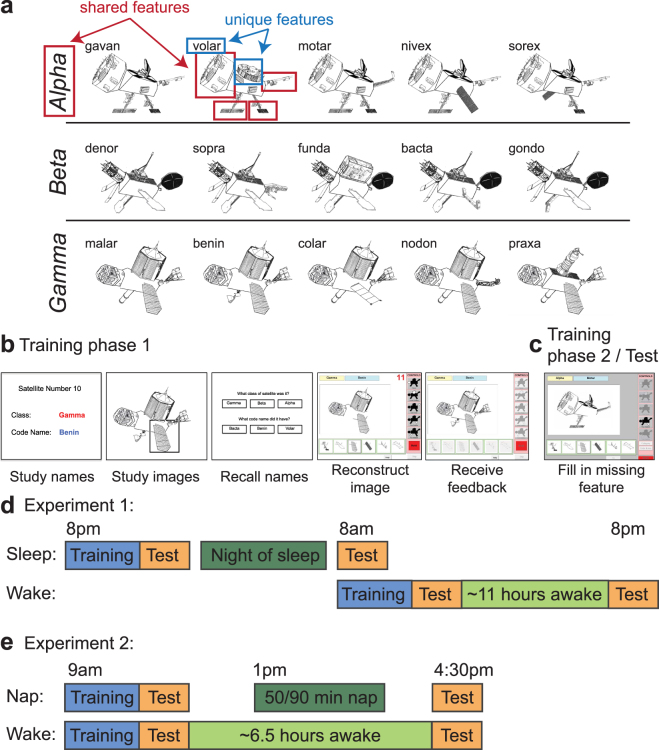
Semantic memory encompasses knowledge about both the properties that typify concepts (e.g. robins, like all birds, have wings) as well as the properties that individuate conceptually related items (e.g. robins, in particular, have red breasts). We investigate the impact of sleep on new semantic learning using a property inference task in which both kinds of information are initially acquired equally well. Participants learned about three categories of novel objects possessing some properties that were shared among category exemplars and others that were unique to an exemplar, with exposure frequency varying across categories. In Experiment 1, memory for shared properties improved and memory for unique properties was preserved across a night of sleep, while memory for both feature types declined over a day awake. In Experiment 2, memory for shared properties improved across a nap, but only for the lower-frequency category, suggesting a prioritization of weakly learned information early in a sleep period. The increase was significantly correlated with amount of REM, but was also observed in participants who did not enter REM, suggesting involvement of both REM and NREM sleep. The results provide the first evidence that sleep improves memory for the shared structure of object categories, while simultaneously preserving object-unique information.

摘要

语义记忆包括对概念典型属性(例如,知更鸟与所有鸟类一样,都有翅膀)以及概念相关项目区分属性(例如,知更鸟,特别是,有红色的胸脯)的知识。我们使用属性推断任务来研究睡眠对新语义学习的影响,在该任务中,两种信息最初的获取程度相当。参与者学习了三个新的物体类别,每个类别都具有一些在类别示例中共享的属性和一些独特于示例的属性,不同类别的曝光频率不同。在实验 1 中,在一夜睡眠期间,共享属性的记忆得到了改善,而独特属性的记忆得到了保留,而在一天清醒期间,两种特征类型的记忆都下降了。在实验 2 中,在小睡期间,共享属性的记忆得到了改善,但仅适用于较低频率的类别,这表明在睡眠期间早期对弱学习信息进行了优先级排序。这种增加与 REM 的量显著相关,但在没有进入 REM 的参与者中也观察到了这种增加,这表明 REM 和 NREM 睡眠都参与了其中。研究结果首次提供了证据,表明睡眠可以改善物体类别共享结构的记忆,同时保留物体独特的信息。
https://cdn.ncbi.nlm.nih.gov/pmc/blobs/5db8/5665979/51d387a99590/41598_2017_12884_Fig4_HTML.jpg
https://cdn.ncbi.nlm.nih.gov/pmc/blobs/5db8/5665979/9ece6d8fe243/41598_2017_12884_Fig1_HTML.jpg
https://cdn.ncbi.nlm.nih.gov/pmc/blobs/5db8/5665979/fe9497335384/41598_2017_12884_Fig2_HTML.jpg
https://cdn.ncbi.nlm.nih.gov/pmc/blobs/5db8/5665979/796236ff6bfb/41598_2017_12884_Fig3_HTML.jpg
https://cdn.ncbi.nlm.nih.gov/pmc/blobs/5db8/5665979/51d387a99590/41598_2017_12884_Fig4_HTML.jpg
https://cdn.ncbi.nlm.nih.gov/pmc/blobs/5db8/5665979/9ece6d8fe243/41598_2017_12884_Fig1_HTML.jpg
https://cdn.ncbi.nlm.nih.gov/pmc/blobs/5db8/5665979/fe9497335384/41598_2017_12884_Fig2_HTML.jpg
https://cdn.ncbi.nlm.nih.gov/pmc/blobs/5db8/5665979/796236ff6bfb/41598_2017_12884_Fig3_HTML.jpg
https://cdn.ncbi.nlm.nih.gov/pmc/blobs/5db8/5665979/51d387a99590/41598_2017_12884_Fig4_HTML.jpg

相似文献

1
Sleep Benefits Memory for Semantic Category Structure While Preserving Exemplar-Specific Information.睡眠对语义类别结构的记忆有益,同时保留了范例特定的信息。
Sci Rep. 2017 Nov 1;7(1):14869. doi: 10.1038/s41598-017-12884-5.
2
Morning rapid eye movement sleep naps facilitate broad access to emotional semantic networks.早晨快速眼动睡眠小睡有助于广泛访问情绪语义网络。
Sleep. 2015 Mar 1;38(3):433-43. doi: 10.5665/sleep.4504.
3
Semantic priming effect during REM-sleep inertia in patients with narcolepsy.发作性睡病患者快速眼动睡眠惯性期间的语义启动效应。
Brain Res Bull. 2006 Dec 11;71(1-3):270-8. doi: 10.1016/j.brainresbull.2006.09.011. Epub 2006 Oct 5.
4
Sleep-induced changes in associative memory.睡眠引起的联想记忆变化。
J Cogn Neurosci. 1999 Mar;11(2):182-93. doi: 10.1162/089892999563319.
5
Consolidation of strictly episodic memories mainly requires rapid eye movement sleep.严格意义上的情景记忆巩固主要需要快速眼动睡眠。
Sleep. 2004 May 1;27(3):395-401. doi: 10.1093/sleep/27.3.395.
6
Rapid eye movement and non-rapid eye movement sleep contributions in memory consolidation and resistance to retroactive interference for verbal material.快速眼动睡眠和非快速眼动睡眠对言语材料记忆巩固及对倒摄干扰的抵抗力的贡献。
Sleep. 2013 Dec 1;36(12):1875-83. doi: 10.5665/sleep.3220.
7
Memory sources associated with REM and NREM dream reports throughout the night: a new look at the data.与整夜快速眼动(REM)和非快速眼动(NREM)梦境报告相关的记忆来源:对数据的新审视。
Sleep. 2001 Mar 15;24(2):165-70.
8
Sleep before and after learning promotes the consolidation of both neutral and emotional information regardless of REM presence.学习前后的睡眠能够促进中性和情感信息的巩固,无论是否存在快速眼动睡眠。
Neurobiol Learn Mem. 2016 Sep;133:136-144. doi: 10.1016/j.nlm.2016.06.015. Epub 2016 Jun 16.
9
Effects of early morning nap sleep on associative memory for neutral and emotional stimuli.清晨小睡对中性和情绪刺激的联想记忆的影响。
Brain Res. 2018 Nov 1;1698:29-42. doi: 10.1016/j.brainres.2018.06.020. Epub 2018 Jun 18.
10
Complex sound processing during human REM sleep by recovering information from long-term memory as revealed by the mismatch negativity (MMN).快速眼动睡眠期间人类复杂声音处理通过失配负波(MMN)揭示的从长期记忆中恢复信息来实现。
Brain Res. 2001 May 18;901(1-2):151-60. doi: 10.1016/s0006-8993(01)02340-x.

引用本文的文献

1
REM refines and rescues memory representations: a new theory.快速眼动睡眠(REM)改善并挽救记忆表征:一种新理论。
Sleep Adv. 2025 Jan 22;6(1):zpaf004. doi: 10.1093/sleepadvances/zpaf004. eCollection 2025.
2
Sleep selectively and durably enhances memory for the sequence of real-world experiences.睡眠能选择性且持久地增强对现实世界经历序列的记忆。
Nat Hum Behav. 2025 Apr;9(4):746-757. doi: 10.1038/s41562-025-02117-5. Epub 2025 Mar 11.
3
Object Feature Memory Is Distorted by Category Structure.客体特征记忆会被类别结构扭曲。

本文引用的文献

1
The impact of sleep on novel concept learning.睡眠对新概念学习的影响。
Neurobiol Learn Mem. 2017 May;141:19-26. doi: 10.1016/j.nlm.2017.03.008. Epub 2017 Mar 11.
2
Sleep Supports the Slow Abstraction of Gist from Visual Perceptual Memories.睡眠支持从视觉感知记忆中缓慢提取主旨。
Sci Rep. 2017 Feb 17;7:42950. doi: 10.1038/srep42950.
3
Sleep-Driven Computations in Speech Processing.语音处理中的睡眠驱动计算
Open Mind (Camb). 2024 Nov 22;8:1348-1368. doi: 10.1162/opmi_a_00170. eCollection 2024.
4
An afternoon nap facilitates analogical transfer in creative problem solving.午睡有助于在创造性问题解决中进行类比迁移。
J Sleep Res. 2025 Aug;34(4):e14419. doi: 10.1111/jsr.14419. Epub 2024 Nov 27.
5
The role of REM sleep in neural differentiation of memories in the hippocampus.快速眼动睡眠在海马体记忆神经分化中的作用。
bioRxiv. 2024 Nov 3:2024.11.01.621588. doi: 10.1101/2024.11.01.621588.
6
Eliminating episodic memory?消除情景记忆?
Philos Trans R Soc Lond B Biol Sci. 2024 Nov 4;379(1913):20230413. doi: 10.1098/rstb.2023.0413. Epub 2024 Sep 16.
7
Consolidation Enhances Sequential Multistep Anticipation but Diminishes Access to Perceptual Features.巩固增强了连续多步预测,但削弱了对感知特征的获取。
Psychol Sci. 2024 Oct;35(10):1178-1199. doi: 10.1177/09567976241256617. Epub 2024 Aug 7.
8
Experience transforms crossmodal object representations in the anterior temporal lobes.经验改变了前颞叶中的跨模态物体表征。
Elife. 2024 Apr 22;13:e83382. doi: 10.7554/eLife.83382.
9
Memory Reactivation during Sleep Does Not Act Holistically on Object Memory.睡眠期间的记忆再激活不会整体作用于物体记忆。
J Neurosci. 2024 Jun 12;44(24):e0022242024. doi: 10.1523/JNEUROSCI.0022-24.2024.
10
A complementary learning systems model of how sleep moderates retrieval practice effects.睡眠如何调节检索练习效果的互补学习系统模型。
Psychon Bull Rev. 2024 Oct;31(5):2022-2035. doi: 10.3758/s13423-024-02489-1. Epub 2024 Mar 26.
PLoS One. 2017 Jan 5;12(1):e0169538. doi: 10.1371/journal.pone.0169538. eCollection 2017.
4
The neural and computational bases of semantic cognition.语义认知的神经和计算基础。
Nat Rev Neurosci. 2017 Jan;18(1):42-55. doi: 10.1038/nrn.2016.150. Epub 2016 Nov 24.
5
Complementary learning systems within the hippocampus: a neural network modelling approach to reconciling episodic memory with statistical learning.海马体中的互补学习系统:一种将情景记忆与统计学习相协调的神经网络建模方法。
Philos Trans R Soc Lond B Biol Sci. 2017 Jan 5;372(1711). doi: 10.1098/rstb.2016.0049.
6
The influence of sleep on emotional and cognitive processing is primarily trait- (but not state-) dependent.睡眠对情绪和认知加工的影响主要取决于特质(而非状态)。
Neurobiol Learn Mem. 2016 Oct;134 Pt B:275-86. doi: 10.1016/j.nlm.2016.07.032. Epub 2016 Jul 29.
7
To gain or not to gain - The complex role of sleep for memory: Comment on Dumay (2016).增与不增——睡眠对记忆的复杂作用:评杜梅(2016年)
Cortex. 2018 Apr;101:282-287. doi: 10.1016/j.cortex.2016.06.011. Epub 2016 Jun 24.
8
Does Sleep Improve Your Grammar? Preferential Consolidation of Arbitrary Components of New Linguistic Knowledge.睡眠能提高你的语法能力吗?新语言知识任意成分的优先巩固。
PLoS One. 2016 Apr 5;11(4):e0152489. doi: 10.1371/journal.pone.0152489. eCollection 2016.
9
The Benefits of Targeted Memory Reactivation for Consolidation in Sleep are Contingent on Memory Accuracy and Direct Cue-Memory Associations.睡眠中定向记忆再激活对记忆巩固的益处取决于记忆准确性和直接线索-记忆关联。
Sleep. 2016 May 1;39(5):1139-50. doi: 10.5665/sleep.5772.
10
Sleep not just protects memories against forgetting, it also makes them more accessible.睡眠不仅能保护记忆不被遗忘,还能使它们更容易被提取。
Cortex. 2016 Jan;74:289-96. doi: 10.1016/j.cortex.2015.06.007. Epub 2015 Jul 27.