Ahn Sangtae, Jun Sung C
Department of Psychiatry, University of North Carolina at Chapel Hill, Chapel Hill, NC, United States.
School of Electrical Engineering and Computer Science, Gwangju Institute of Science and Technology, Gwangju, South Korea.
Front Hum Neurosci. 2017 Oct 18;11:503. doi: 10.3389/fnhum.2017.00503. eCollection 2017.
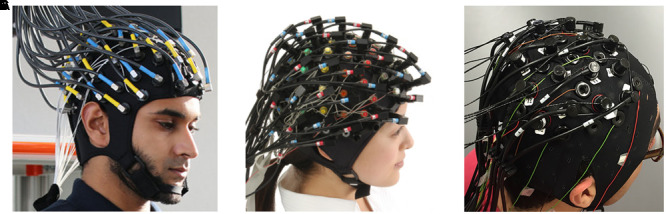
Multi-modal integration, which combines multiple neurophysiological signals, is gaining more attention for its potential to supplement single modality's drawbacks and yield reliable results by extracting complementary features. In particular, integration of electroencephalography (EEG) and functional near-infrared spectroscopy (fNIRS) is cost-effective and portable, and therefore is a fascinating approach to brain-computer interface (BCI). However, outcomes from the integration of these two modalities have yielded only modest improvement in BCI performance because of the lack of approaches to integrate the two different features. In addition, mismatch of recording locations may hinder further improvement. In this literature review, we surveyed studies of the integration of EEG/fNIRS in BCI thoroughly and discussed its current limitations. We also suggested future directions for efficient and successful multi-modal integration of EEG/fNIRS in BCI systems.
多模态整合结合了多种神经生理信号,因其有潜力弥补单模态的缺点,并通过提取互补特征产生可靠结果而受到越来越多的关注。特别是,脑电图(EEG)和功能近红外光谱(fNIRS)的整合具有成本效益且便于携带,因此是脑机接口(BCI)领域一种引人入胜的方法。然而,由于缺乏整合这两种不同特征的方法,这两种模态整合的结果在BCI性能方面仅取得了适度的提升。此外,记录位置的不匹配可能会阻碍进一步的改善。在这篇文献综述中,我们全面调查了BCI中EEG/fNIRS整合的研究,并讨论了其当前的局限性。我们还提出了在BCI系统中高效且成功地进行EEG/fNIRS多模态整合的未来方向。