Miron-Shatz Talya, Becker Stefan, Zaromb Franklin, Mertens Alexander, Tsafrir Avi
Center for Medical Decision Making, Faculty of Business Administration, Ono Academic College, Kiryat Ono, Israel.
Center for Medicine in the Public Interest, New York, NY, United States.
Interact J Med Res. 2017 Nov 2;6(2):e22. doi: 10.2196/ijmr.7107.
Thank you letters to physicians and medical facilities are an untapped resource, providing an invaluable glimpse into what patients notice and appreciate in their care.
The aim of this study was to analyze such thank you letters as posted on the Web by medical institutions to find what patients and families consider to be good care. In an age of patient-centered care, it is pivotal to see what metrics patients and families apply when assessing their care and whether they grasp specific versus general qualities in their care.
Our exploratory inquiry covered 100 thank you letters posted on the Web by 26 medical facilities in the United States and the United Kingdom. We systematically coded and descriptively presented the aspects of care that patients and their families thanked doctors and medical facilities for. We relied on previous work outlining patient priorities and satisfaction (Anderson et al, 2007), to which we added a distinction between global and specific evaluations for each of the already existing categories with two additional categories: general praise and other, and several subcategories, such as treatment outcome, to the category of medical care.
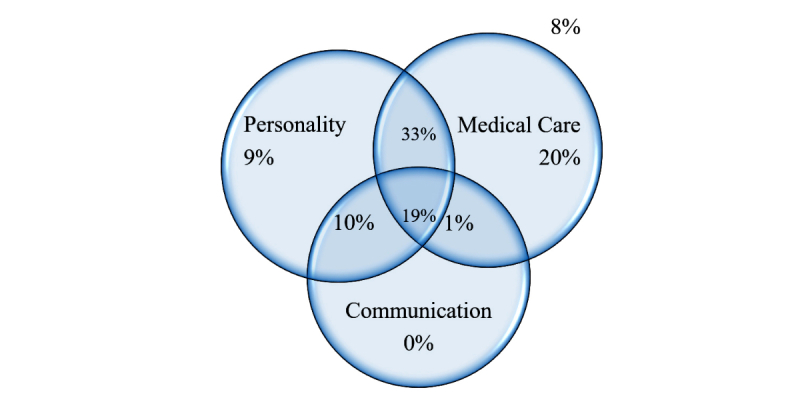
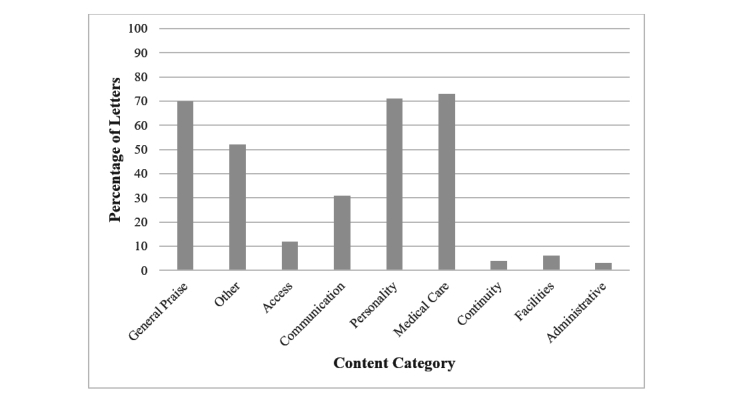
In 73% of the letters (73/100), physicians were primarily thanked for their medical treatment. In 71% (71/100) of the letters, they were thanked for their personality and demeanor. In 52% cases (52/100), these two aspects were mentioned together, suggesting that from the perspective of patient as well as the family member, both are deemed necessary in positive evaluation of medical care. Only 8% (8/100) of the letters lacked reference to medical care, personality or demeanor, or communication. No statistically significant differences were observed in the number of letters that expressed gratitude for the personality or demeanor of medical care providers versus the quality of medical care (χ21, N=200=0.1, not statistically significant). Letters tended to express more specific praise for personality or demeanor, such as being supportive, understanding, humane and caring (48/71, 68%) but more general praise for medical care (χ21, N=424=63.9, P<.01). The most often mentioned specific quality of medical care were treatment outcomes (30/73, 41%), followed by technical competence (15/73, 21%) and treatment approach (14/73, 19%). A limitation of this inquiry is that we analyzed the letters that medical centers chose to post on the Web. These are not necessarily a representative sample of all thank you letters as are sent to health care institutions but are still indicative of what centers choose to showcase on the Web.
Physician demeanor and quality of interaction with patients are pivotal in how laymen perceive good care, no less so than medical care per se. This inquiry can inform care providers and medical curricula, leading to an improvement in the perceived quality of care.
给医生和医疗机构的感谢信是一种未被充分利用的资源,能让我们深入了解患者在就医过程中注意到并感激的方面。
本研究旨在分析医疗机构在网上发布的此类感谢信,以找出患者及其家属认为的优质医疗服务。在以患者为中心的医疗时代,了解患者及其家属在评估医疗服务时所采用的标准,以及他们是否能区分医疗服务的具体与一般品质至关重要。
我们的探索性调查涵盖了美国和英国26家医疗机构在网上发布的100封感谢信。我们系统地对患者及其家属感谢医生和医疗机构的医疗服务方面进行编码和描述性呈现。我们参考了之前概述患者优先事项和满意度的研究(安德森等人,2007年),并在此基础上,对每个现有类别区分了整体评价和具体评价,另外增加了两个类别:一般赞扬和其他,以及几个子类别,如将治疗结果归入医疗服务类别。
在73%(73/100)的信件中,医生主要因其医疗治疗而受到感谢。在71%(71/100)的信件中,他们因其个性和态度而受到感谢。在52%(52/100)的案例中,这两个方面被同时提及,这表明从患者及其家属的角度来看,在对医疗服务的积极评价中,两者都被认为是必要的。只有8%(8/100)的信件未提及医疗服务、个性或态度,或沟通。在表达对医疗服务提供者个性或态度的感激之情与对医疗服务质量的感激之情的信件数量上,未观察到统计学上的显著差异(χ21,N = 200 = 0.1,无统计学意义)。信件往往对个性或态度表达更具体的赞扬,如支持、理解、人道和关怀(48/71,68%),但对医疗服务表达更一般的赞扬(χ21,N = 424 = 63.9,P <.01)。医疗服务最常被提及的具体品质是治疗结果(30/73,41%),其次是技术能力(15/73,21%)和治疗方法(14/73,19%)。本调查的一个局限性在于,我们分析的是医疗中心选择在网上发布的信件。这些信件不一定是发送给医疗机构的所有感谢信的代表性样本,但仍能表明各中心选择在网上展示的内容。
医生的态度以及与患者互动的质量,在外行对优质医疗服务的认知中与医疗服务本身同样重要。这项调查可为医疗服务提供者和医学课程提供参考,从而提高人们对医疗服务质量的认知。