Frankel Cardiovascular Center, Department of Internal Medicine, University of Michigan Medical School, Ann Arbor, MI 48109, USA.
Section on Comparative Medicine, Department of Pathology, Wake Forest School of Medicine, Winston-Salem, NC 27157, USA.
Oxid Med Cell Longev. 2017;2017:7317251. doi: 10.1155/2017/7317251. Epub 2017 Oct 2.
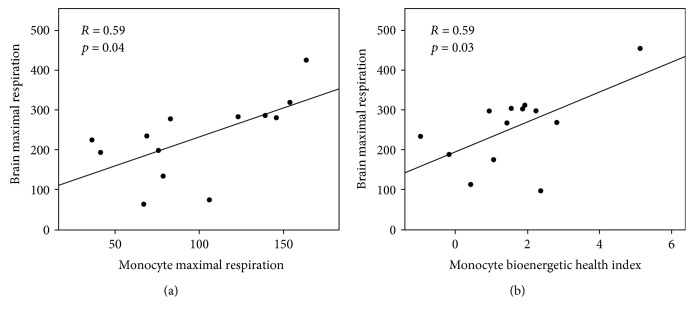
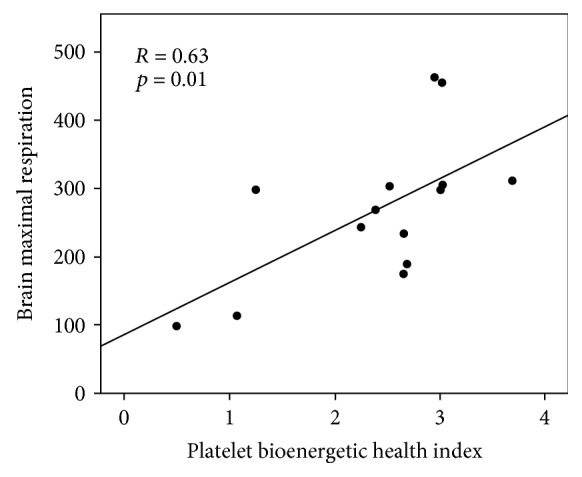
Blood-based bioenergetic profiling provides a minimally invasive assessment of mitochondrial health shown to be related to key features of aging. Previous studies show that blood cells recapitulate mitochondrial alterations in the central nervous system under pathological conditions, including the development of Alzheimer's disease. In this study of nonhuman primates, we focus on mitochondrial function and bioenergetic capacity assessed by the respirometric profiling of monocytes, platelets, and frontal cortex mitochondria. Our data indicate that differences in the maximal respiratory capacity of brain mitochondria are reflected by CD14+ monocyte maximal respiratory capacity and platelet and monocyte bioenergetic health index. A subset of nonhuman primates also underwent [F] fluorodeoxyglucose positron emission tomography (FDG-PET) imaging to assess brain glucose metabolism. Our results indicate that platelet respiratory capacity positively correlates to measures of glucose metabolism in multiple brain regions. Altogether, the results of this study provide early evidence that blood-based bioenergetic profiling is related to brain mitochondrial metabolism. While these measures cannot substitute for direct measures of brain metabolism, provided by measures such as FDG-PET, they may have utility as a metabolic biomarker and screening tool to identify individuals exhibiting systemic bioenergetic decline who may therefore be at risk for the development of neurodegenerative diseases.
基于血液的生物能量分析提供了一种微创的线粒体健康评估方法,研究表明它与衰老的关键特征有关。先前的研究表明,在病理条件下,包括阿尔茨海默病的发展,血细胞会再现中枢神经系统中线粒体的改变。在这项对非人类灵长类动物的研究中,我们专注于通过对单核细胞、血小板和额皮质线粒体的呼吸分析来评估线粒体功能和生物能量能力。我们的数据表明,大脑线粒体最大呼吸能力的差异反映在 CD14+单核细胞最大呼吸能力和血小板及单核细胞生物能量健康指数上。一部分非人类灵长类动物还接受了[F]氟脱氧葡萄糖正电子发射断层扫描(FDG-PET)成像,以评估大脑葡萄糖代谢。我们的结果表明血小板呼吸能力与多个大脑区域的葡萄糖代谢测量值呈正相关。总之,这项研究的结果提供了早期证据,表明基于血液的生物能量分析与大脑线粒体代谢有关。虽然这些测量方法不能替代 FDG-PET 等方法提供的直接大脑代谢测量方法,但它们可能作为代谢生物标志物和筛查工具具有一定的实用性,可用于识别表现出系统性生物能量下降的个体,这些个体可能有患神经退行性疾病的风险。