Cheng Xuan, Xie Nan-Chang, Xu Hong-Liang, Chen Chen, Lian Ya-Jun
Department of Neurology, The first affiliated hospital of Zhengzhou University, Zhengzhou, Henan province, P.R. China.
Oncotarget. 2017 Aug 18;8(44):77086-77095. doi: 10.18632/oncotarget.20356. eCollection 2017 Sep 29.
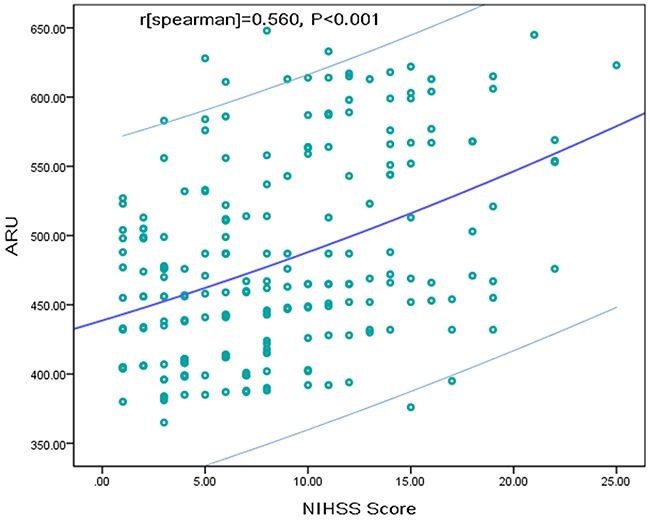
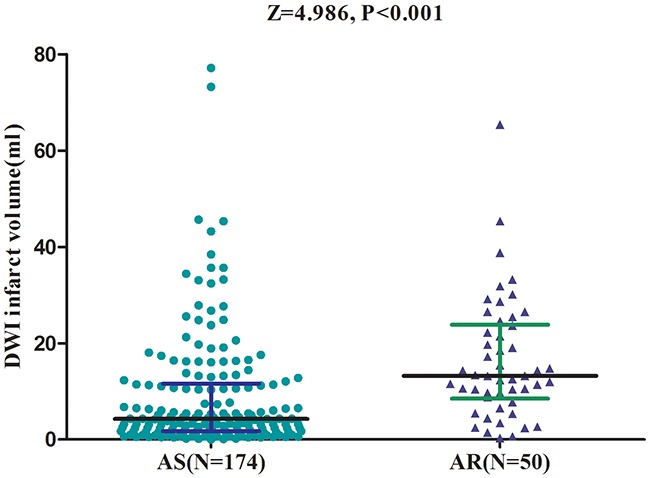
To explore the correlation of aspirin resistance (AR) with clinical stroke severity and infarct volume using diffusion-weighted imaging (DWI) in 224 Chinese ischemic stroke patients who were taking aspirin before stroke onset. In those patients, the median age was 64 years (IQR, 56-75 years), and males accounting for 54.9%(123)of the total subjects. Fifty of 224 enrolled patients (22.3%; 95% confidence interval (CI), 16.9% to 27.7%) showed AR. In the median regression model, significant increase was estimated in NIHSS score of 0.04 point for every 1-point increase in aspirin reaction units (ARU) (95% CI, 0.02 to 0.06; <0.001). Diffusion-weighted MRI (DWI)-measured infarct volume were significantly higher in patients with AR as compared with those with AS [13.21 (interquartile ranges [IQR], 8.51-23.88) .4.26 (IQR, 1.74-11.62); <0.001). Furthermore, a statistically significant increase was also measured in NIHSS score of 0.05 point for every 1-point increase in ARU in the median regression model (95% CI, 0.03 to 0.08; <0.001). The median DWI infarct volume was significantly larger in the highest ARU quartile when compared to that in the low 3 quartiles (P<0.001). In conclusion, stroke patients with AR indicated higher risk of severe strokes and large infarcts compared to patients in the aspirin-sensitive group.
在224例卒中发作前服用阿司匹林的中国缺血性卒中患者中,采用弥散加权成像(DWI)探讨阿司匹林抵抗(AR)与临床卒中严重程度及梗死体积的相关性。这些患者的中位年龄为64岁(四分位间距,56 - 75岁),男性占总研究对象的54.9%(123例)。224例纳入患者中,50例(22.3%;95%置信区间(CI),16.9%至27.7%)表现为AR。在中位数回归模型中,阿司匹林反应单位(ARU)每增加1分,美国国立卫生研究院卒中量表(NIHSS)评分显著增加0.04分(95% CI,0.02至0.06;<0.001)。与阿司匹林敏感(AS)患者相比,AR患者经弥散加权磁共振成像(DWI)测量的梗死体积显著更高[13.21(四分位间距[IQR],8.51 - 23.88)对4.26(IQR,1.74 - 11.62);<0.001]。此外,在中位数回归模型中,ARU每增加1分,NIHSS评分也有统计学意义的显著增加0.05分(95% CI,0.03至0.08;<0.001)。与低3个四分位数相比,ARU最高四分位数的DWI梗死体积中位数显著更大(P<0.001)。总之,与阿司匹林敏感组患者相比,AR的卒中患者发生严重卒中和大面积梗死的风险更高。