Wang Jue, Cao Bin, Gao Yan, Han Dong, Zhao Haiping, Chen Yuhua, Luo Yumin, Feng Juan, Guo Yanxia
Department of Neurology, Shengjing Hospital of China Medical University, Shenyang, China.
Institute of Cerebrovascular Diseases Research and Department of Neurology, Xuanwu Hospital of Capital Medical University, Shenyang, China.
Front Pharmacol. 2020 Sep 25;11:580783. doi: 10.3389/fphar.2020.580783. eCollection 2020.
Aspirin is a novel anti-platelet drug that is intensively recommended for the prevention and treatment of cerebral ischemic stroke. However, the existence of aspirin resistance weakens the effects of aspirin and usually induces the recurrence of ischemic stroke. While the mechanism underlying aspirin resistance is still unclear. Long non-coding RNA H19 (H19) is closely associated with the onset and prognosis of cerebral ischemic stroke. Since the relationship between H19 and aspirin resistance have never been reported, herein, we aimed to evaluate the H19 expression in aspirin-resistant ischemic stroke patients and subsequently, ascertain the ability of H19 to diagnose aspirin resistance.
We included 150 patients with acute cerebral ischemic stroke who were followed up for one year to determine stroke recurrence. Levels of 11-dehydro thromboxane B2 (11dhTXB2) in urine were tested to evaluate the status of aspirin resistance, and those of H19 and 8-iso-prostaglandin-2α in plasma were assessed. The relationship between 11dhTXB2 or and 8-iso-prostaglandin-2α and H19, and the receiver operating characteristic curve of H19, the association of H19 and aspirin resistance with the recurrence of stoke were statistically analyzed.
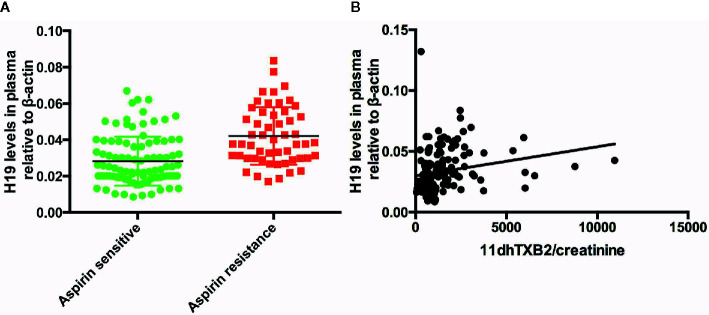
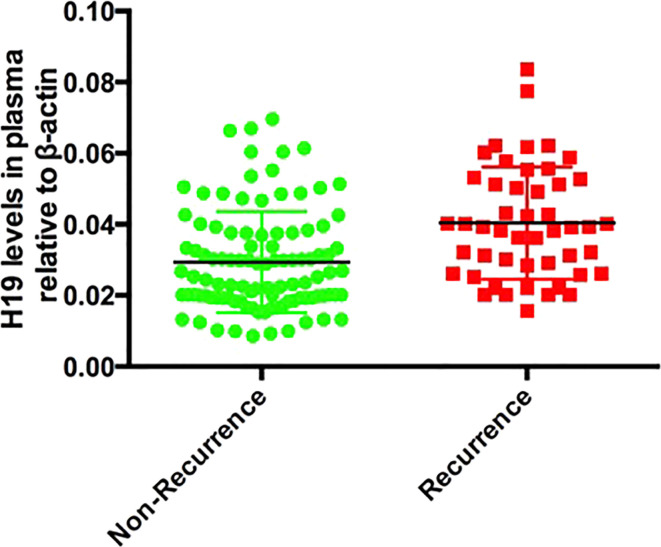
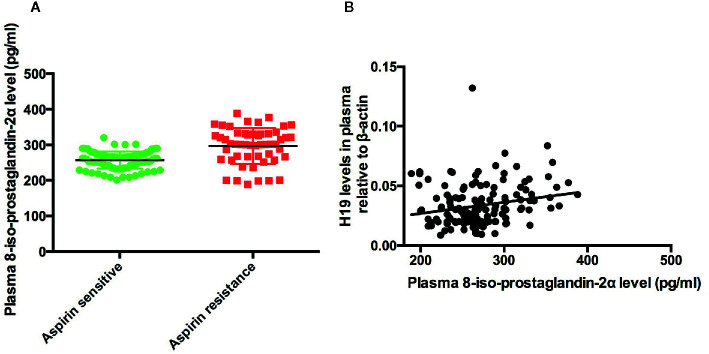
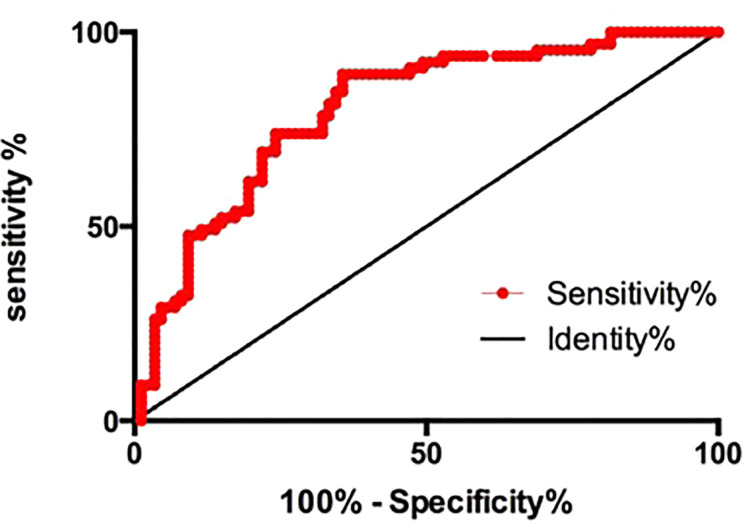
Plasma H19 was significantly up-regulated in patients with aspirin resistance (p=0.0203), and the H19 levels were positively associated with urine 11dhTXB2/creatinine (R=0.04364, p=0.0106) and positively associated with the level of 8-iso-PGF2α (R=0.04561, p=0.0089). The ROC curves indicated that H19 can sensitively and specifically diagnose aspirin resistance (area under the curve, 0.8005; 95% CI, 0.7301-0.8710; p < 0.0001; specificity, 75.86207%; sensitivity, 73.84615%.). H19 is an independent risk factor for aspirin resistance (OR=1.129, p=0.0321), and aspirin resistance and H19 are closely related with ischemic stroke recurrence.
H19 is closely associated with aspirin resistance, and H19 probably induces aspirin resistance through increasing the production of 8-iso-prostaglandin-2α. Besides which, H19 may serve as a serological marker for diagnosing aspirin resistance with high specificity and sensitivity, and the test of H19 could give clues to the recurrence of ischemic stroke.
阿司匹林是一种新型抗血小板药物,被强烈推荐用于预防和治疗脑缺血性中风。然而,阿司匹林抵抗的存在削弱了阿司匹林的疗效,并常常诱发缺血性中风复发。目前阿司匹林抵抗的潜在机制仍不清楚。长链非编码RNA H19(H19)与脑缺血性中风的发病及预后密切相关。由于H19与阿司匹林抵抗之间的关系此前从未被报道,因此,我们旨在评估阿司匹林抵抗的缺血性中风患者中H19的表达情况,并随后确定H19诊断阿司匹林抵抗的能力。
我们纳入了150例急性脑缺血性中风患者,对其进行为期一年的随访以确定中风复发情况。检测尿中11-脱氢血栓素B2(11dhTXB2)水平以评估阿司匹林抵抗状态,并评估血浆中H19和8-异前列腺素-2α水平。对11dhTXB2或8-异前列腺素-2α与H19之间的关系、H19的受试者工作特征曲线、H19及阿司匹林抵抗与中风复发的相关性进行统计学分析。
阿司匹林抵抗患者血浆H19显著上调(p=0.0203),且H19水平与尿11dhTXB2/肌酐呈正相关(R=0.04364,p=0.0106),与8-异前列腺素F2α水平呈正相关(R=0.04561,p=0.0089)。ROC曲线表明H19能够灵敏且特异诊断阿司匹林抵抗(曲线下面积,0.8005;95%CI,0.7301-0.8710;p<0.0001;特异性,75.86207%;敏感性,73.84615%)。H19是阿司匹林抵抗的独立危险因素(OR=1.129,p=0.0321),且阿司匹林抵抗和H19与缺血性中风复发密切相关。
H19与阿司匹林抵抗密切相关,且H19可能通过增加8-异前列腺素F2α的生成诱导阿司匹林抵抗。此外,H19可能作为一种具有高特异性和敏感性的诊断阿司匹林抵抗的血清学标志物,检测H19可为缺血性中风复发提供线索。