Skowronek Paweł, Olszewski Paweł, Święszkowski Wojciech, Sibiński Marcin, Synder Marek, Polguj Michał
Clinic of Orthopedic and Traumatology, Regional Hospital and Kochanowski Medical University, Kielce, Poland.
Faculty of Materials Science and Engineering, Warsaw University of Technology, Warsaw, Poland.
BMC Musculoskelet Disord. 2017 Nov 3;18(1):426. doi: 10.1186/s12891-017-1784-x.
The aim of the study was to evaluate the potential consequences of drilling titanium alloy (Ti) and tantalum (Ta) implants.
During an in vitro study, four holes were made in each of two spatially porous trabecular implants: one Ta and the other Ti alloy (Ti-6Al-7Nb). The weight and the volume of particles produced during the drilling were then measured using a Radwag XA 110/2X (USA) laboratory balance.
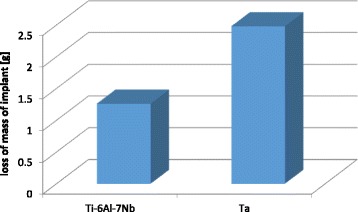
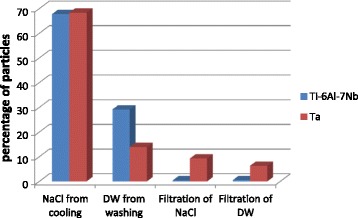
The loss of mass of the Ti and Ta implants was respectively 1.26 g and 2.48 g, and the volume of free particles was respectively 280 mm and 149 mm. The particles were recovered after each stage. Despite the use of 5 μm filters, around 0.6% of the total implant mass from both implants was not recovered after drilling (roughly 2% of the mass of the particles created).
It is technically difficult to make holes in Ti and Ta implants using standard surgical tools, and the process creates a significant amount of metal particles which cannot be removed, despite intensive flushing. This may have a potentially adverse influence on the survival of the implant and result in negative systemic consequences.
本研究的目的是评估钻削钛合金(Ti)和钽(Ta)植入物的潜在后果。
在一项体外研究中,对两个具有空间多孔结构的小梁植入物分别钻四个孔:一个是钽植入物,另一个是钛合金(Ti-6Al-7Nb)植入物。然后使用美国Radwag XA 110/2X实验室天平测量钻削过程中产生的颗粒的重量和体积。
Ti和Ta植入物的质量损失分别为1.26 g和2.48 g,游离颗粒的体积分别为280 mm³和149 mm³。在每个阶段后都回收了颗粒。尽管使用了5μm的过滤器,但钻削后仍有大约0.6%的两个植入物的总植入物质量未被回收(大约是所产生颗粒质量的2%)。
使用标准手术工具在Ti和Ta植入物上钻孔在技术上具有难度,并且该过程会产生大量无法去除的金属颗粒,尽管进行了强力冲洗。这可能会对植入物的存活产生潜在的不利影响,并导致负面的全身后果。