Yamakado Minoru, Tanaka Takayuki, Nagao Kenji, Imaizumi Akira, Komatsu Michiharu, Daimon Takashi, Miyano Hiroshi, Tani Mizuki, Toda Akiko, Yamamoto Hiroshi, Horimoto Katsuhisa, Ishizaka Yuko
Center for Multiphasic Health Testing and Services, Mitsui Memorial Hospital, 1 Kanda, Izumicho, Chiyoda-ku, Tokyo, 101-8643, Japan.
Institute for Innovation, Ajinomoto Co., Inc., 1-1 Suzuki-cho, Kawasaki-ku, Kawasaki, 210-8681, Japan.
Sci Rep. 2017 Nov 3;7(1):14485. doi: 10.1038/s41598-017-14974-w.
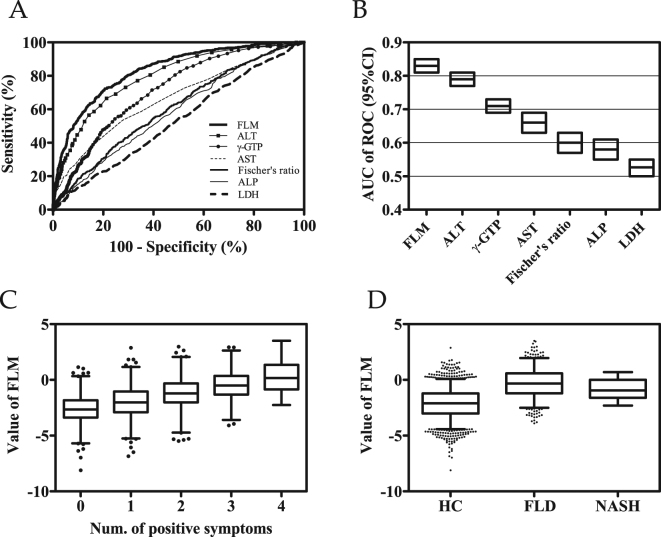
Fatty liver disease (FLD) increases the risk of diabetes, cardiovascular disease, and steatohepatitis, which leads to fibrosis, cirrhosis, and hepatocellular carcinoma. Thus, the early detection of FLD is necessary. We aimed to find a quantitative and feasible model for discriminating the FLD, based on plasma free amino acid (PFAA) profiles. We constructed models of the relationship between PFAA levels in 2,000 generally healthy Japanese subjects and the diagnosis of FLD by abdominal ultrasound scan by multiple logistic regression analysis with variable selection. The performance of these models for FLD discrimination was validated using an independent data set of 2,160 subjects. The generated PFAA-based model was able to identify FLD patients. The area under the receiver operating characteristic curve for the model was 0.83, which was higher than those of other existing liver function-associated markers ranging from 0.53 to 0.80. The value of the linear discriminant in the model yielded the adjusted odds ratio (with 95% confidence intervals) for a 1 standard deviation increase of 2.63 (2.14-3.25) in the multiple logistic regression analysis with known liver function-associated covariates. Interestingly, the linear discriminant values were significantly associated with the progression of FLD, and patients with nonalcoholic steatohepatitis also exhibited higher values.
脂肪肝疾病(FLD)会增加患糖尿病、心血管疾病和脂肪性肝炎的风险,而脂肪性肝炎会导致纤维化、肝硬化和肝细胞癌。因此,早期检测FLD很有必要。我们旨在基于血浆游离氨基酸(PFAA)谱找到一种定量且可行的鉴别FLD的模型。我们通过变量选择的多元逻辑回归分析,构建了2000名一般健康的日本受试者的PFAA水平与腹部超声扫描诊断FLD之间的关系模型。使用2160名受试者的独立数据集验证了这些模型对FLD鉴别的性能。所生成的基于PFAA的模型能够识别FLD患者。该模型的受试者操作特征曲线下面积为0.83,高于其他现有肝功能相关标志物的曲线下面积,后者范围为0.53至0.80。在已知肝功能相关协变量的多元逻辑回归分析中,模型中线性判别值每增加1个标准差,调整后的优势比(95%置信区间)为2.63(2.14 - 3.25)。有趣的是,线性判别值与FLD的进展显著相关,非酒精性脂肪性肝炎患者的线性判别值也更高。