Levine J D, Gordon N C, Bornstein J C, Fields H L
Proc Natl Acad Sci U S A. 1979 Jul;76(7):3528-31. doi: 10.1073/pnas.76.7.3528.
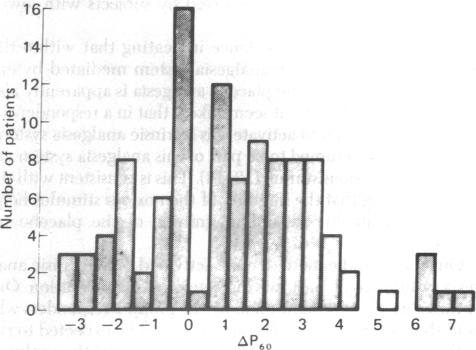
The hypothesis that perceived pain intensity can influence placebo analgesia was tested. One hundred and seven subjects rated their pain from from 0 to 10 on a visual analog scale after a standard wisdom tooth extraction. The expected course of such postoperative pain in the absence of therapy or placebo is a steady increase; this was confirmed by blind administration of the placebo. When placebos were given intravenously in view of the patients, some (placebo nonresponders) reported that their pain increased, whereas others (placebo responders) reported that their pain either decreased or remained the same over the next 60 min. A placebo response was more likely to occur if the pain rating 5 min prior to placebo administration (initial pain) was greater than 2.6. Furthermore, placebo responders with initial pain above this 2.6 level reported significantly greater mean analgesia than those with lower initial pain. Indeed, responders with initial pain less than 2.6 reported no change in pain during the 60 min after administration of a placebo. When their initial pain level was greater than 2.6, they reported a steady decline in pain over this period. However, above the 2.6 level there was no obvious relationship between the magnitude of the placebo analgesia and the initial pain.
关于感知疼痛强度会影响安慰剂镇痛效果的假说得到了验证。107名受试者在接受标准智齿拔除术后,通过视觉模拟量表对自己的疼痛程度从0到10进行评分。在没有治疗或安慰剂的情况下,这种术后疼痛的预期过程是持续加剧;这一点通过安慰剂的盲法给药得到了证实。当在患者可视的情况下静脉注射安慰剂时,一些人(安慰剂无反应者)报告称他们的疼痛加剧,而另一些人(安慰剂反应者)报告称在接下来的60分钟内他们的疼痛减轻或保持不变。如果在给予安慰剂前5分钟的疼痛评分(初始疼痛)大于2.6,则更有可能出现安慰剂反应。此外,初始疼痛高于2.6这个水平的安慰剂反应者报告的平均镇痛效果明显大于初始疼痛较低的反应者。事实上,初始疼痛小于2.6的反应者在给予安慰剂后的60分钟内报告疼痛没有变化。当他们的初始疼痛水平大于2.6时,他们报告在此期间疼痛持续减轻。然而,在2.6这个水平以上,安慰剂镇痛效果的大小与初始疼痛之间没有明显的关系。