Lu Yifan, Jiang Lu, Li Wanlu, Qu Meijie, Song Yaying, He Xiaosong, Zhang Zhijun, Yang Guo-Yuan, Wang Yongting
Neuroscience and Neuroengineering Research Center, Med-X Research Institute and School of Biomedical Engineering, Shanghai Jiao Tong University, Shanghai, China.
Department of Neurology, Ruijin Hospital, School of Medicine, Shanghai Jiao Tong University, Shanghai 200030, China.
Stem Cells Int. 2017;2017:4364302. doi: 10.1155/2017/4364302. Epub 2017 Sep 14.
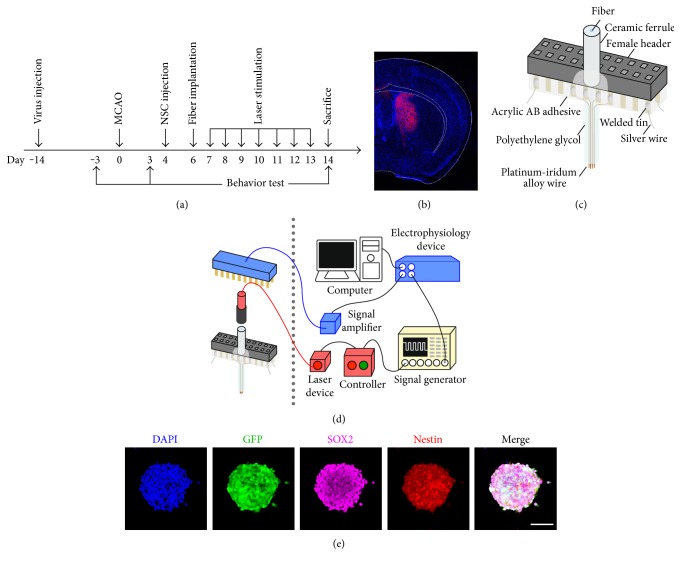
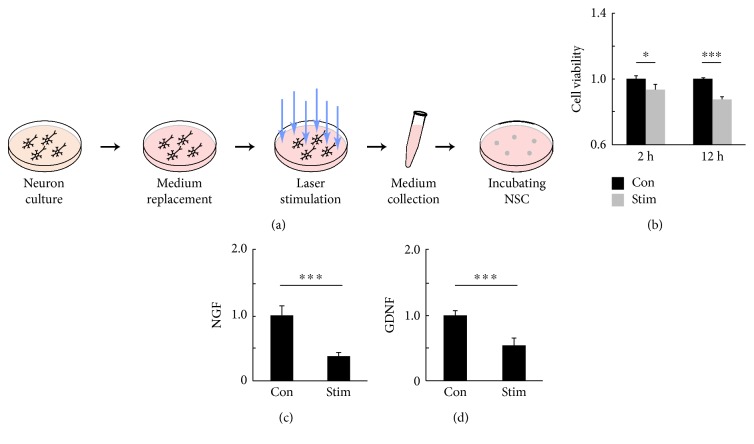
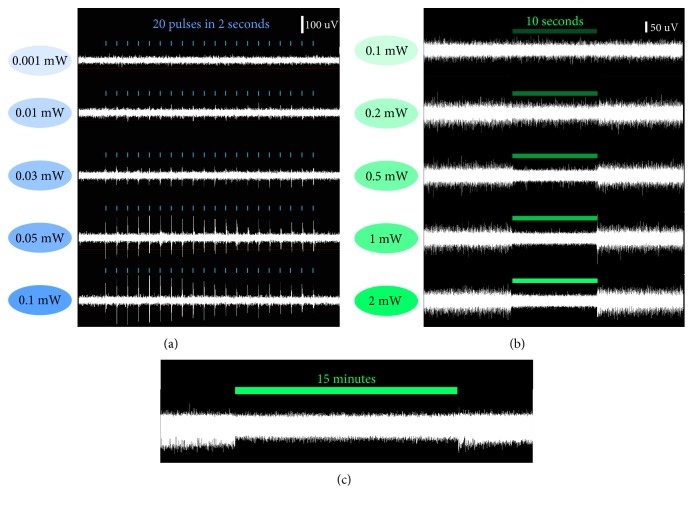
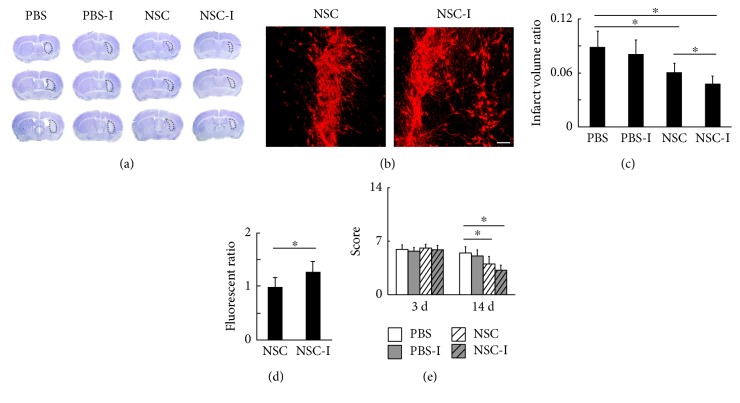
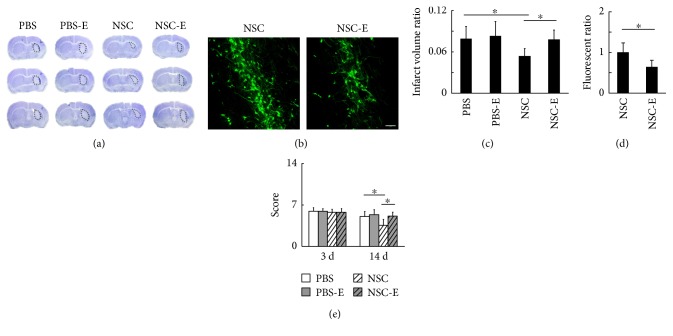
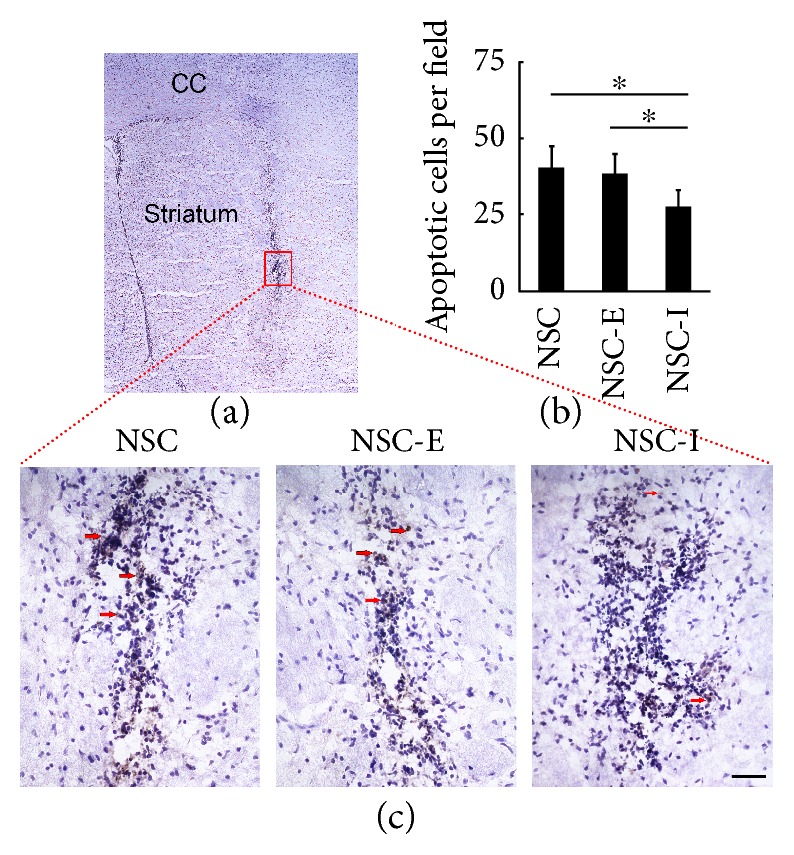
Neural stem cell (NSC) transplantation is a promising treatment to improve the recovery after brain ischemia. However, how the survival, proliferation, migration, and differentiation of implanted NSC are influenced by endogenous neuronal activity remains unclear. In this work, we used optogenetic techniques to control the activity of striatal neurons and investigated how their activity affected the survival and migration of transplanted NSCs and overall neurological outcome after ischemic stroke. NSCs cultured from transgenic mice expressing fluorescent protein were transplanted into the peri-infarct region of the striatum after transient middle cerebral artery occlusion (tMCAO) surgery. The striatal neurons were excited or inhibited for 15 minutes daily via implanted optical fiber after tMCAO. The results revealed that mice which received NSC transplantation and optogenetic inhibition had smaller brain infarct volume and increased NSC migration compared to the NSC alone or PBS group ( < 0.05). In contrast, mice which received NSC transplantation and optogenetic excitation showed no difference in infarct volume and neurological behavior improvement compared to the PBS control group. In vitro experiments further revealed that the conditioned media from excited GABAergic neurons reduced NSC viability through paracrine mechanisms. . Optogenetic inhibition of striatal neuronal activity further improved neurological recovery after NSC transplantation at the subacute phase after brain ischemia.
神经干细胞(NSC)移植是一种有望改善脑缺血后恢复情况的治疗方法。然而,植入的神经干细胞的存活、增殖、迁移和分化如何受内源性神经元活动影响仍不清楚。在这项研究中,我们使用光遗传学技术来控制纹状体神经元的活动,并研究其活动如何影响移植神经干细胞的存活和迁移以及缺血性中风后的整体神经功能结局。在短暂性大脑中动脉闭塞(tMCAO)手术后,将从表达荧光蛋白的转基因小鼠培养的神经干细胞移植到纹状体的梗死周边区域。在tMCAO后,通过植入的光纤每天对纹状体神经元进行15分钟的兴奋或抑制。结果显示,与单独移植神经干细胞组或磷酸盐缓冲盐水(PBS)组相比,接受神经干细胞移植和光遗传学抑制的小鼠脑梗死体积更小,神经干细胞迁移增加(P<0.05)。相反,与PBS对照组相比,接受神经干细胞移植和光遗传学兴奋的小鼠在梗死体积和神经行为改善方面没有差异。体外实验进一步表明,兴奋的γ-氨基丁酸能神经元的条件培养基通过旁分泌机制降低神经干细胞活力。脑缺血亚急性期,光遗传学抑制纹状体神经元活动可进一步改善神经干细胞移植后的神经功能恢复。