Department of Biological Sciences andChronic Pain Research Consortium, Duquesne University, Pittsburgh, PA.
Department of Chemistry and Chemical Biology.
Mol Pain. 2017 Jan-Dec;13:1744806917743479. doi: 10.1177/1744806917743479.
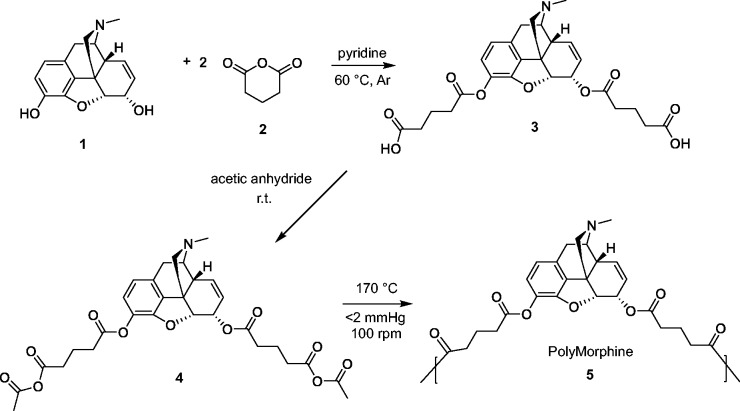
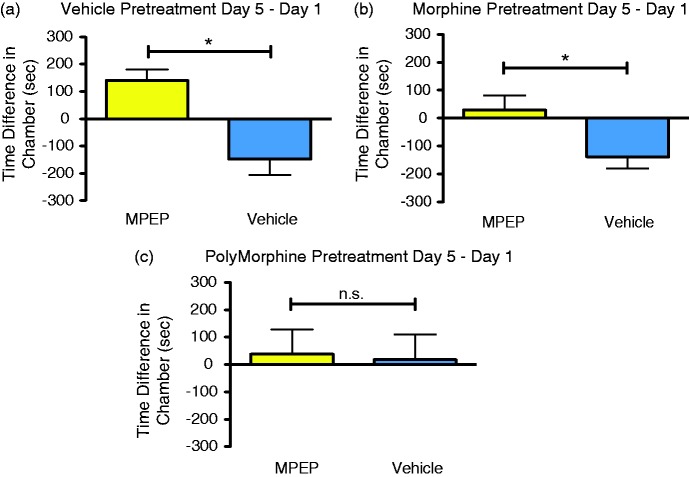
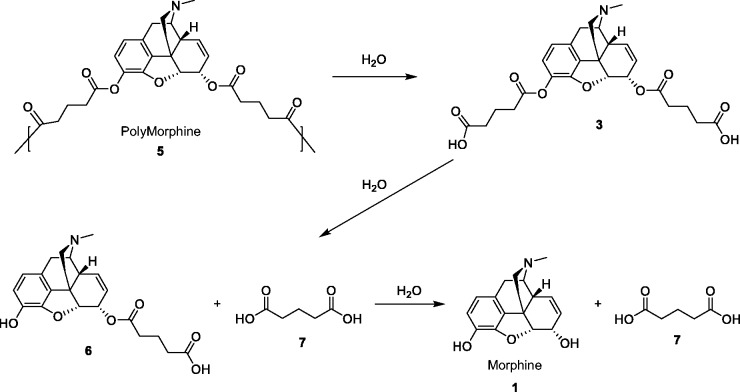
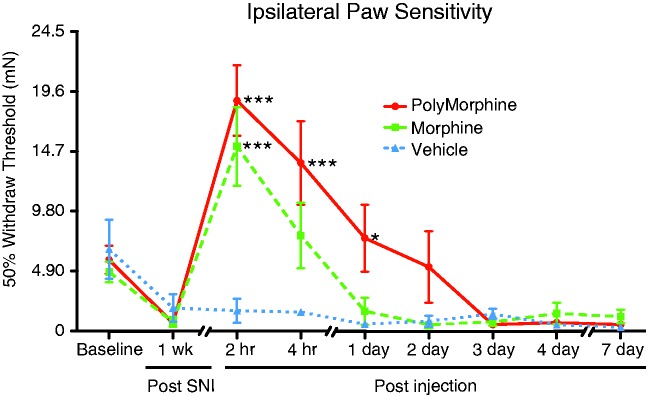
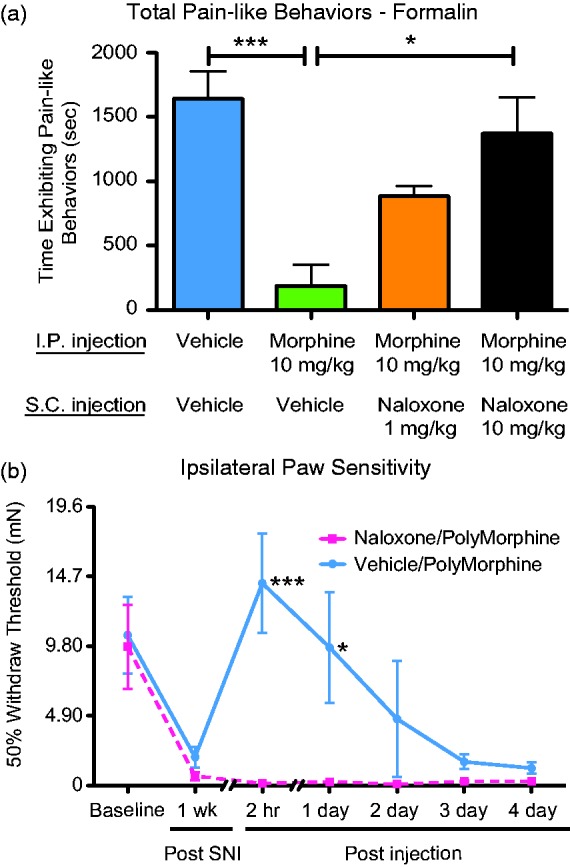
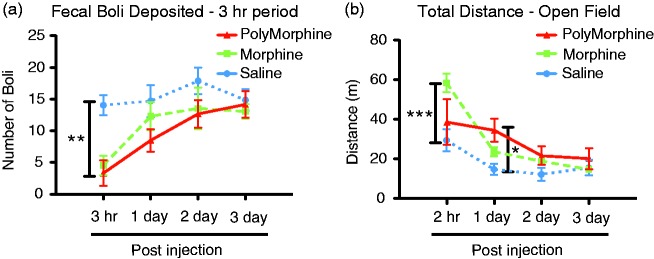
Morphine is a well-characterized and effective analgesic commonly used to provide pain relief to patients suffering from both acute and chronic pain conditions. Despite its widespread use and effectiveness, one of the major drawbacks of morphine is its relatively short half-life of approximately 4 h. This short half-life often necessitates multiple administrations of the drug each day, which may contribute to both dependence and tolerance to morphine. Here, we tested the analgesic properties of a new polymer form of morphine known as PolyMorphine. This polymer has monomeric units of morphine incorporated into a poly(anhydride-ester) backbone that has been shown to hydrolyze into free morphine in vitro. Using an animal model of chronic pain, the spared nerve injury surgery, we showed that PolyMorphine is able to block spared nerve injury-induced hypersensitivity in mice for up to 24-h post-administration. Free morphine was shown to only block spared nerve injury-induced hypersensitivity for up to 2-h post-injection. PolyMorphine was also shown to act through the mu opioid receptor due to the ability of naloxone (a mu opioid receptor antagonist) to block PolyMorphine-induced analgesia in spared nerve injury animals pretreated with PolyMorphine. Additionally, we observed that PolyMorphine causes similar locomotor and constipation side effects as free morphine. Finally, we investigated if PolyMorphine had any effects in a non-evoked pain assay, conditioned place preference. Pretreatment of spared nerve injury mice with PolyMorphine blocked the development of conditioned place preference for 2-methyl-6-(phenylethynyl)pyridine (MPEP), a short-lasting mGluR5 antagonist with analgesic-like properties. Free morphine does not block the development of preference for MPEP, suggesting that PolyMorphine has longer lasting analgesic effects compared to free morphine. Together, these data show that PolyMorphine has the potential to provide analgesia for significantly longer than free morphine while likely working through the same receptor.
吗啡是一种特征明确且有效的镇痛药,常用于缓解急性和慢性疼痛患者的疼痛。尽管吗啡应用广泛且有效,但它的主要缺点之一是半衰期相对较短,约为 4 小时。这种较短的半衰期通常需要每天多次给药,这可能导致对吗啡的依赖和耐受。在这里,我们测试了一种新的吗啡聚合物形式——聚吗啡的镇痛特性。这种聚合物的单体单元是吗啡,嵌入到一种已证明在体外可水解成游离吗啡的聚(酸酐-酯)主链中。使用慢性疼痛动物模型—— spared nerve injury surgery( spared nerve injury 手术),我们表明聚吗啡能够阻断 spared nerve injury-induced hypersensitivity( spared nerve injury 诱导的过敏)长达给药后 24 小时。游离吗啡仅能阻断 spared nerve injury 诱导的过敏长达注射后 2 小时。由于纳洛酮(一种 mu 阿片受体拮抗剂)能够阻断预处理过聚吗啡的 spared nerve injury 动物中聚吗啡诱导的镇痛作用,因此聚吗啡也被证明是通过 mu 阿片受体起作用的。此外,我们观察到聚吗啡引起的运动和便秘副作用与游离吗啡相似。最后,我们研究了聚吗啡在非诱发疼痛测定——条件性位置偏爱中是否有任何作用。预处理 spared nerve injury 小鼠的聚吗啡阻断了 2-甲基-6-(苯乙炔基)吡啶(MPEP)的条件性位置偏爱( conditioned place preference )的发展,MPEP 是一种具有镇痛样特性的短半衰期 mGluR5 拮抗剂。游离吗啡不能阻断对 MPEP 的偏好的发展,这表明聚吗啡的镇痛作用比游离吗啡持续时间更长。总之,这些数据表明,聚吗啡有可能提供比游离吗啡更长时间的镇痛作用,而可能通过相同的受体起作用。