Department of Chemistry and Chemical Biology, Harvard University, Cambridge, MA 02138.
John A. Paulson School of Engineering and Applied Sciences, Harvard University, Cambridge, MA 02138.
Proc Natl Acad Sci U S A. 2017 Nov 21;114(47):E10046-E10055. doi: 10.1073/pnas.1717695114. Epub 2017 Nov 6.
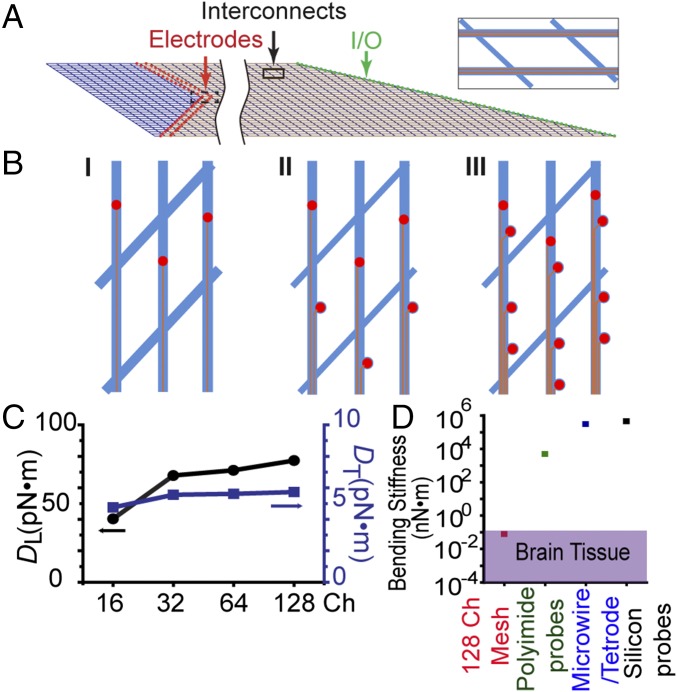
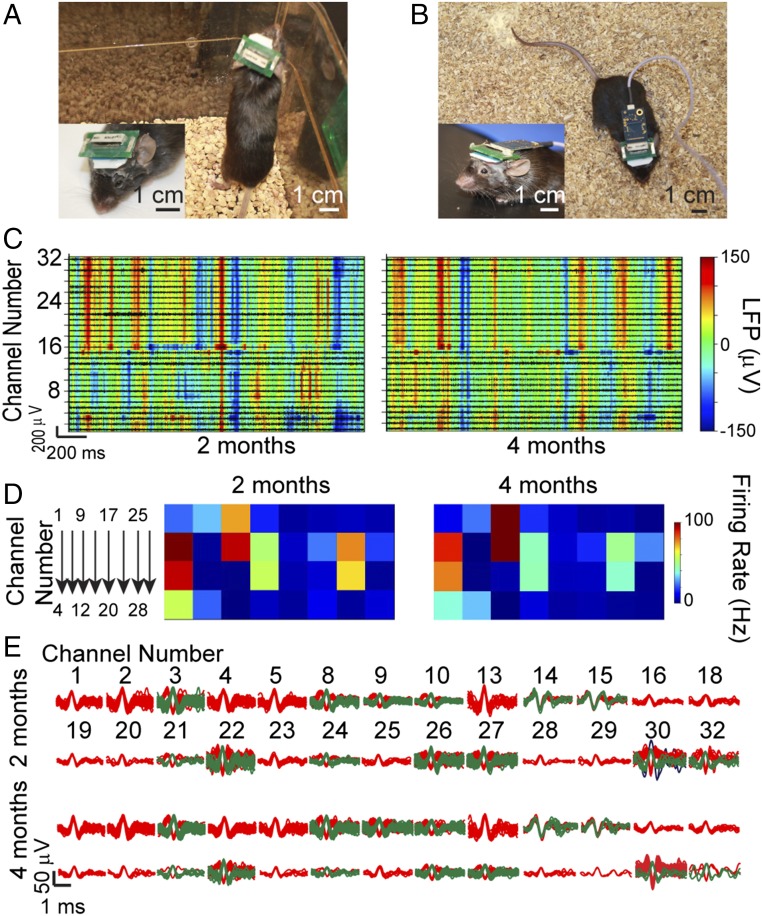
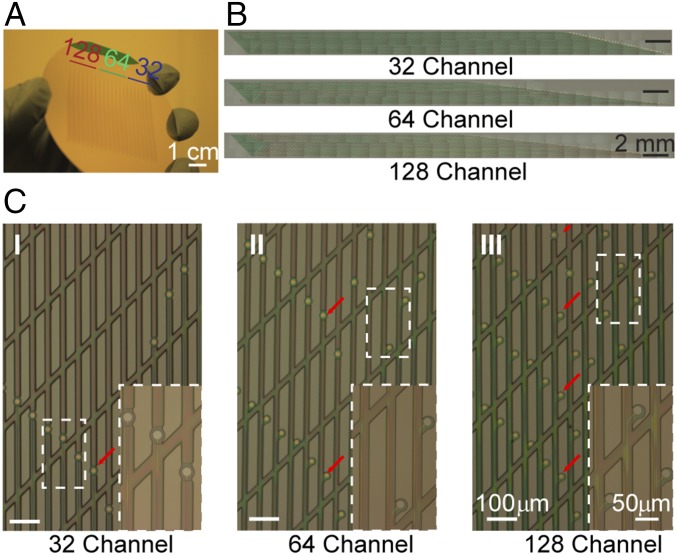
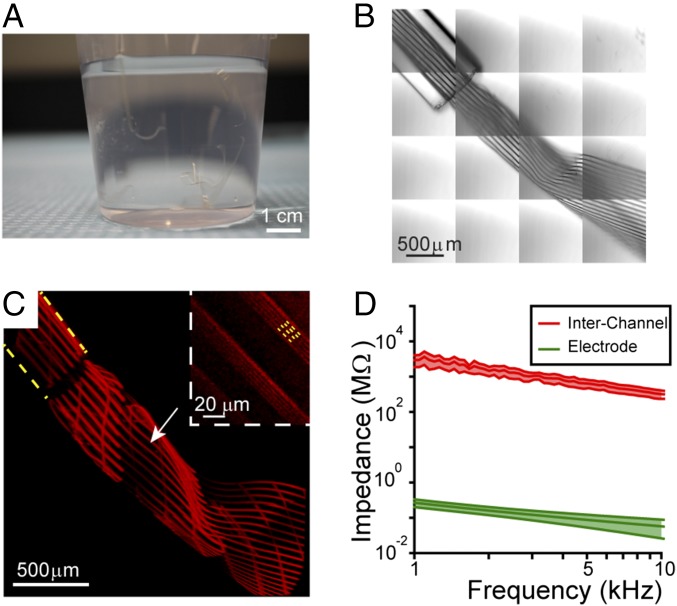
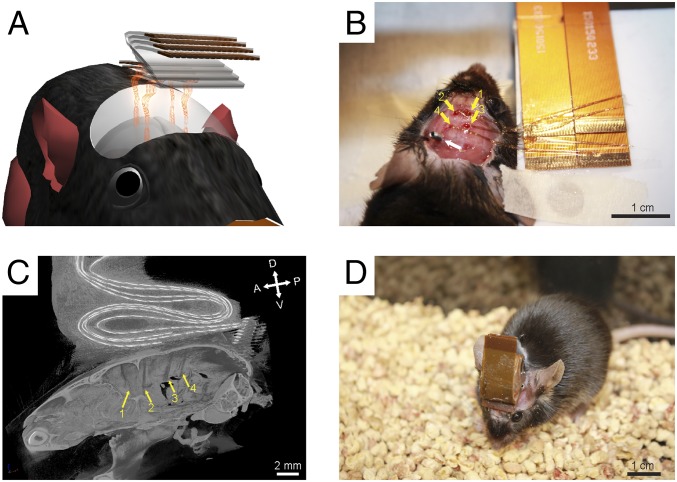
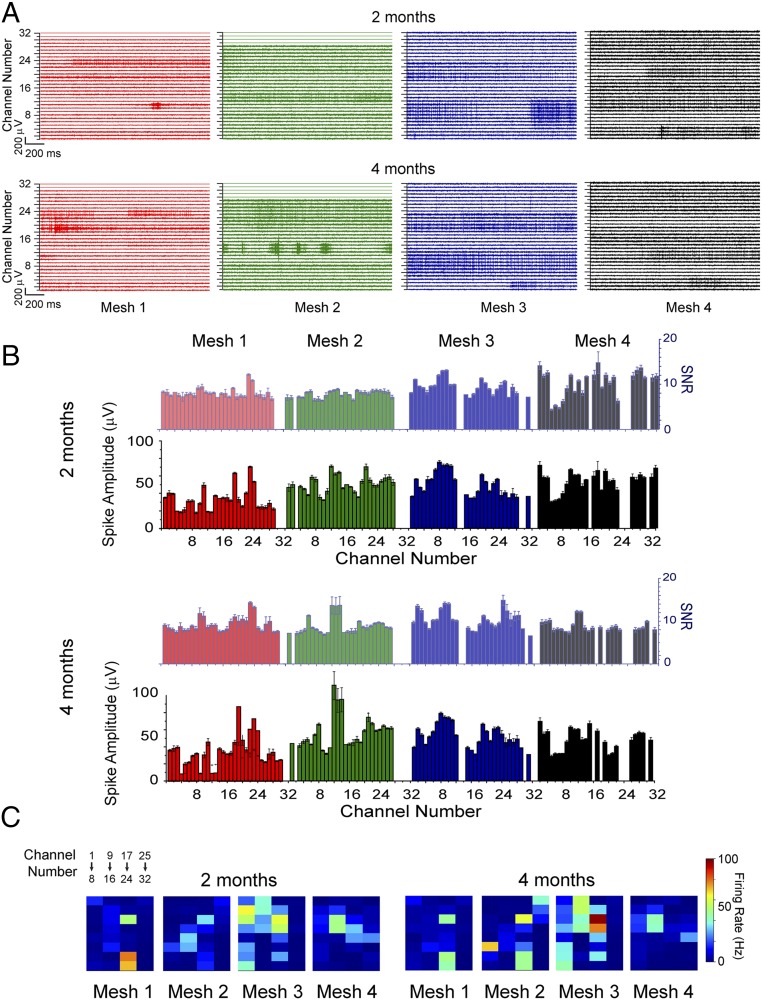
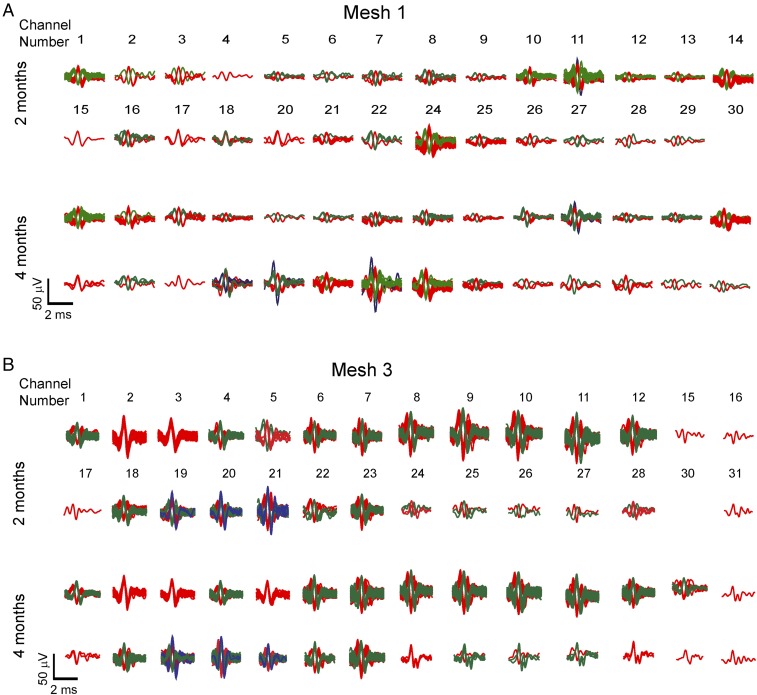
Implantable electrical probes have led to advances in neuroscience, brain-machine interfaces, and treatment of neurological diseases, yet they remain limited in several key aspects. Ideally, an electrical probe should be capable of recording from large numbers of neurons across multiple local circuits and, importantly, allow stable tracking of the evolution of these neurons over the entire course of study. Silicon probes based on microfabrication can yield large-scale, high-density recording but face challenges of chronic gliosis and instability due to mechanical and structural mismatch with the brain. Ultraflexible mesh electronics, on the other hand, have demonstrated negligible chronic immune response and stable long-term brain monitoring at single-neuron level, although, to date, it has been limited to 16 channels. Here, we present a scalable scheme for highly multiplexed mesh electronics probes to bridge the gap between scalability and flexibility, where 32 to 128 channels per probe were implemented while the crucial brain-like structure and mechanics were maintained. Combining this mesh design with multisite injection, we demonstrate stable 128-channel local field potential and single-unit recordings from multiple brain regions in awake restrained mice over 4 mo. In addition, the newly integrated mesh is used to validate stable chronic recordings in freely behaving mice. This scalable scheme for mesh electronics together with demonstrated long-term stability represent important progress toward the realization of ideal implantable electrical probes allowing for mapping and tracking single-neuron level circuit changes associated with learning, aging, and neurodegenerative diseases.
植入式电子探针在神经科学、脑机接口和神经疾病治疗方面取得了进展,但在几个关键方面仍存在局限性。理想情况下,电子探针应该能够在多个局部回路中记录大量神经元,并且重要的是,允许在整个研究过程中稳定跟踪这些神经元的演变。基于微制造的硅探针可以实现大规模、高密度的记录,但由于与大脑的机械和结构不匹配,面临慢性神经胶质增生和不稳定性的挑战。另一方面,超柔软的网格电子产品具有可忽略的慢性免疫反应和稳定的长期单神经元水平的大脑监测能力,尽管迄今为止,它仅限于 16 个通道。在这里,我们提出了一种可扩展的方案,用于高度复用的网格电子产品探针,以弥合可扩展性和灵活性之间的差距,其中每个探针实现 32 到 128 个通道,同时保持关键的类脑结构和力学。将这种网格设计与多部位注射相结合,我们在清醒束缚的小鼠中展示了长达 4 个月的稳定的 128 通道局部场电位和单个单元记录,来自多个大脑区域。此外,新集成的网格用于验证自由行为小鼠中的稳定慢性记录。这种可扩展的网格电子产品方案以及展示的长期稳定性代表了朝着实现理想的植入式电子探针迈出的重要一步,该探针允许映射和跟踪与学习、衰老和神经退行性疾病相关的单神经元水平的电路变化。