Central Saint Martins College of Arts and Design, University of Arts London, Granary Building, London, N1C 4AA, UK.
Department of Life Sciences, Imperial College London, Sir Ernst Chain Building - Wolfson Laboratories, South Kensington Campus, London, SW7 2AZ, UK.
Nat Commun. 2017 Nov 6;8(1):1327. doi: 10.1038/s41467-017-01084-4.
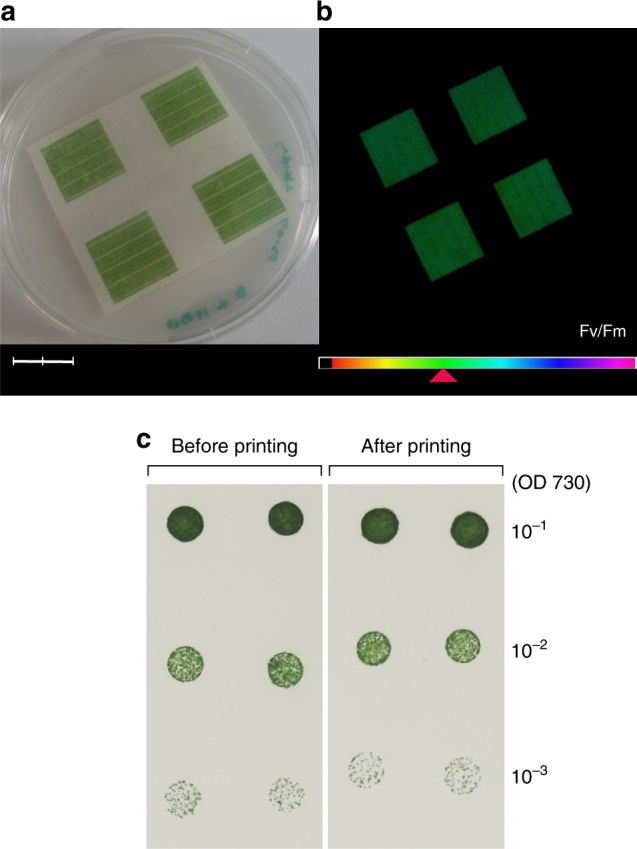
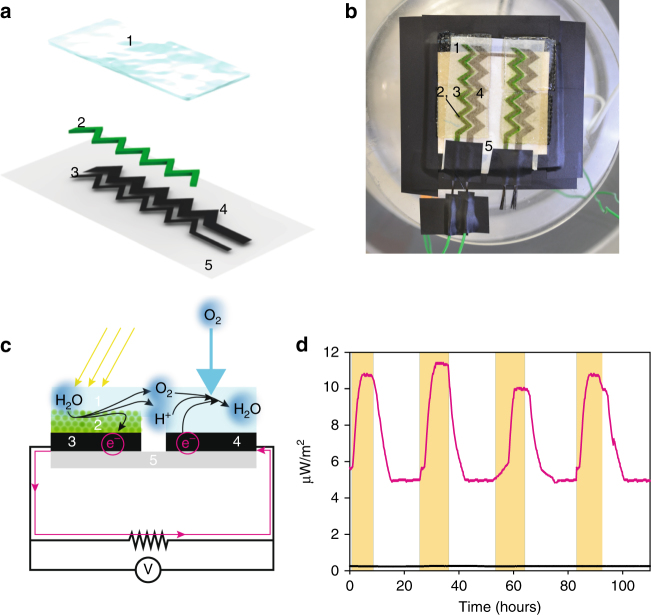
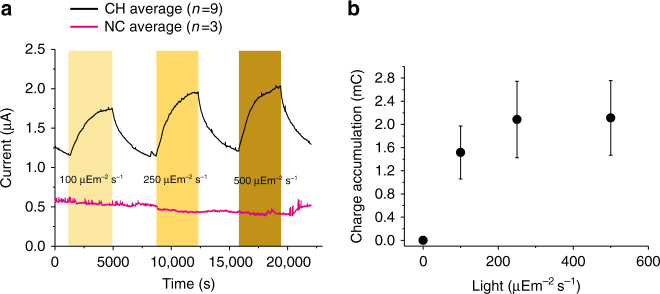
Microbial biophotovoltaic cells exploit the ability of cyanobacteria and microalgae to convert light energy into electrical current using water as the source of electrons. Such bioelectrochemical systems have a clear advantage over more conventional microbial fuel cells which require the input of organic carbon for microbial growth. However, innovative approaches are needed to address scale-up issues associated with the fabrication of the inorganic (electrodes) and biological (microbe) parts of the biophotovoltaic device. Here we demonstrate the feasibility of using a simple commercial inkjet printer to fabricate a thin-film paper-based biophotovoltaic cell consisting of a layer of cyanobacterial cells on top of a carbon nanotube conducting surface. We show that these printed cyanobacteria are capable of generating a sustained electrical current both in the dark (as a 'solar bio-battery') and in response to light (as a 'bio-solar-panel') with potential applications in low-power devices.
微生物生物光伏电池利用蓝藻和微藻将光能转化为电流的能力,用水作为电子的来源。与更传统的微生物燃料电池相比,这种生物电化学系统具有明显的优势,因为后者需要输入有机碳来促进微生物生长。然而,需要创新的方法来解决与生物光伏器件的无机(电极)和生物(微生物)部分制造相关的规模化问题。在这里,我们展示了使用简单的商业喷墨打印机来制造由一层蓝藻细胞覆盖在碳纳米管导电表面上的薄膜纸基生物光伏电池的可行性。我们表明,这些打印的蓝藻能够在黑暗中(作为“太阳能生物电池”)和响应光时(作为“生物太阳能电池板”)持续产生电流,在低功率设备中有潜在的应用。