Abdel-Haleem Alyaa M, Lewis Nathan E, Jamshidi Neema, Mineta Katsuhiko, Gao Xin, Gojobori Takashi
King Abdullah University of Science and Technology (KAUST), Computational Bioscience Research Centre (CBRC), Thuwal, Saudi Arabia.
King Abdullah University of Science and Technology (KAUST), Biological and Environmental Sciences and Engineering (BESE) Division, Thuwal, Saudi Arabia.
Front Endocrinol (Lausanne). 2017 Oct 23;8:279. doi: 10.3389/fendo.2017.00279. eCollection 2017.
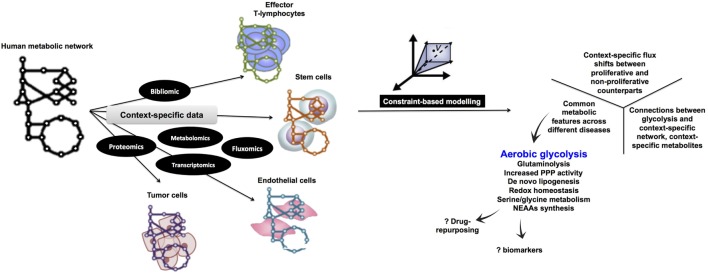
The Warburg effect (WE), or aerobic glycolysis, is commonly recognized as a hallmark of cancer and has been extensively studied for potential anti-cancer therapeutics development. Beyond cancer, the WE plays an important role in many other cell types involved in immunity, angiogenesis, pluripotency, and infection by pathogens (e.g., malaria). Here, we review the WE in non-cancerous context as a "hallmark of rapid proliferation." We observe that the WE operates in rapidly dividing cells in normal and pathological states that are triggered by internal and external cues. Aerobic glycolysis is also the preferred metabolic program in the cases when robust transient responses are needed. We aim to draw attention to the potential of computational modeling approaches in systematic characterization of common metabolic features beyond the WE across physiological and pathological conditions. Identification of metabolic commonalities across various diseases may lead to successful repurposing of drugs and biomarkers.
瓦伯格效应(WE),即有氧糖酵解,通常被认为是癌症的一个标志,并且已经针对潜在的抗癌治疗药物开发进行了广泛研究。除癌症外,WE在参与免疫、血管生成、多能性以及病原体感染(如疟疾)的许多其他细胞类型中也发挥着重要作用。在此,我们将非癌背景下的WE作为“快速增殖的标志”进行综述。我们观察到,WE在由内部和外部信号触发的正常和病理状态下快速分裂的细胞中起作用。在需要强大的瞬时反应的情况下,有氧糖酵解也是首选的代谢程序。我们旨在提请注意计算建模方法在系统表征跨越生理和病理条件的WE之外的常见代谢特征方面的潜力。识别各种疾病中的代谢共性可能会成功实现药物和生物标志物的重新利用。