Cancer Research Center, Sanford Burnham Prebys Medical Discovery Institute, La Jolla, CA, 92037, USA.
Laboratory of Cancer Biology, Institute of Biomedicine and Translational Medicine, University of Tartu, Tartu, 50411, Estonia.
Nat Commun. 2017 Nov 10;8(1):1403. doi: 10.1038/s41467-017-01096-0.
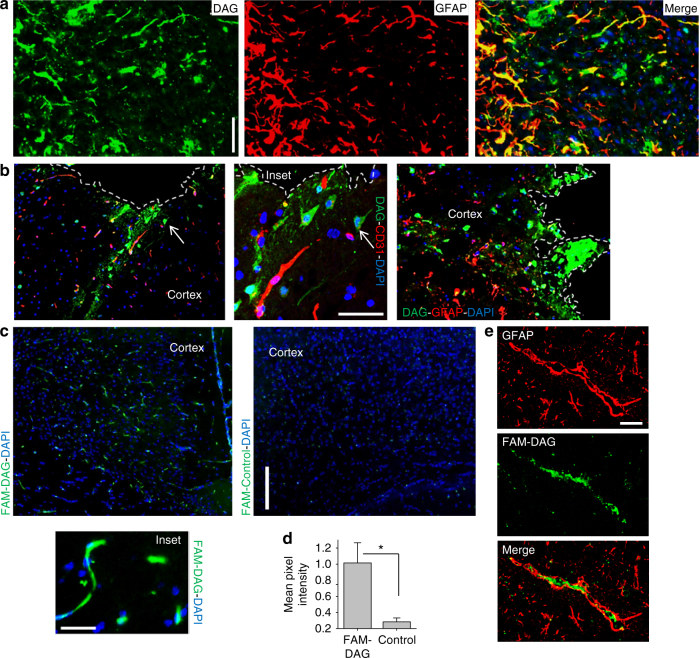
Cerebrovascular changes occur in Alzheimer's disease (AD). Using in vivo phage display, we searched for molecular markers of the neurovascular unit, including endothelial cells and astrocytes, in mouse models of AD. We identified a cyclic peptide, CDAGRKQKC (DAG), that accumulates in the hippocampus of hAPP-J20 mice at different ages. Intravenously injected DAG peptide homes to neurovascular unit endothelial cells and to reactive astrocytes in mouse models of AD. We identified connective tissue growth factor (CTGF), a matricellular protein that is highly expressed in the brain of individuals with AD and in mouse models, as the target of the DAG peptide. We also showed that exogenously delivered DAG homes to the brain in mouse models of glioblastoma, traumatic brain injury, and Parkinson's disease. DAG may potentially be used as a tool to enhance delivery of therapeutics and imaging agents to sites of vascular changes and astrogliosis in diseases associated with neuroinflammation.
脑血管变化发生在阿尔茨海默病(AD)中。我们使用体内噬菌体展示技术,在 AD 的小鼠模型中寻找神经血管单元的分子标志物,包括内皮细胞和星形胶质细胞。我们鉴定出一种环状肽 CDAGRKQKC(DAG),它在不同年龄的 hAPP-J20 小鼠的海马体中积累。静脉注射的 DAG 肽可归巢到 AD 小鼠模型中的神经血管单元内皮细胞和反应性星形胶质细胞。我们鉴定出结缔组织生长因子(CTGF)是 DAG 肽的靶标,CTGF 是一种基质细胞蛋白,在 AD 患者和小鼠模型的大脑中高度表达。我们还表明,外源性 DAG 可递送至神经胶质母细胞瘤、创伤性脑损伤和帕金森病的小鼠模型的大脑中。DAG 可能有望被用作一种工具,以增强递送到与神经炎症相关的血管变化和星形胶质细胞增生部位的治疗药物和成像剂。