Reijgwart Marsinah L, Schoemaker Nico J, Pascuzzo Riccardo, Leach Matthew C, Stodel Melanie, de Nies Loes, Hendriksen Coenraad F M, van der Meer Miriam, Vinke Claudia M, van Zeeland Yvonne R A
Animal Research Centre, Institute for Translational Vaccinology (Intravacc), Bilthoven, The Netherlands.
Department of Animals in Science & Society, Faculty of Veterinary Medicine, Utrecht University, Utrecht, The Netherlands.
PLoS One. 2017 Nov 13;12(11):e0187986. doi: 10.1371/journal.pone.0187986. eCollection 2017.
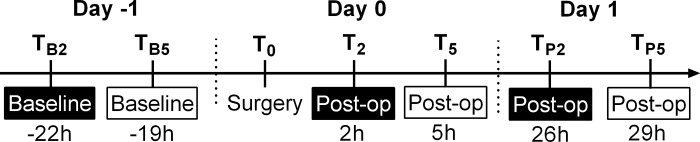
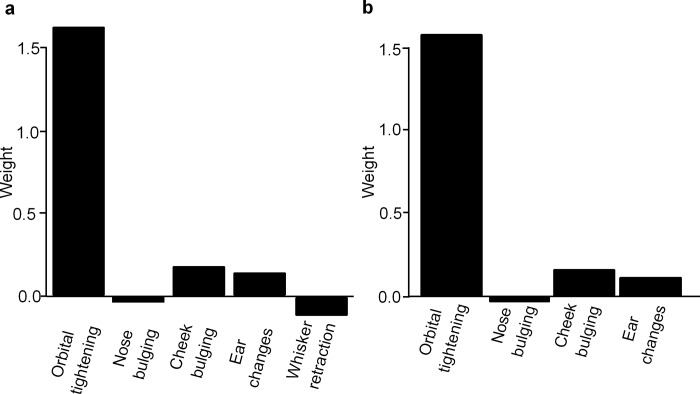
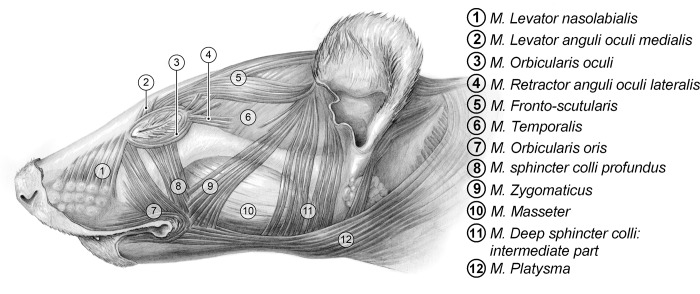
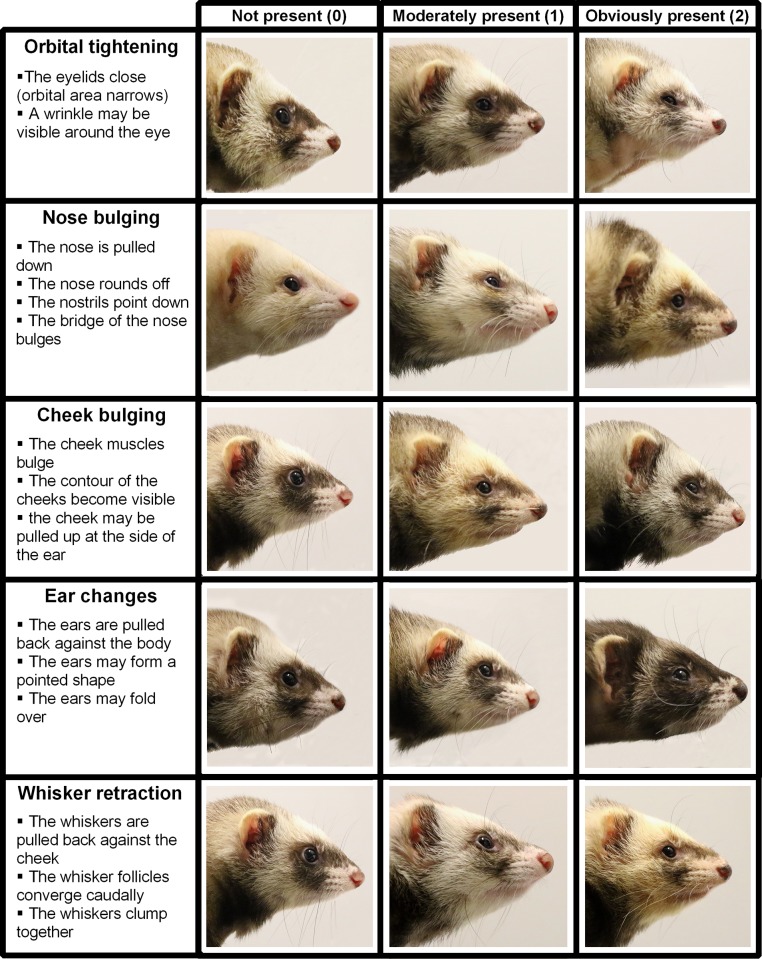
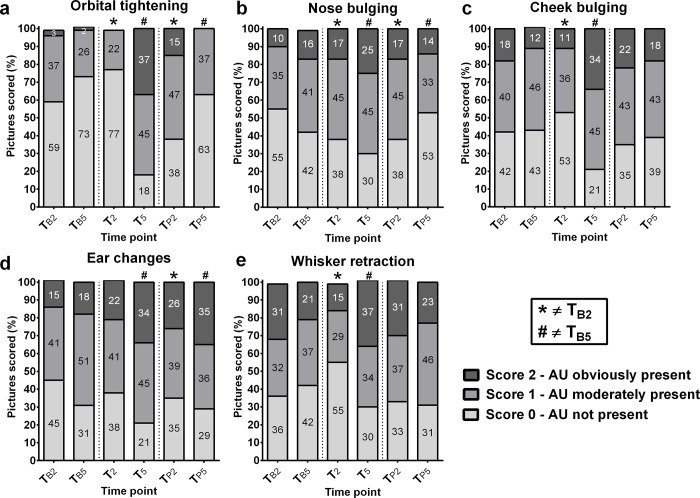
Reliable recognition of pain is difficult in ferrets as many currently available parameters are non-specific, inconsistent and/or impractical. Grimace scales have successfully been applied to assess pain in different animal species and might also be applicable to ferrets. To compose a Ferret Grimace Scale (FGS), we studied the facial musculature of ferrets and compared lateral photographs of 19 ferret faces at six time points before and after intraperitoneal telemetry probe implantation. We identified the Action Units (AUs) orbital tightening, nose bulging, cheek bulging, ear changes and whisker retraction as potential indicators of pain in ferrets. To evaluate whether these AUs could reliably be used to identify photographs taken before and after surgery, the photographs were scored 0, 1 or 2 (not, moderately or obviously present) by 11 observers that were blinded to the treatment and timing of the photographs. All AU-scores assigned to the photographs taken five hours after surgery were significantly higher compared to their time-matched baseline scores. Further analysis using the weights that were obtained using a Linear Discriminant Analysis revealed that scoring orbital tightening alone was sufficient to make this distinction with high sensitivity, specificity and accuracy. Including weighted scores for nose bulging, cheek bulging and ear change did not change this. As these AUs had more missing values than orbital tightening, their descriptions should be re-evaluated. Including whisker retraction, which had a negative weight, resulted in lower accuracy and should therefore in its current form be left out of the FGS. Overall, the results of this study suggest that the FGS and the AU orbital tightening in particular could be useful in a multifactorial pain assessment protocol for ferrets. However, before applying the FGS in practice, it should be further validated by incorporating more time points before and after applying (different) painful stimuli, and different levels of analgesia.
雪貂疼痛的可靠识别很困难,因为目前许多可用参数都不具有特异性、不一致且/或不实用。痛苦表情量表已成功应用于评估不同动物物种的疼痛,也可能适用于雪貂。为编制雪貂痛苦表情量表(FGS),我们研究了雪貂的面部肌肉组织,并比较了19只雪貂在腹腔遥测探头植入前后六个时间点的侧面照片。我们确定了动作单元(AUs)眼眶收紧、鼻子鼓起、脸颊鼓起、耳朵变化和胡须后缩是雪貂疼痛的潜在指标。为评估这些动作单元是否可可靠用于识别手术前后拍摄的照片,11名对照片的处理和拍摄时间不知情的观察者对照片评分为0、1或2(不存在、中度存在或明显存在)。与时间匹配的基线评分相比,所有在手术后五小时拍摄的照片的动作单元评分均显著更高。使用线性判别分析获得的权重进行的进一步分析表明,仅对眼眶收紧进行评分就足以以高灵敏度、特异性和准确性进行这种区分。纳入鼻子鼓起、脸颊鼓起和耳朵变化的加权评分并没有改变这一点。由于这些动作单元的缺失值比眼眶收紧更多,它们的描述应重新评估。纳入权重为负的胡须后缩会导致准确性降低,但在目前的形式下,应将其排除在雪貂痛苦表情量表之外。总体而言,本研究结果表明,雪貂痛苦表情量表,尤其是动作单元眼眶收紧,可能有助于雪貂多因素疼痛评估方案。然而,在实际应用雪貂痛苦表情量表之前,应通过纳入更多施加(不同)疼痛刺激前后的时间点以及不同水平的镇痛措施来进一步验证。