Cheng Yali, Lv Qiaoying, Xie Bingying, Yang Bingyi, Shan Weiwei, Ning Chengcheng, Li Bing, Xie Liying, Gu Chao, Luo Xuezhen, Chen Xiaojun, Zhu Qin
Department of GynecologyObstetrics and Gynecology Hospital of Fudan University, Shanghai, China.
Department of GynecologyObstetrics and Gynecology Hospital of Fudan University, Shanghai, China
Endocr Connect. 2018 Jan;7(1):36-46. doi: 10.1530/EC-17-0315. Epub 2017 Nov 13.
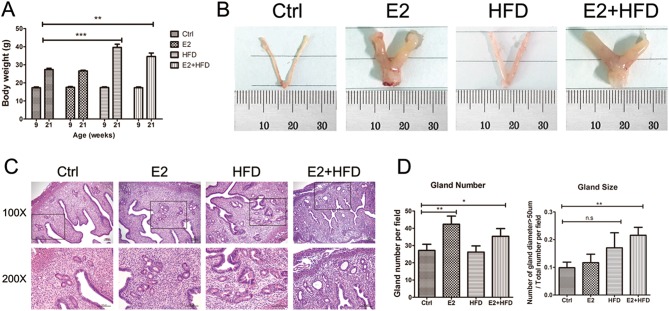
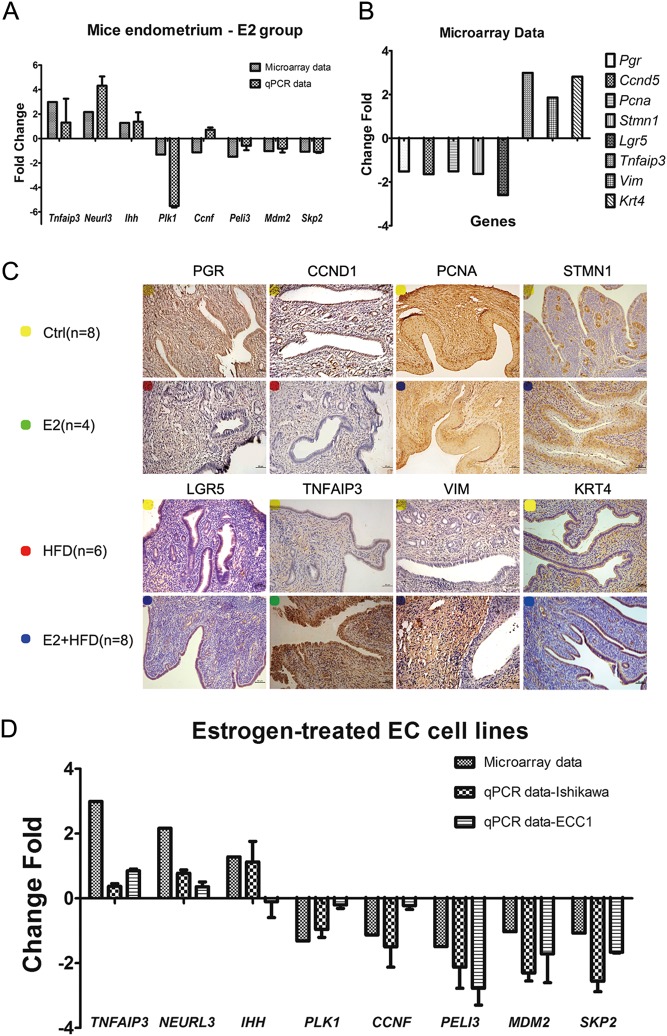
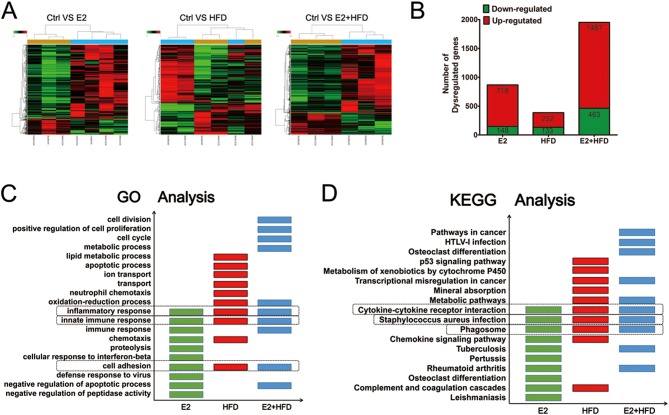
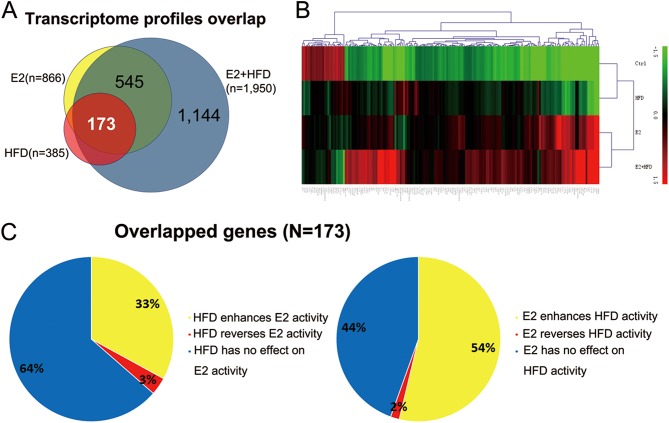
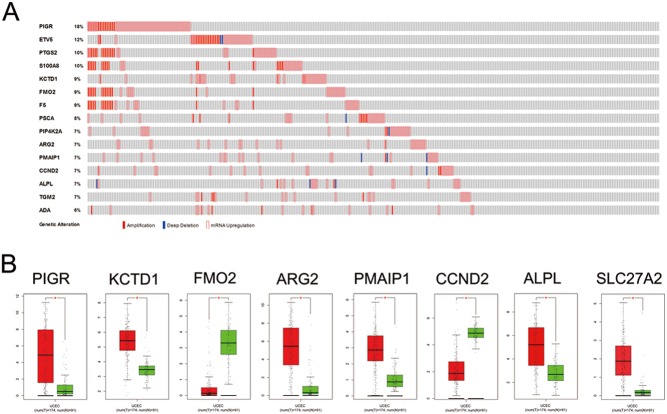
Unopposed estrogen stimulation and insulin resistance are known to play important roles in endometrial cancer (EC), but the interaction between these two factors and how they contribute to endometrial lesions are not completely elucidated. To investigate the endometrial transcriptome profile and the associated molecular pathway alterations, we established an ovariectomized C57BL/6 mouse model treated with subcutaneous implantation of 17-β estradiol (E2) pellet and/or high-fat diet (HFD) for 12 weeks to mimic sustained estrogen stimulation and insulin resistance. Histomorphologically, we found that both E2 and E2 + HFD groups showed markedly enlarged uterus and increased number of endometrial glands. The endometrium samples were collected for microarray assay. GO and KEGG analysis showed that genes regulated by E2 and/or HFD are mainly responsible for immune response, inflammatory response and metabolic pathways. Further IPA analysis demonstrated that the acute phase response signaling, NF-κB signaling, leukocyte extravasation signaling, PPAR signaling and LXR/RXR activation pathways are mainly involved in the pathways above. In addition, the genes modulated reciprocally by E2 and/or HFD were also analyzed, and their crosstalk mainly focuses on enhancing one another's activity. The combination analysis of microarray data and TCGA database provided potential diagnostic or therapeutic targets for EC. Further validation was performed in mice endometrium and human EC cell lines. In conclusion, this study unraveled the endometrial transcriptome profile alterations affected by E2 and/or HFD that may disturb endometrial homeostasis and contribute to the development of endometrial hyperplasia.
已知无对抗的雌激素刺激和胰岛素抵抗在子宫内膜癌(EC)中发挥重要作用,但这两个因素之间的相互作用以及它们如何导致子宫内膜病变尚未完全阐明。为了研究子宫内膜转录组谱及其相关的分子途径改变,我们建立了一个卵巢切除的C57BL/6小鼠模型,皮下植入17-β雌二醇(E2)药丸和/或高脂饮食(HFD)12周,以模拟持续的雌激素刺激和胰岛素抵抗。组织形态学上,我们发现E2组和E2+HFD组的子宫均明显增大,子宫内膜腺体数量增加。收集子宫内膜样本进行微阵列分析。GO和KEGG分析表明,受E2和/或HFD调控的基因主要负责免疫反应、炎症反应和代谢途径。进一步的IPA分析表明,急性期反应信号通路、NF-κB信号通路、白细胞外渗信号通路、PPAR信号通路和LXR/RXR激活通路主要参与上述途径。此外,还分析了受E2和/或HFD相互调节的基因,它们的相互作用主要集中在增强彼此的活性上。微阵列数据与TCGA数据库的联合分析为EC提供了潜在的诊断或治疗靶点。在小鼠子宫内膜和人EC细胞系中进行了进一步验证。总之,本研究揭示了受E2和/或HFD影响的子宫内膜转录组谱改变,这些改变可能扰乱子宫内膜稳态并促进子宫内膜增生的发展。