Shang Chen-Guang, Liu Zhao-Hui, Wang Xiao-Hui, Feng Zong-Hao, Zhang Yan
Department of Obstetrics and Gynecology, Peking University First Hospital, Beijing 100034, China.
Chin Med J (Engl). 2017 Aug 5;130(15):1831-1837. doi: 10.4103/0366-6999.211551.
Epidemiologic and genetic studies suggest a link between insulin resistance (IR) and endometrial cancer, and endometrial hyperplasia (EH) is a precancerous stage of endometrial cancer. Adiponectin is an adipokine which previously shown to be a risk factor for endometrial cancer. The aim of the study was to develop a rat model of IR and EH and evaluate adiponectin system in circulation and uterus.
This study was a 46-week animal trial from February 2014 to January 2015. Female Sprague-Dawley rats were fed with high-fat diet (HFD) for 40 weeks to induce IR. Followed by ovariectomization, rats were orally administrated to 17β-estradiol (E2) for 4 weeks to induce EH and then sacrificed. A total of 36 rats were divided into four groups: E2, HFD, HFD + E2, and control groups. Data were analyzed with Student's t-test, one-way analysis of variance (ANOVA), and Mann-Whitney U-tests. Chi-square was used to evaluate the score of immunohistochemistry.
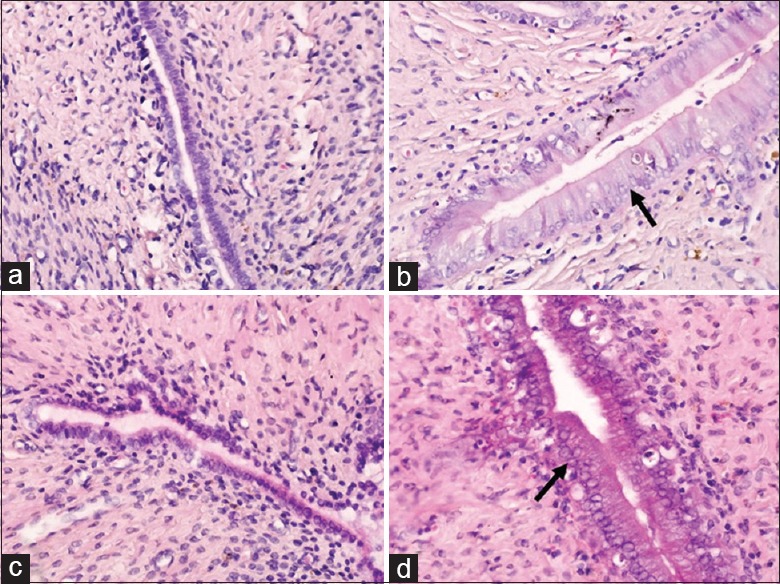
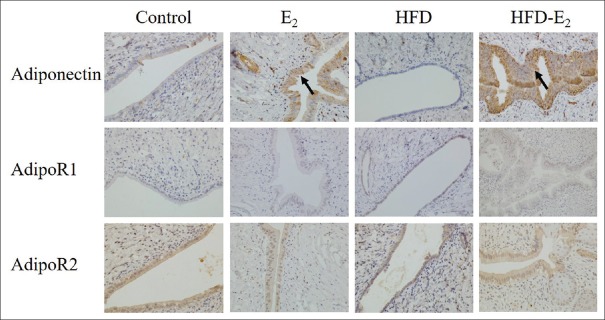
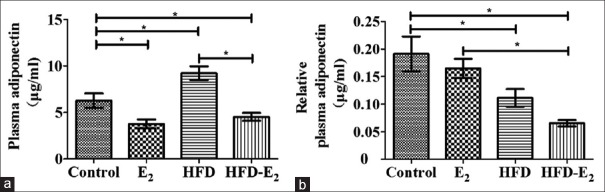
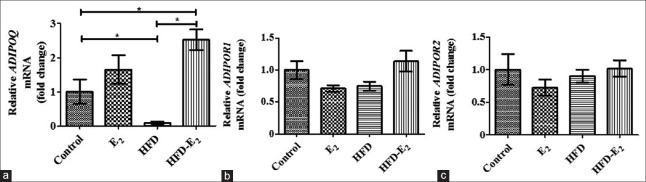
The thickness of endometrial, glandular epithelium, and myometrium in the HFD-E2group were higher than the E2group (F = 59.02, F = 23.51 and F = 12.53, respectively, all P < 0.001). Plasma adiponectin levels in the E2group were lower than those in the control group, and the levels in the HFD-E2group were lower than those in the HFD group (F = 13.15, P < 0.05). However, after normalized to visceral adipose tissue, compared to the control group, plasma adiponectin levels were decreased in rat with HFD in the absence or presence of E2, respectively (F = 6.72, P < 0.05). Adiponectin gene (F = 10.48, P < 0.05) and protein (P < 0.05) levels in uterus in the HFD-E2group were higher than those in the HFD group.
This study manifests that IR can effectively modulate EH, which suggests the involvement of energetic metabolism in uterine alternation. The combination effects of IR and EH modulate circulating adiponectin levels. However, adiponectin gene and protein levels in uterus are mainly response to estradiol.
流行病学和遗传学研究表明胰岛素抵抗(IR)与子宫内膜癌之间存在联系,子宫内膜增生(EH)是子宫内膜癌的癌前阶段。脂联素是一种脂肪因子,先前已被证明是子宫内膜癌的危险因素。本研究的目的是建立IR和EH的大鼠模型,并评估循环系统和子宫中的脂联素系统。
本研究是一项从2014年2月至2015年1月的为期46周的动物试验。对雌性斯普拉格-道利大鼠喂食高脂饮食(HFD)40周以诱导IR。随后进行卵巢切除术,给大鼠口服17β-雌二醇(E2)4周以诱导EH,然后处死。总共36只大鼠分为四组:E2组、HFD组、HFD + E2组和对照组。数据采用学生t检验、单因素方差分析(ANOVA)和曼-惠特尼U检验进行分析。卡方检验用于评估免疫组织化学评分。
HFD-E2组的子宫内膜、腺上皮和肌层厚度高于E2组(F分别为59.02、23.51和12.53,均P < 0.001)。E2组的血浆脂联素水平低于对照组,HFD-E2组的水平低于HFD组(F = 13.15, P < 0.05)。然而,在根据内脏脂肪组织进行标准化后,与对照组相比,无论有无E2,HFD大鼠的血浆脂联素水平均降低(F = 6.72, P < 0.05)。HFD-E2组子宫中的脂联素基因(F = 10.48, P < 0.05)和蛋白水平(P < 0.05)高于HFD组。
本研究表明IR可有效调节EH,这提示能量代谢参与子宫变化。IR和EH的联合作用调节循环脂联素水平。然而,子宫中的脂联素基因和蛋白水平主要对雌二醇产生反应。