Department of Experimental and Applied Psychology, Vrije Universiteit Amsterdam, Amsterdam 1081BT, The Netherlands;
Department of Psychology, University of Turin, Turin 10124, Italy.
Proc Natl Acad Sci U S A. 2017 Nov 28;114(48):12702-12707. doi: 10.1073/pnas.1712921114. Epub 2017 Nov 13.
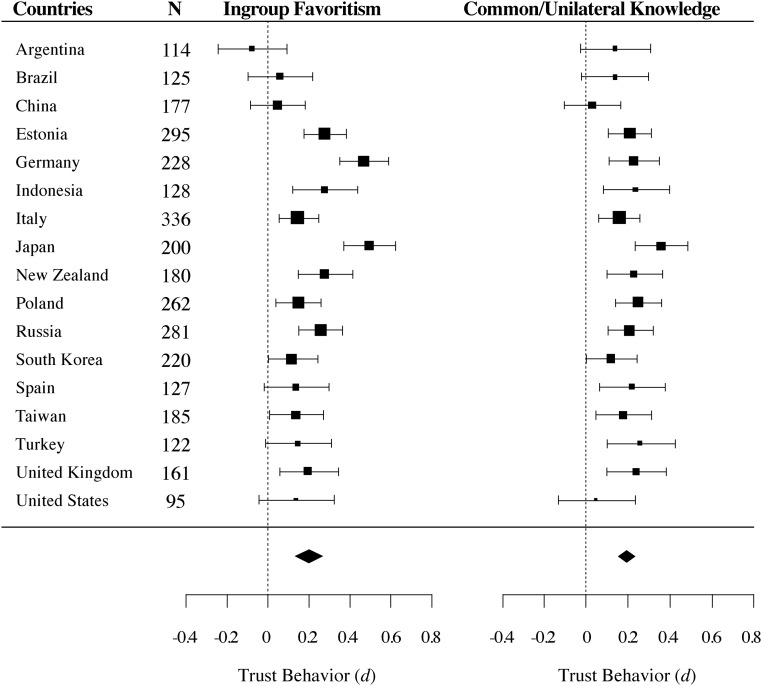
International challenges such as climate change, poverty, and intergroup conflict require countries to cooperate to solve these complex problems. However, the political tide in many countries has shifted inward, with skepticism and reluctance to cooperate with other countries. Thus, cross-societal investigations are needed to test theory about trust and cooperation within and between groups. We conducted an experimental study in 17 countries designed to test several theories that explain why, who, and where people trust and cooperate more with ingroup members, compared with outgroup members. The experiment involved several interactions in the trust game, either as a trustor or trustee. We manipulated partner group membership in the trust game (ingroup, outgroup, or unknown) and if their reputation was at stake during the interaction. In addition to the standard finding that participants trust and cooperate more with ingroup than outgroup members, we obtained findings that reputational concerns play a decisive role for promoting trust and cooperation universally across societies. Furthermore, men discriminated more in favor of their ingroup than women. Individual differences in cooperative preferences, as measured by social value orientation, predicted cooperation with both ingroup and outgroup members. Finally, we did not find support for three theories about the cross-societal conditions that influence the degree of ingroup favoritism observed across societies (e.g., material security, religiosity, and pathogen stress). We discuss the implications for promoting cooperation within and between countries.
国际挑战,如气候变化、贫困和群体间冲突,需要各国合作来解决这些复杂的问题。然而,许多国家的政治潮流已经转向内部,对与其他国家合作持怀疑和不情愿的态度。因此,需要进行跨社会调查,以检验关于群体内和群体间信任与合作的理论。我们在 17 个国家进行了一项实验研究,旨在测试几种理论,这些理论解释了为什么、谁以及在何处人们更信任和更愿意与内群体成员而不是外群体成员合作。该实验涉及信任游戏中的几次互动,无论是作为信任者还是受托人。我们在信任游戏中操纵了伙伴群体的成员(内群体、外群体或未知),以及他们的声誉是否在互动中受到影响。除了参与者更信任和更愿意与内群体成员而不是外群体成员合作的标准发现外,我们还发现声誉问题在普遍促进社会间信任和合作方面起着决定性的作用。此外,男性比女性更倾向于歧视自己的内群体。合作偏好的个体差异,如社会价值取向,预测了与内群体和外群体成员的合作。最后,我们没有发现支持三种关于影响跨社会条件的理论的证据,这些理论影响着跨社会观察到的对内群体偏好的程度(例如,物质安全、宗教信仰和病原体压力)。我们讨论了促进国家内部和国家之间合作的意义。