Columbia Business School, Columbia University, New York City, NY 10027;
Graduate School of Business, Stanford University, Stanford, CA 94305.
Proc Natl Acad Sci U S A. 2017 Nov 28;114(48):12714-12719. doi: 10.1073/pnas.1710966114. Epub 2017 Nov 13.
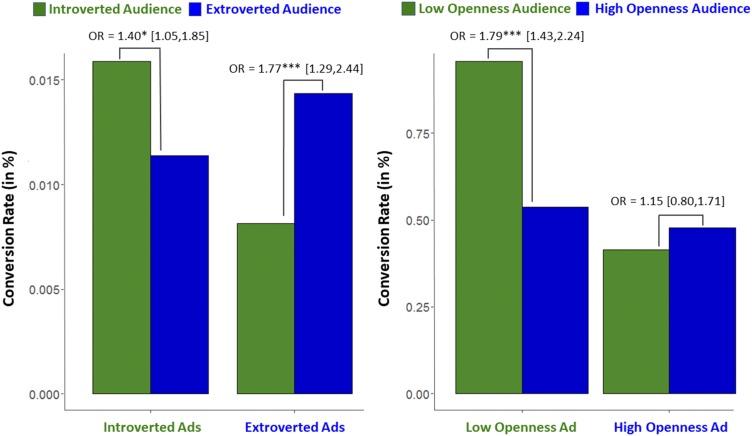
People are exposed to persuasive communication across many different contexts: Governments, companies, and political parties use persuasive appeals to encourage people to eat healthier, purchase a particular product, or vote for a specific candidate. Laboratory studies show that such persuasive appeals are more effective in influencing behavior when they are tailored to individuals' unique psychological characteristics. However, the investigation of large-scale psychological persuasion in the real world has been hindered by the questionnaire-based nature of psychological assessment. Recent research, however, shows that people's psychological characteristics can be accurately predicted from their digital footprints, such as their Facebook Likes or Tweets. Capitalizing on this form of psychological assessment from digital footprints, we test the effects of psychological persuasion on people's actual behavior in an ecologically valid setting. In three field experiments that reached over 3.5 million individuals with psychologically tailored advertising, we find that matching the content of persuasive appeals to individuals' psychological characteristics significantly altered their behavior as measured by clicks and purchases. Persuasive appeals that were matched to people's extraversion or openness-to-experience level resulted in up to 40% more clicks and up to 50% more purchases than their mismatching or unpersonalized counterparts. Our findings suggest that the application of psychological targeting makes it possible to influence the behavior of large groups of people by tailoring persuasive appeals to the psychological needs of the target audiences. We discuss both the potential benefits of this method for helping individuals make better decisions and the potential pitfalls related to manipulation and privacy.
政府、公司和政党会利用有说服力的诉求来鼓励人们更健康地饮食、购买特定产品或投票给特定候选人。实验室研究表明,当这些诉求针对个人独特的心理特征进行定制时,它们在影响行为方面更为有效。然而,对现实世界中大规模心理说服的研究受到基于问卷的心理评估性质的限制。然而,最近的研究表明,人们的心理特征可以通过他们的数字足迹(如他们的 Facebook 点赞或推文)准确预测。利用这种来自数字足迹的心理评估形式,我们在生态有效的环境中测试心理说服对人们实际行为的影响。在三个涉及 350 多万人的现场实验中,我们通过有针对性的广告为人们提供心理定制,发现将说服性诉求与个人的心理特征相匹配,显著改变了他们的行为,表现在点击量和购买量上。与不匹配或非个性化的广告相比,与人们的外向或开放性经验水平相匹配的说服性诉求会导致点击量增加多达 40%,购买量增加多达 50%。我们的研究结果表明,心理定位的应用使得通过针对目标受众的心理需求来定制有说服力的信息,从而影响大量人群的行为成为可能。我们讨论了这种方法帮助个人做出更好决策的潜在好处,以及与操纵和隐私相关的潜在陷阱。