Jockey Club School of Public Health and Primary Care, The Chinese University of Hong Kong, Hong Kong, China.
Shenzhen Research Institute of the Chinese University of Hong Kong, Shenzhen, China.
Occup Environ Med. 2018 Feb;75(2):148-154. doi: 10.1136/oemed-2017-104529. Epub 2017 Nov 13.
Environmental exposure to chemicals has been considered a potential factor contributing to deteriorated semen quality. However, previous literature on exposure to air pollution and semen quality is inconsistent. We therefore investigated the health effects of short-term and long-term exposure to fine particulate matter (PM) on semen quality in Taiwanese men from the general population.
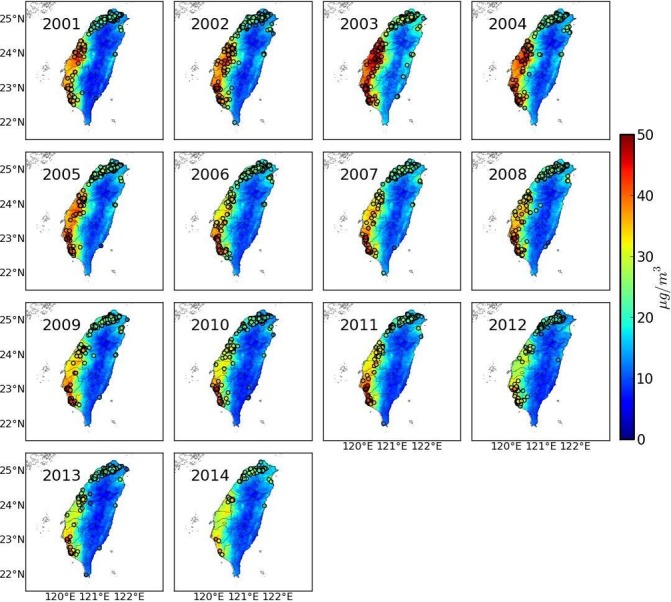
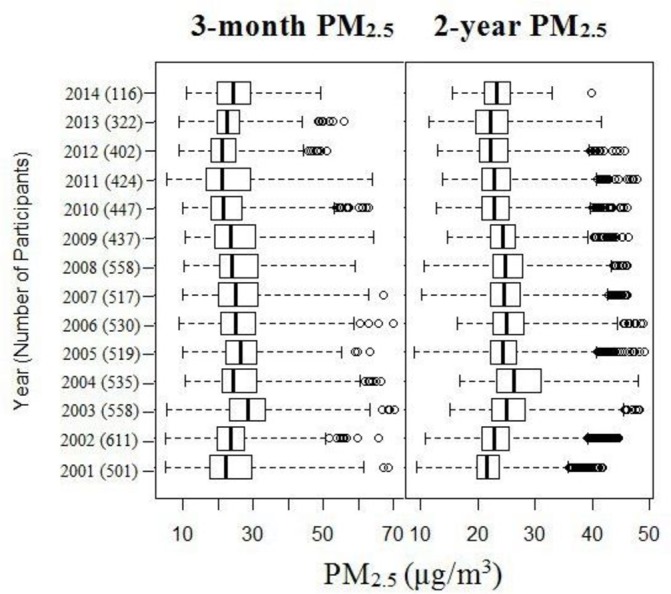
A cross-sectional study was conducted among 6475 male participants aged 15-49 years who participated in a standard medical examination programme in Taiwan between 2001 and 2014. Semen quality was assessed according to the WHO 1999 guidelines, including sperm concentration, total motility, progressive motility and morphology. Three-month and 2-year average PM concentrations were estimated at each participant's address using a spatiotemporal model based on satellite-derived aerosol optical depth data. Multivariable linear and logistic regressions were used to examine the associations between PM and semen quality.
A robust association was observed between exposure to PM and decreased normal morphology. Every increment of 5 µg/m in 2-year average PM was significantly associated with a decrease of 1.29% in sperm normal morphology and a 26% increased risk of having the bottom 10% of sperm normal morphology, after adjusting for a wide range of potential confounders (p<0.001). On the other hand, an increment of 5 µg/m in 2-year average PM was associated with an increase of 1.03×10/mL in sperm concentration and a 10% decreased risk of being the bottom 10% of sperm concentration (both p<0.001). Similar results were found for 3-month PM.
Exposure to ambient PM air pollution is associated with a lower level of sperm normal morphology and a higher level of sperm concentration.
环境中的化学物质暴露被认为是导致精液质量恶化的潜在因素。然而,先前关于空气污染与精液质量关系的文献结果并不一致。因此,我们研究了台湾普通人群中短期和长期暴露于细颗粒物(PM)对精液质量的健康影响。
本研究为横断面研究,共纳入 6475 名 15-49 岁的男性参与者,他们于 2001 年至 2014 年期间参加了台湾的一项标准体检计划。根据世界卫生组织 1999 年的指南评估精液质量,包括精子浓度、总活力、前向运动活力和形态。在每个参与者的地址处,使用基于卫星衍生气溶胶光学深度数据的时空模型来估计三个月和两年的平均 PM 浓度。使用多变量线性和逻辑回归来检验 PM 与精液质量之间的关系。
暴露于 PM 与正常形态精子减少之间存在显著关联。调整广泛的潜在混杂因素后,2 年平均 PM 每增加 5μg/m3,精子正常形态的比例下降 1.29%,正常形态精子比例处于底部 10%的风险增加 26%(p<0.001)。另一方面,2 年平均 PM 每增加 5μg/m3,精子浓度增加 1.03×10/ml,精子浓度处于底部 10%的风险降低 10%(均 p<0.001)。对于 3 个月 PM 也得到了类似的结果。
暴露于环境 PM 空气污染与较低的精子正常形态比例和较高的精子浓度相关。