Gruber Jodie, Brown Gregory, Whiting Martin J, Shine Richard
School of Life and Environmental Sciences, The University of Sydney, Sydney, New South Wales, Australia.
Department of Biological Sciences, Macquarie University, North Ryde, New South Wales, Australia.
R Soc Open Sci. 2017 Oct 25;4(10):170789. doi: 10.1098/rsos.170789. eCollection 2017 Oct.
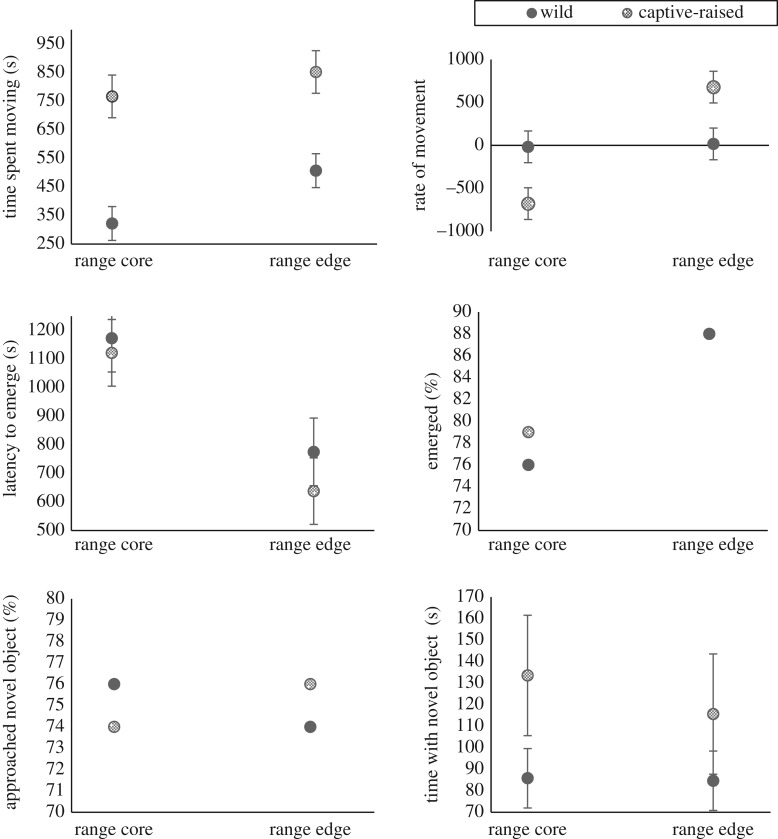
Individuals at the leading edge of expanding biological invasions often show distinctive phenotypic traits, in ways that enhance their ability to disperse rapidly and to function effectively in novel environments. Cane toads () at the invasion front in Australia exhibit shifts in morphology, physiology and behaviour (directionality of dispersal, boldness, risk-taking). We took a common-garden approach, raising toads from range-core and range-edge populations in captivity, to see if the behavioural divergences observed in wild-caught toads are also evident in common-garden offspring. Captive-raised toads from the invasion vanguard population were more exploratory and bolder (more prone to 'risky' behaviours) than toads from the range core, which suggests that these are evolved, genetic traits. Our study highlights the importance of behaviour as being potentially adaptive in invasive populations and adds these behavioural traits to the increasing list of phenotypic traits that have evolved rapidly during the toads' 80-year spread through tropical Australia.
处于生物入侵扩张前沿的个体通常表现出独特的表型特征,这些特征能增强它们在新环境中快速扩散和有效发挥功能的能力。澳大利亚入侵前沿的蔗蟾蜍在形态、生理和行为(扩散方向、大胆程度、冒险行为)方面出现了变化。我们采用了共同饲养的方法,在圈养环境中饲养来自分布核心区和边缘区种群的蟾蜍,以观察在野生捕获的蟾蜍中观察到的行为差异在共同饲养的后代中是否也很明显。来自入侵先锋种群的圈养蟾蜍比来自分布核心区的蟾蜍更具探索性和大胆(更倾向于“冒险”行为),这表明这些是进化而来的遗传特征。我们的研究强调了行为在入侵种群中可能具有适应性的重要性,并将这些行为特征添加到在蟾蜍在热带澳大利亚80年的扩散过程中迅速进化的越来越多的表型特征列表中。