Food Quality and Design Group, Department of Agrotechnology and Food Sciences, Wageningen University, PO Box 17, 6700 AA, Wageningen, The Netherlands.
Department of Food Technology, Soegijapranata Catholic University, Jl. Pawiyatan Luhur IV/1 Bendan Duwur, Semarang, 50234, Indonesia.
Plant Foods Hum Nutr. 2017 Dec;72(4):439-444. doi: 10.1007/s11130-017-0646-x.
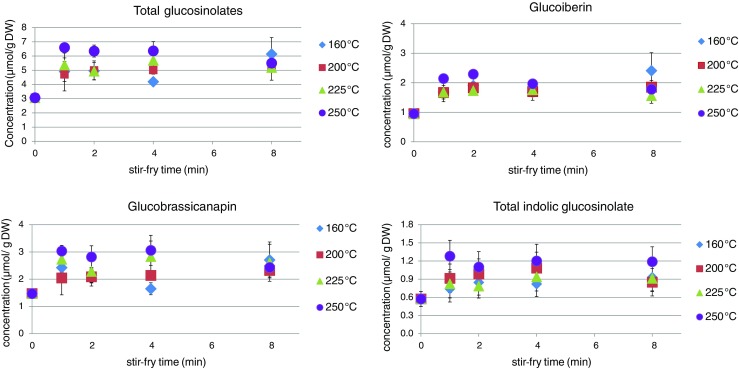
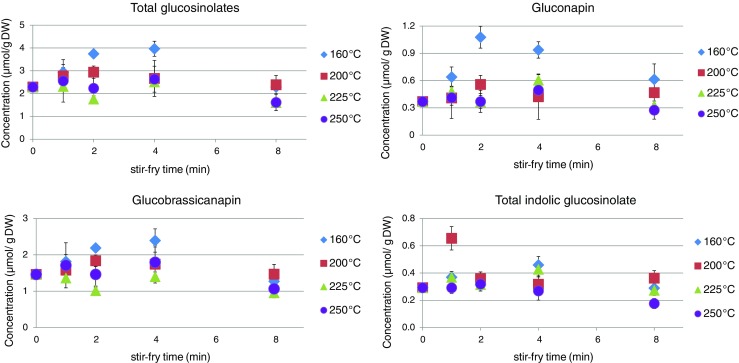
Stir-frying is a cooking method, originating from Asia, in which food is fried in small amount of very hot oil. Nowadays in many other parts of the world stir-frying is a very popular method to prepare vegetables, because it is fast and fried vegetables are tasty. However, the retention of phytochemicals like the health-beneficial glucosinolates in Brassica vegetables is less explored for stir-frying in comparison to other cooking methods. This study investigates the retention of glucosinolates in Chinese cabbage (Brassica rapa ssp. pekinensis) and pakchoi (Brassica rapa ssp. chinensis) as affected by stir-frying at various cooking durations and temperatures. Stir-frying experiments were performed at set pan temperatures ranging from 160 to 250 °C for a duration of 1 to 8 min. Results showed that aliphatic glucobrassicanapin is the most abundant glucosinolate identified in fresh Chinese cabbage and pakchoi, contributing for 48 and 63% of the total glucosinolate content, respectively, followed by glucoiberin and gluconapin. Stir-frying retains the glucosinolates even at the highest temperature applied. Such retention is explained by the quick inactivation of the glucosinolate-hydrolytic enzyme myrosinase during the first minutes of frying, and by the thermal stability of the glucosinolates at those temperature/time conditions. Moreover, due to the absence of a separate water phase, leaching losses did not occur, in contrast to what is observed when boiling Brassica vegetables. These results show that stir-frying may be a suitable health-beneficial cooking option that prevents the loss of glucosinolates.
炒制是一种起源于亚洲的烹饪方法,即将食物用少量热油快速翻炒。如今,在世界上许多其他地区,炒制是一种非常流行的蔬菜烹饪方法,因为它速度快,炒出来的蔬菜味道鲜美。然而,与其他烹饪方法相比,人们对炒制过程中如何保留十字花科蔬菜中的有益健康的硫代葡萄糖苷类化合物(glucosinolates)研究较少。本研究探讨了不同炒制时间和温度对白菜( Brassica rapa ssp. pekinensis )和上海青( Brassica rapa ssp. chinensis )中硫代葡萄糖苷类化合物保留的影响。炒制实验在设定的锅温(160-250°C)下进行,时间为 1-8 分钟。结果表明,在新鲜的白菜和上海青中,脂肪族的葡萄糖苷菜菔硫烷(glucobrassicanapin)是含量最丰富的硫代葡萄糖苷,分别占总硫代葡萄糖苷含量的 48%和 63%,其次是葡萄糖异硫氰酸盐( glucoiberin )和葡萄糖苷( gluconapin )。即使在最高温度下炒制,硫代葡萄糖苷也能保留下来。这种保留可以用以下原因来解释:在炒制的最初几分钟内,硫代葡萄糖苷水解酶黑芥子酶(myrosinase)迅速失活,并且在这些温度和时间条件下,硫代葡萄糖苷具有热稳定性。此外,由于不存在单独的水相,因此不会发生浸出损失,这与煮食 Brassica 类蔬菜时观察到的情况不同。这些结果表明,炒制可能是一种有益健康的烹饪选择,可以防止硫代葡萄糖苷的损失。