Department of Plant Quality, Leibniz Institute of Vegetable and Ornamental Crops, Theodor-Echtermeyer-Weg 1, 14979 Grossbeeren, Germany.
Food Quality and Design Group, Wageningen University, PO Box 17, 6700 AA Wageningen, The Netherlands.
Sci Rep. 2017 Jan 17;7:40807. doi: 10.1038/srep40807.
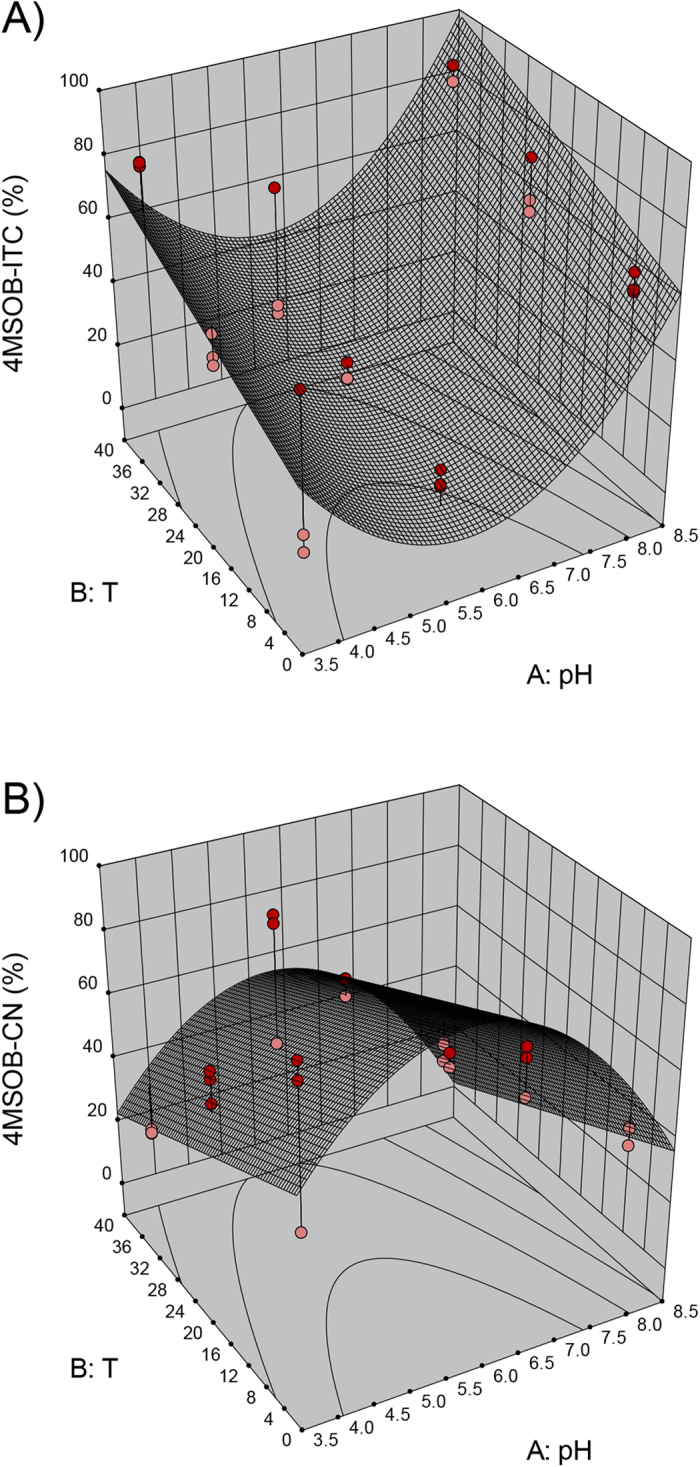
Consumption of glucosinolate-rich Brassicales vegetables is associated with a decreased risk of cancer with enzymatic hydrolysis of glucosinolates playing a key role. However, formation of health-promoting isothiocyanates is inhibited by the epithiospecifier protein in favour of nitriles and epithionitriles. Domestic processing conditions, such as changes in pH value, temperature or dilution, might also affect isothiocyanate formation. Therefore, the influences of these three factors were evaluated in accessions of Brassica rapa, Brassica oleracea, and Arabidopsis thaliana. Mathematical modelling was performed to determine optimal isothiocyanate formation conditions and to obtain knowledge on the kinetics of the reactions. At 22 °C and endogenous plant pH, nearly all investigated plants formed nitriles and epithionitriles instead of health-promoting isothiocyanates. Response surface models, however, clearly demonstrated that upon change in pH to domestic acidic (pH 4) or basic pH values (pH 8), isothiocyanate formation considerably increases. While temperature also affects this process, the pH value has the greatest impact. Further, a kinetic model showed that isothiocyanate formation strongly increases due to dilution. Finally, the results show that isothiocyanate intake can be strongly increased by optimizing the conditions of preparation of Brassicales vegetables.
食用富含硫代葡萄糖苷的芸薹属蔬菜可降低癌症风险,其中酶解硫代葡萄糖苷起着关键作用。然而,硫代糖苷水解酶会优先生成促进健康的异硫氰酸盐,而非腈和硫代腈。家庭加工条件,如 pH 值、温度或稀释度的变化,也可能会影响异硫氰酸盐的形成。因此,本研究评估了芸薹属植物( Brassica rapa 、 Brassica oleracea )和拟南芥( Arabidopsis thaliana )中这三个因素的影响。通过数学模型确定了最佳异硫氰酸盐形成条件,从而获得了有关反应动力学的知识。在 22°C 和内源性植物 pH 值条件下,几乎所有被研究的植物都形成了腈和硫代腈,而不是促进健康的异硫氰酸盐。然而,响应面模型清楚地表明,当 pH 值变为家庭酸性(pH 值 4)或碱性(pH 值 8)时,异硫氰酸盐的形成会显著增加。虽然温度也会影响这个过程,但 pH 值的影响最大。此外,动力学模型表明,由于稀释,异硫氰酸盐的形成会强烈增加。最后,结果表明,通过优化芸薹属蔬菜的制备条件,可以大大增加异硫氰酸盐的摄入量。