Zagórska Justyna, Czernicka-Boś Lidia, Kukula-Koch Wirginia, Szalak Radosław, Koch Wojciech
Department of Food and Nutrition, Medical University of Lublin, 4a Chodzki Str., 20-093 Lublin, Poland.
Department of Pharmacognosy with Medical Plants Garden, Medical University of Lublin, 1 Chodzki Str., 20-093 Lublin, Poland.
Foods. 2022 Nov 2;11(21):3484. doi: 10.3390/foods11213484.
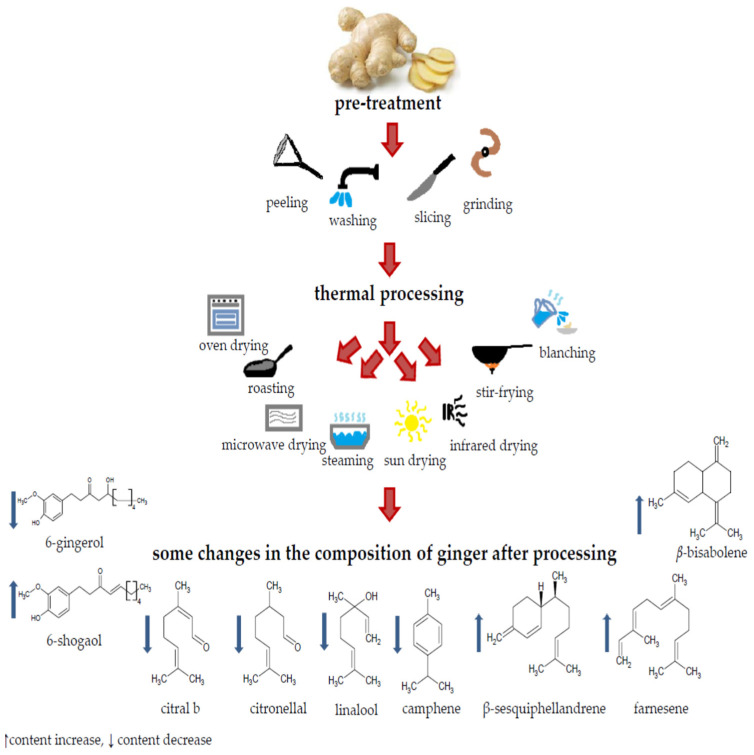
Ginger ( Rosc.) is both a commonly used spice, and an ingredient of various dietary supplements and medications. Its diverse applications result from the range of health benefits that this plant brings thanks to the presence of active compounds (secondary metabolites) in the matrix. Even if several studies underline a stronger pharmacological activity of fresh ginger rhizomes, the unprocessed plant is relatively rarely used. Ginger rhizomes are subjected to thermal processing, such as boiling, blanching, steam drying and others, at different temperature and time settings. Additionally, freeze-drying of the rhizomes is used as the first step in the preparation of raw material. It was proved that the composition of secondary metabolites of the rhizome changes upon the influence of temperature. Therefore, the aim of the review was to put together scientific results on the impact of traditional and unconventional methods of heat treatment on ginger rhizomes and to show the compositional differences that they induce in the plant matrix. Variations in the content and the transformation of some compounds into other metabolites will be also discussed, with particular attention paid to two major groups of secondary metabolites present in the plant, namely, phenolics and terpenes.
姜(Zingiber officinale Rosc.)既是一种常用香料,也是各种膳食补充剂和药物的成分。其广泛应用源于该植物基质中存在的活性化合物(次生代谢产物)所带来的一系列健康益处。即便多项研究强调新鲜姜根茎具有更强的药理活性,但未加工的植物相对较少被使用。姜根茎会在不同温度和时间设置下进行热处理,如煮沸、烫漂、热风干燥等。此外,根茎的冷冻干燥被用作原料制备的第一步。事实证明,根茎的次生代谢产物组成会因温度影响而发生变化。因此,本综述的目的是汇总关于传统和非传统热处理方法对姜根茎影响的科学成果,并展示它们在植物基质中引起的成分差异。还将讨论某些化合物含量的变化以及它们向其他代谢产物的转化,尤其关注植物中存在的两大类次生代谢产物,即酚类和萜类。