Atlantic Cancer Research Institute, 35 Providence Street, Moncton, NB, E1C 8X3, Canada.
Department of Chemistry and Biochemistry, Université de Moncton, Moncton, NB, Canada.
Cell Commun Signal. 2017 Nov 14;15(1):48. doi: 10.1186/s12964-017-0204-z.
Human hyaluronic acid (HA) molecules are synthesized by three membrane spanning Hyaluronic Acid Synthases (HAS1, HAS2 and HAS3). Of the three, HAS1 is found to be localized more into the cytoplasmic space where it synthesizes intracellular HA. HA is a ubiquitous glycosaminoglycan, mainly present in the extracellular matrix (ECM) and on the cell surface, but are also detected intracellularly. Accumulation of HA in cancer cells, the cancer-surrounding stroma, and ECM is generally considered an independent prognostic factors for patients. Higher HA production also correlates with higher tumor grade and more genetic heterogeneity in multiple cancer types which is known to contribute to drug resistance and results in treatment failure. Tumor heterogeneity and intra-tumor clonal diversity are major challenges for diagnosis and treatment. Identification of the driver pathway(s) that initiate genomic instability, tumor heterogeneity and subsequent phenotypic/clinical manifestations, are fundamental for the diagnosis and treatment of cancer. Thus far, no evidence was shown to correlate intracellular HA status (produced by HAS1) and the generation of genetic diversity in tumors.
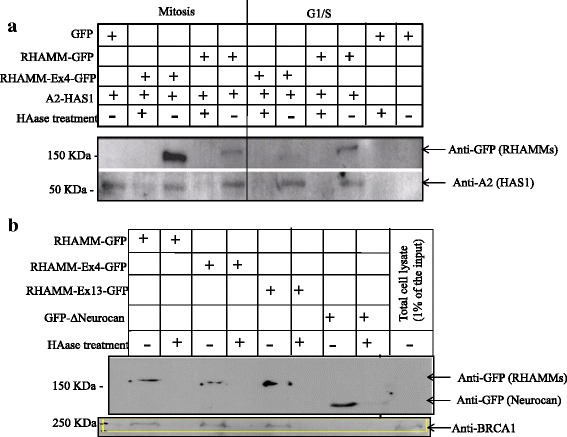
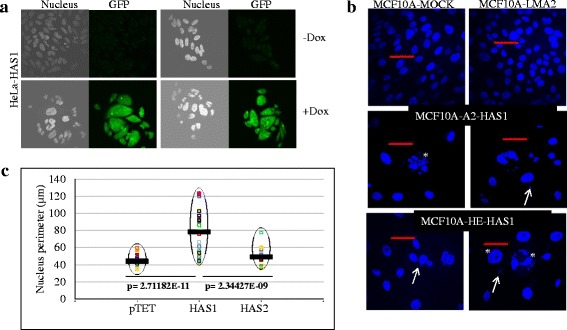
We tested different cell lines engineered to induce HAS1 expression. We measured the epithelial traits, centrosomal abnormalities, micronucleation and polynucleation of those HAS1-expressing cells. We performed real-time PCR, 3D cell culture assay, confocal microscopy, immunoblots and HA-capture methods.
Our results demonstrate that overexpression of HAS1 induces loss of epithelial traits, increases centrosomal abnormalities, micronucleation and polynucleation, which together indicate manifestation of malignant transformation, intratumoral genetic heterogeneity, and possibly create suitable niche for cancer stem cells generation.
The intracellular HA produced by HAS1 can aggravate genomic instability and intratumor heterogeneity, pointing to a fundamental role of intracellular HA in cancer initiation and progression.
人类透明质酸(HA)分子由三种跨膜透明质酸合成酶(HAS1、HAS2 和 HAS3)合成。在这三种酶中,HAS1 更多地定位于细胞质中,在那里合成细胞内 HA。HA 是一种普遍存在的糖胺聚糖,主要存在于细胞外基质(ECM)和细胞表面,但也在细胞内检测到。在癌细胞、癌周围基质和 ECM 中 HA 的积累通常被认为是患者独立的预后因素。在多种癌症类型中,更高的 HA 产生也与更高的肿瘤分级和更多的遗传异质性相关,这已知会导致药物耐药性并导致治疗失败。肿瘤异质性和肿瘤内克隆多样性是诊断和治疗的主要挑战。鉴定启动基因组不稳定性、肿瘤异质性和随后表型/临床表现的驱动途径,对于癌症的诊断和治疗至关重要。迄今为止,没有证据表明细胞内 HA 状态(由 HAS1 产生)与肿瘤中遗传多样性的产生相关。
我们测试了不同的细胞系,这些细胞系被设计用来诱导 HAS1 表达。我们测量了这些 HAS1 表达细胞的上皮特征、中心体异常、微核和多核形成。我们进行了实时 PCR、3D 细胞培养测定、共聚焦显微镜、免疫印迹和 HA 捕获方法。
我们的结果表明,HAS1 的过表达诱导上皮特征的丧失,增加中心体异常、微核和多核形成,这共同表明恶性转化、肿瘤内遗传异质性的表现,并且可能为癌症干细胞的产生创造合适的生态位。
HAS1 产生的细胞内 HA 可加重基因组不稳定性和肿瘤内异质性,表明细胞内 HA 在癌症发生和进展中具有基本作用。