• 文献检索
  • 文档翻译
  • 深度研究
  • 学术资讯
  • Suppr Zotero 插件Zotero 插件
  • 邀请有礼
  • 套餐&价格
  • 历史记录
应用&插件
Suppr Zotero 插件Zotero 插件浏览器插件Mac 客户端Windows 客户端微信小程序
定价
高级版会员购买积分包购买API积分包
服务
文献检索文档翻译深度研究API 文档MCP 服务
关于我们
关于 Suppr公司介绍联系我们用户协议隐私条款
关注我们

Suppr 超能文献

核心技术专利:CN118964589B侵权必究
粤ICP备2023148730 号-1Suppr @ 2026

文献检索

告别复杂PubMed语法,用中文像聊天一样搜索,搜遍4000万医学文献。AI智能推荐,让科研检索更轻松。

立即免费搜索

文件翻译

保留排版,准确专业,支持PDF/Word/PPT等文件格式,支持 12+语言互译。

免费翻译文档

深度研究

AI帮你快速写综述,25分钟生成高质量综述,智能提取关键信息,辅助科研写作。

立即免费体验

巴西东北部萨尔瓦多市寨卡病毒血清阳性率高,限制了进一步爆发的潜力。

High Zika Virus Seroprevalence in Salvador, Northeastern Brazil Limits the Potential for Further Outbreaks.

机构信息

Hospital Universitário Professor Edgard Santos, Universidade Federal de Bahia, Salvador, Brazil.

Instituto Brasileiro para a Investigação da Tuberculose/Fundação José Silveira (IBIT/FJS), Salvador, Brazil.

出版信息

mBio. 2017 Nov 14;8(6):e01390-17. doi: 10.1128/mBio.01390-17.

DOI:10.1128/mBio.01390-17
PMID:29138300
原文链接:https://pmc.ncbi.nlm.nih.gov/articles/PMC5686533/
Abstract

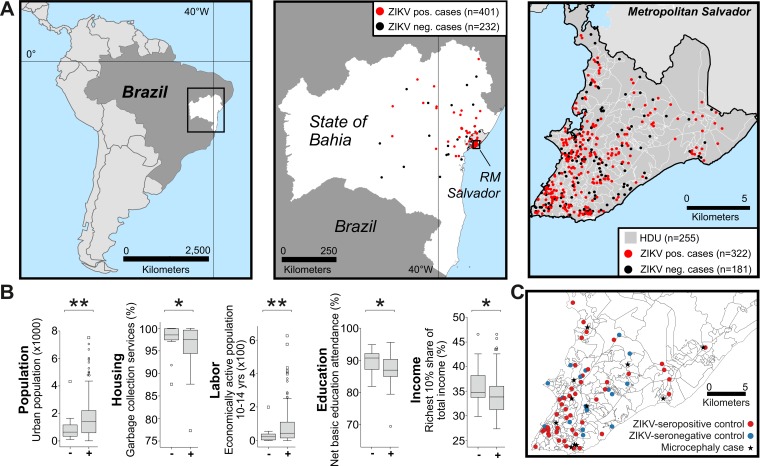
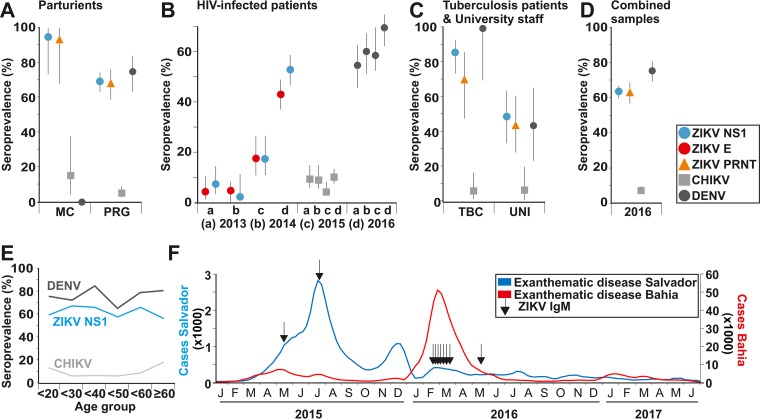
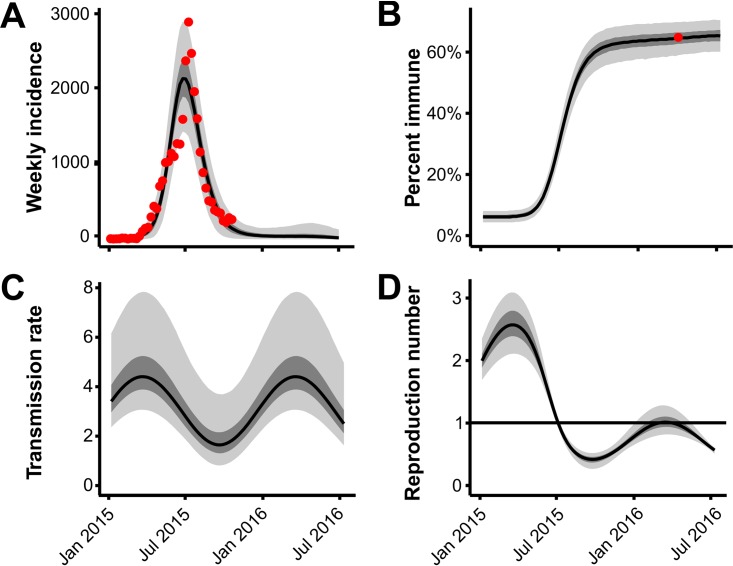
During 2015 to 2016, Brazil reported more Zika virus (ZIKV) cases than any other country, yet population exposure remains unknown. Serological studies of ZIKV are hampered by cross-reactive immune responses against heterologous viruses. We conducted serosurveys for ZIKV, dengue virus (DENV), and Chikungunya virus (CHIKV) in 633 individuals prospectively sampled during 2015 to 2016, including microcephaly and non-microcephaly pregnancies, HIV-infected patients, tuberculosis patients, and university staff in Salvador in northeastern Brazil using enzyme-linked immunosorbent assays (ELISAs) and plaque reduction neutralization tests. Sera sampled retrospectively during 2013 to 2015 from 277 HIV-infected patients were used to assess the spread of ZIKV over time. Individuals were georeferenced, and sociodemographic indicators were compared between ZIKV-positive and -negative areas and areas with and without microcephaly cases. Epidemiological key parameters were modeled in a Bayesian framework. ZIKV seroprevalence increased rapidly during 2015 to 2016, reaching 63.3% by 2016 (95% confidence interval [CI], 59.4 to 66.8%), comparable to the seroprevalence of DENV (75.7%; CI, 69.4 to 81.1%) and higher than that of CHIKV (7.4%; CI, 5.6 to 9.8%). Of 19 microcephaly pregnancies, 94.7% showed ZIKV IgG antibodies, compared to 69.3% of 257 non-microcephaly pregnancies ( = 0.017). Analyses of sociodemographic data revealed a higher ZIKV burden in low socioeconomic status (SES) areas. High seroprevalence, combined with case data dynamics allowed estimates of the basic reproduction number of 2.1 (CI, 1.8 to 2.5) at the onset of the outbreak and an effective reproductive number of <1 in subsequent years. Our data corroborate ZIKV-associated congenital disease and an association of low SES and ZIKV infection and suggest that population immunity caused cessation of the outbreak. Similar studies from other areas will be required to determine the fate of the American ZIKV outbreak. The ongoing American Zika virus (ZIKV) outbreak involves millions of cases and has a major impact on maternal and child health. Knowledge of infection rates is crucial to project future epidemic patterns and determine the absolute risk of microcephaly upon maternal ZIKV infection during pregnancy. For unknown reasons, the vast majority of ZIKV-associated microcephaly cases are concentrated in northeastern Brazil. We analyzed different subpopulations from Salvador, a Brazilian metropolis representing one of the most affected areas during the American ZIKV outbreak. We demonstrate rapid spread of ZIKV in Salvador, Brazil, and infection rates exceeding 60%. We provide evidence for the link between ZIKV and microcephaly, report that ZIKV predominantly affects geographic areas with low socioeconomic status, and show that population immunity likely caused cessation of the outbreak. Our results enable stakeholders to identify target populations for vaccination and for trials on vaccine efficacy and allow refocusing of research efforts and intervention strategies.

摘要

在 2015 年至 2016 年期间,巴西报告的寨卡病毒(ZIKV)病例比任何其他国家都多,但人口暴露情况仍不清楚。ZIKV 的血清学研究受到针对异源病毒的交叉反应性免疫反应的阻碍。我们前瞻性地对 633 名个体进行了寨卡病毒、登革热病毒(DENV)和基孔肯雅热病毒(CHIKV)的血清学调查,这些个体于 2015 年至 2016 年期间在巴西东北部的萨尔瓦多进行采样,包括微小头畸形和非微小头畸形妊娠、HIV 感染患者、结核病患者和大学工作人员,使用酶联免疫吸附试验(ELISA)和蚀斑减少中和试验。使用 2013 年至 2015 年期间从 277 名 HIV 感染患者中采集的回顾性血清样本来评估 ZIKV 随时间的传播情况。对个体进行地理参考,并比较 ZIKV 阳性和阴性地区以及有和没有小头畸形病例地区的社会人口学指标。在贝叶斯框架中对流行病学关键参数进行建模。2015 年至 2016 年期间,ZIKV 血清阳性率迅速上升,到 2016 年达到 63.3%(95%置信区间[CI],59.4 至 66.8%),与 DENV(75.7%;CI,69.4 至 81.1%)的血清阳性率相当,高于 CHIKV(7.4%;CI,5.6 至 9.8%)。在 19 例小头畸形妊娠中,94.7%显示 ZIKV IgG 抗体,而在 257 例非小头畸形妊娠中,69.3%显示 ZIKV IgG 抗体(=0.017)。对社会人口学数据的分析显示,在社会经济地位(SES)较低的地区,ZIKV 负担更高。高血清阳性率结合病例数据动态,估计暴发开始时的基本繁殖数为 2.1(CI,1.8 至 2.5),随后几年的有效繁殖数<1。我们的数据证实了寨卡病毒相关的先天性疾病,以及低 SES 和寨卡病毒感染之间的关联,并表明人群免疫力导致了疫情的停止。需要来自其他地区的类似研究来确定美洲寨卡病毒疫情的结局。正在进行的美洲寨卡病毒(ZIKV)疫情涉及数百万例病例,对母婴健康有重大影响。了解感染率对于预测未来的疫情模式和确定孕妇在怀孕期间感染寨卡病毒后的小头畸形绝对风险至关重要。由于未知原因,绝大多数寨卡病毒相关的小头畸形病例集中在巴西东北部。我们分析了来自巴西大都市萨尔瓦多的不同亚群,萨尔瓦多是美洲寨卡病毒疫情中受影响最严重的地区之一。我们证明了 ZIKV 在巴西萨尔瓦多的快速传播,感染率超过 60%。我们提供了寨卡病毒与小头畸形之间联系的证据,报告了寨卡病毒主要影响社会经济地位较低的地理区域,并表明人群免疫力可能导致疫情停止。我们的结果使利益相关者能够确定疫苗接种的目标人群,并为疫苗效力试验和研究重点提供信息,并允许重新调整研究工作和干预策略。
https://cdn.ncbi.nlm.nih.gov/pmc/blobs/72af/5686533/5c862f3dca2b/mbo0061735870005.jpg
https://cdn.ncbi.nlm.nih.gov/pmc/blobs/72af/5686533/57b97a77aab8/mbo0061735870001.jpg
https://cdn.ncbi.nlm.nih.gov/pmc/blobs/72af/5686533/99be483e1d06/mbo0061735870002.jpg
https://cdn.ncbi.nlm.nih.gov/pmc/blobs/72af/5686533/648be764d872/mbo0061735870003.jpg
https://cdn.ncbi.nlm.nih.gov/pmc/blobs/72af/5686533/18923fbf6030/mbo0061735870004.jpg
https://cdn.ncbi.nlm.nih.gov/pmc/blobs/72af/5686533/5c862f3dca2b/mbo0061735870005.jpg
https://cdn.ncbi.nlm.nih.gov/pmc/blobs/72af/5686533/57b97a77aab8/mbo0061735870001.jpg
https://cdn.ncbi.nlm.nih.gov/pmc/blobs/72af/5686533/99be483e1d06/mbo0061735870002.jpg
https://cdn.ncbi.nlm.nih.gov/pmc/blobs/72af/5686533/648be764d872/mbo0061735870003.jpg
https://cdn.ncbi.nlm.nih.gov/pmc/blobs/72af/5686533/18923fbf6030/mbo0061735870004.jpg
https://cdn.ncbi.nlm.nih.gov/pmc/blobs/72af/5686533/5c862f3dca2b/mbo0061735870005.jpg

相似文献

1
High Zika Virus Seroprevalence in Salvador, Northeastern Brazil Limits the Potential for Further Outbreaks.巴西东北部萨尔瓦多市寨卡病毒血清阳性率高,限制了进一步爆发的潜力。
mBio. 2017 Nov 14;8(6):e01390-17. doi: 10.1128/mBio.01390-17.
2
Seroprevalence of Dengue, Chikungunya and Zika at the epicenter of the congenital microcephaly epidemic in Northeast Brazil: A population-based survey.巴西东北部先天性小头畸形流行中心登革热、基孔肯雅热和寨卡病毒血清流行率:一项基于人群的调查。
PLoS Negl Trop Dis. 2023 Jul 3;17(7):e0011270. doi: 10.1371/journal.pntd.0011270. eCollection 2023 Jul.
3
Zika virus displacement by a chikungunya outbreak in Recife, Brazil.巴西累西腓基孔肯雅热疫情导致寨卡病毒被取代。
PLoS Negl Trop Dis. 2017 Nov 6;11(11):e0006055. doi: 10.1371/journal.pntd.0006055. eCollection 2017 Nov.
4
Exhaustive TORCH Pathogen Diagnostics Corroborate Zika Virus Etiology of Congenital Malformations in Northeastern Brazil.全面的 TORCH 病原体诊断证实了寨卡病毒是巴西东北部先天性畸形的病因。
mSphere. 2018 Aug 8;3(4):e00278-18. doi: 10.1128/mSphere.00278-18.
5
Prevalence of Zika virus neutralizing antibodies in healthy adults in Vietnam during and after the Zika virus epidemic season: a longitudinal population-based survey.寨卡病毒流行期间和流行季节过后越南健康成年人中寨卡病毒中和抗体的流行情况:一项基于人群的纵向调查。
BMC Infect Dis. 2020 May 11;20(1):332. doi: 10.1186/s12879-020-05042-2.
6
Perinatal analyses of Zika- and dengue virus-specific neutralizing antibodies: A microcephaly case-control study in an area of high dengue endemicity in Brazil.寨卡病毒和登革热病毒特异性中和抗体的围产期分析:巴西登革热高发地区的小头畸形病例对照研究。
PLoS Negl Trop Dis. 2019 Mar 11;13(3):e0007246. doi: 10.1371/journal.pntd.0007246. eCollection 2019 Mar.
7
Seroprevalence, spatial dispersion and factors associated with flavivirus and chikungunha infection in a risk area: a population-based seroprevalence study in Brazil.在一个风险地区,与黄病毒和基孔肯雅热感染相关的血清流行率、空间分布和因素:巴西的一项基于人群的血清流行率研究。
BMC Infect Dis. 2020 Nov 24;20(1):881. doi: 10.1186/s12879-020-05611-5.
8
Serological and molecular epidemiology of the Dengue, Zika and Chikungunya viruses in a risk area in Brazil.巴西一个危险地区登革热、寨卡病毒和基孔肯雅病毒的血清学和分子流行病学
BMC Infect Dis. 2021 Jul 24;21(1):704. doi: 10.1186/s12879-021-06401-3.
9
Survey on neutralizing antibodies against Zika virus eighteen months post-outbreak in two southern Thailand communities.泰国南部两个社区暴发寨卡病毒 18 个月后对中和抗体的调查。
BMC Infect Dis. 2020 Dec 3;20(1):921. doi: 10.1186/s12879-020-05654-8.
10
Dengue Virus and Zika Virus Seroprevalence in the South Pacific Populations of the Cook Islands and Vanuatu.库克群岛和瓦努阿图南太平洋人群中登革热病毒和 Zika 病毒血清流行率。
Viruses. 2024 May 19;16(5):807. doi: 10.3390/v16050807.

引用本文的文献

1
Serological differentiation of West Nile, Usutu, and tick-borne encephalitis virus antibodies in birds and horses using mutant E protein ELISAs.使用突变E蛋白酶联免疫吸附测定法对鸟类和马匹中西尼罗病毒、乌苏图病毒和蜱传脑炎病毒抗体进行血清学鉴别
Sci Rep. 2025 Aug 6;15(1):28752. doi: 10.1038/s41598-025-14448-4.
2
Seroprevalence and Placental Transfer of Zika and Dengue Virus Antibodies in Postpartum Women in Southeast Brazil.巴西东南部产后妇女中寨卡病毒和登革热病毒抗体的血清流行率及胎盘转移情况
J Med Virol. 2025 May;97(5):e70384. doi: 10.1002/jmv.70384.
3
High correlation between detection of dengue IgG from dried blood spots and serum using an indirect IgG ELISA assay: A validation study in Fortaleza, Brazil.

本文引用的文献

1
Specific detection of dengue and Zika virus antibodies using envelope proteins with mutations in the conserved fusion loop.利用在保守融合环中发生突变的包膜蛋白,特异性检测登革热和 Zika 病毒抗体。
Emerg Microbes Infect. 2017 Nov 8;6(11):e99. doi: 10.1038/emi.2017.87.
2
Antibody-based assay discriminates Zika virus infection from other flaviviruses.基于抗体的检测方法可区分寨卡病毒感染与其他黄病毒感染。
Proc Natl Acad Sci U S A. 2017 Aug 1;114(31):8384-8389. doi: 10.1073/pnas.1704984114. Epub 2017 Jul 17.
3
High risk for chikungunya virus to initiate an enzootic sylvatic cycle in the tropical Americas.
使用间接IgG ELISA检测法对干血斑和血清中登革热IgG的检测具有高度相关性:巴西福塔雷萨的一项验证研究。
PLoS Negl Trop Dis. 2025 Feb 28;19(2):e0012880. doi: 10.1371/journal.pntd.0012880. eCollection 2025 Feb.
4
RT-RPA as a dual tool for detection and phylogenetic analysis of epidemic arthritogenic alphaviruses.逆转录重组酶聚合酶扩增技术作为一种用于检测和系统发育分析流行的致关节炎甲病毒的双重工具。
Sci Rep. 2024 Dec 3;14(1):30134. doi: 10.1038/s41598-024-81763-7.
5
Serologic Evidence for Early SARS-CoV-2 Circulation in Lima, Peru, 2020.2020年秘鲁利马SARS-CoV-2早期传播的血清学证据。
Am J Trop Med Hyg. 2024 Oct 1;111(6):1290-1294. doi: 10.4269/ajtmh.24-0260. Print 2024 Dec 4.
6
The Impact of Zika Emergence in Remote Communities in Northwestern Ecuador.寨卡疫情对厄瓜多尔西北部偏远社区的影响。
J Infect Dis. 2024 Nov 15;230(5):e1058-e1066. doi: 10.1093/infdis/jiae384.
7
Comprehensive analysis of early T cell responses to acute Zika Virus infection during the first epidemic in Bahia, Brazil.巴西巴伊亚州首次寨卡病毒流行期间急性寨卡病毒感染早期 T 细胞应答的综合分析。
PLoS One. 2024 May 9;19(5):e0302684. doi: 10.1371/journal.pone.0302684. eCollection 2024.
8
Intrauterine Transmission of Zika and Vertical Transfer of Neutralizing Antibodies Detected Immediately at Birth in Oaxaca, Mexico: An Analysis in the Context of Microcephaly.墨西哥瓦哈卡州寨卡病毒的宫内传播及出生时立即检测到的中和抗体的垂直传递:在小头畸形背景下的分析
Microorganisms. 2024 Feb 20;12(3):423. doi: 10.3390/microorganisms12030423.
9
Assessing vulnerability for future Zika virus outbreaks using seroprevalence data and environmental suitability maps.利用血清流行率数据和环境适宜性地图评估未来寨卡病毒暴发的脆弱性。
PLoS Negl Trop Dis. 2024 Mar 22;18(3):e0012017. doi: 10.1371/journal.pntd.0012017. eCollection 2024 Mar.
10
Zika Virus-A Reemerging Neurotropic Arbovirus Associated with Adverse Pregnancy Outcomes and Neuropathogenesis.寨卡病毒——一种再度出现的嗜神经性虫媒病毒,与不良妊娠结局和神经发病机制相关。
Pathogens. 2024 Feb 15;13(2):177. doi: 10.3390/pathogens13020177.
基孔肯雅病毒在热带美洲引发动物源性丛林循环的风险很高。
PLoS Negl Trop Dis. 2017 Jun 29;11(6):e0005698. doi: 10.1371/journal.pntd.0005698. eCollection 2017 Jun.
4
Low seroprevalence of Zika virus in Cameroonian blood donors.喀麦隆献血者中寨卡病毒血清阳性率较低。
Braz J Infect Dis. 2017 Jul-Aug;21(4):481-483. doi: 10.1016/j.bjid.2017.03.018. Epub 2017 May 23.
5
Zika virus evolution and spread in the Americas.寨卡病毒在美洲的演变与传播。
Nature. 2017 Jun 15;546(7658):411-415. doi: 10.1038/nature22402. Epub 2017 May 24.
6
Establishment and cryptic transmission of Zika virus in Brazil and the Americas.寨卡病毒在巴西及美洲的传播与隐秘扩散
Nature. 2017 Jun 15;546(7658):406-410. doi: 10.1038/nature22401. Epub 2017 May 24.
7
Serologic Testing for Zika Virus: Comparison of Three Zika Virus IgM-Screening Enzyme-Linked Immunosorbent Assays and Initial Laboratory Experiences.寨卡病毒的血清学检测:三种寨卡病毒IgM筛查酶联免疫吸附试验的比较及初步实验室经验
J Clin Microbiol. 2017 Jul;55(7):2127-2136. doi: 10.1128/JCM.00580-17. Epub 2017 Apr 26.
8
Lack of Durable Cross-Neutralizing Antibodies Against Zika Virus from Dengue Virus Infection.登革病毒感染不会产生针对寨卡病毒的持久交叉中和抗体。
Emerg Infect Dis. 2017 May;23(5):773-781. doi: 10.3201/eid2305.161630.
9
Risk of microcephaly after Zika virus infection in Brazil, 2015 to 2016.2015年至2016年巴西寨卡病毒感染后小头畸形的风险
Bull World Health Organ. 2017 Mar 1;95(3):191-198. doi: 10.2471/BLT.16.178608.
10
Cross reactivity of commercial anti-dengue immunoassays in patients with acute Zika virus infection.商业抗登革热免疫检测试剂在急性 Zika 病毒感染患者中的交叉反应性。
J Med Virol. 2017 Aug;89(8):1477-1479. doi: 10.1002/jmv.24789. Epub 2017 Mar 3.