Donders Institute for Brain, Cognition and Behaviour, Radboud University Nijmegen, Nijmegen, The Netherlands.
Affective NeuroEconomics, University of Amsterdam, Amsterdam, The Netherlands.
Soc Cogn Affect Neurosci. 2017 Nov 1;12(11):1814-1822. doi: 10.1093/scan/nsx111.
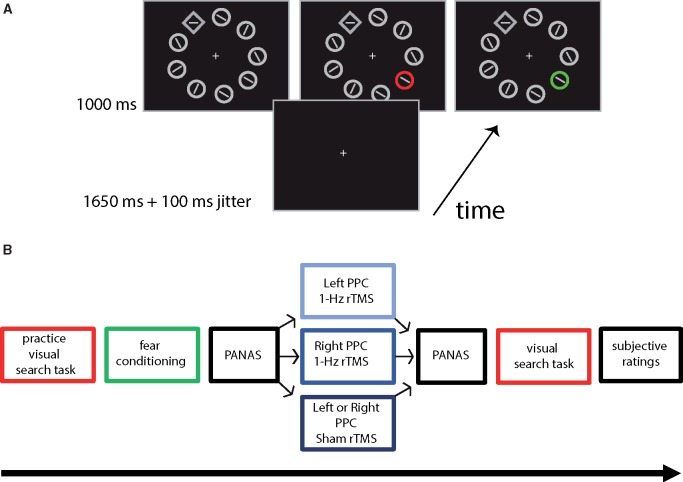
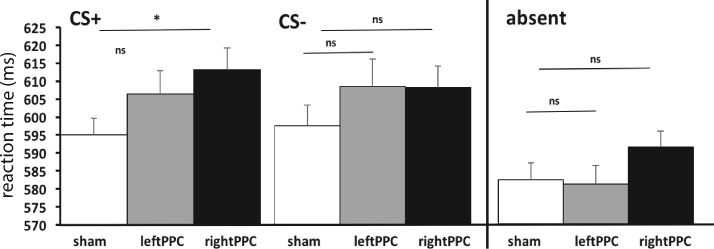
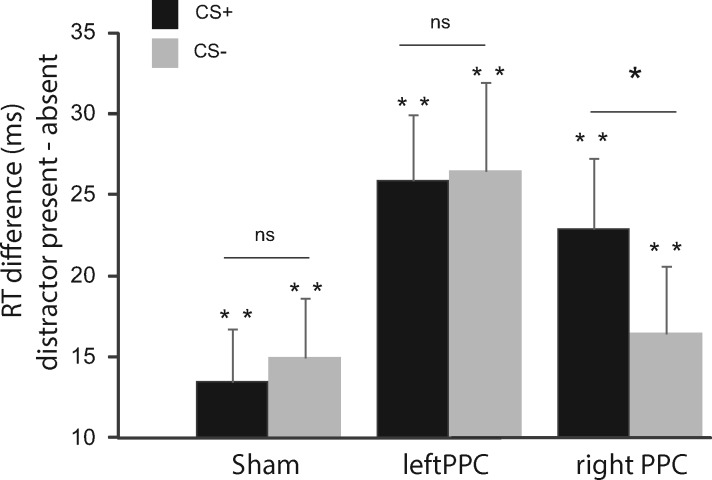
The right posterior parietal cortex (PPC) is implicated in spatial attention, but its specific role in emotional spatial attention remains unclear. In this study, we combined inhibitory transcranial magnetic stimulation (TMS) with a fear-conditioning paradigm to test the role of the right PPC in attentional control of task-irrelevant threatening distractors. In a sham-controlled within-subject design, 1-Hz repetitive TMS was applied to the left and right PPC after which participants performed a visual search task with a distractor that was either associated with a loud noise burst (threat) or not (non-threat). Results demonstrated attentional capture across all conditions as evidenced by the typical reaction time costs of the distractor. However, only after inhibitory rTMS to the right PPC reaction time cost in the threatening distractor condition was increased relative to the non-threatening distractor condition, suggesting that attention lingered longer on the threatening distractor. We propose that the right PPC is involved in disengagement of attention from emotionally salient stimuli in order to re-orient attention to task relevant stimuli and may have implications for anxiety disorders associated with difficulties to disengage from threatening stimuli.
右顶叶后部皮层(PPC)与空间注意有关,但它在情绪空间注意中的具体作用仍不清楚。在这项研究中,我们将抑制性经颅磁刺激(TMS)与恐惧条件反射范式相结合,以测试右 PPC 在控制与任务无关的威胁性分心物方面的作用。在假刺激对照的被试内设计中,在参与者执行带有与大声噪声突发(威胁)或不相关(非威胁)的分心物的视觉搜索任务后,将 1Hz 重复 TMS 施加到左和右 PPC。结果表明,在所有条件下都存在注意力捕获,这表现在分心物的典型反应时间成本上。然而,只有在对右 PPC 进行抑制性 rTMS 后,在威胁性分心物条件下的反应时间成本才会相对于非威胁性分心物条件增加,这表明注意力在威胁性分心物上停留的时间更长。我们提出,右 PPC 参与了从情绪上显著的刺激中解脱注意力的过程,以便将注意力重新集中到与任务相关的刺激上,这可能与与难以从威胁性刺激中解脱出来有关的焦虑障碍有关。